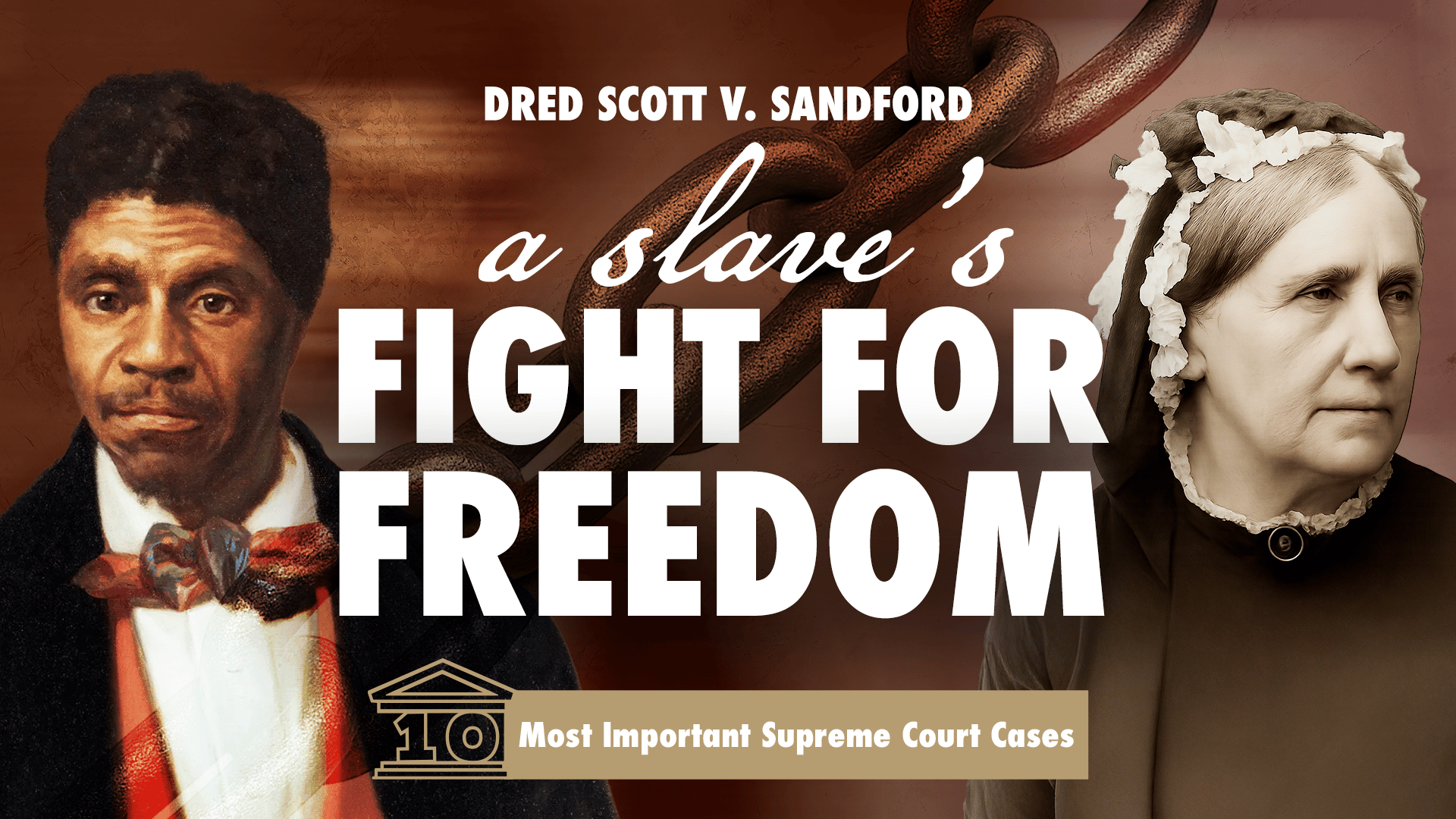
Dred Scott v. Sandford: A Slave's Fight for Freedom
It’s hard to believe now, but there was a time when the Supreme Court once ruled that black Americans could never be citizens. Janice Rogers Brown, former California Supreme Court Justice, examines the case that is universally acknowledged to be the low point in the Supreme Court’s history—and one of the prime causes for the American Civil War.
Topics
Hosted By
 Janice Rogers Brown
By common consensus, Dred Scott v. Sandford (1857) is the most infamous decision in Supreme Court history.
Ironically, it also may be the most significant decision in Supreme Court history.
Why? Because it almost destroyed the Union.
Here’s what happened:
In 1846, Dred Scott, a slave, sued for his freedom.
Scott had been born into slavery in Virginia, but during the 1830s, he traveled with his “owner,” John Emerson, an Army doctor, to Illinois and the Wisconsin Territory, both of which had banned slavery.
When Emerson died in 1843, his widow Irene Sanford, “inherited” Scott. In 1846, Scott sought to buy his freedom from Sanford, offering her $300. She refused. Scott then turned to the legal system, filing a lawsuit against her in a St. Louis, Missouri court.
He had a strong case. It was not uncommon for slaves to claim that once they entered a free state, they were free. And Missouri courts were sympathetic to these claims.
Over the next eight years, however, Scott endured a legal rollercoaster, first losing his case, then winning, then losing again.
His appeal reached the Supreme Court in February 1856. Chief Justice Roger Taney immediately grasped its importance. Here was a case, Taney reasoned, that could settle once and for all the vexing issue of slavery and its role in America’s future.
To understand Taney’s thinking, we need a bit of historical context.
As the nation expanded in the early- and mid-19th century, and admitted new states, the slavery issue became more and more contentious.
In 1820 and then again in 1850, Congress passed two bills to defuse the growing conflict, respectively known as the Missouri Compromise and the Compromise of 1850. Both laws divided the country into free states and slave states.
Although these laws kept the nation at peace, they failed to address the fundamental issue: did blacks have the same rights as whites?
Taney believed he had the answer.
On March 6, 1857, the Court announced its decision: by a 7-2 vote, it ruled that blacks did not have the same rights as whites, and therefore could be treated as property, no different than any other kind of property. And as property, they were not and could never be citizens. And if they were not citizens, they had no standing in any court.
Taney explicitly stated that blacks were “beings of an inferior order… altogether unfit” to participate in government and that whatever “privileges” they enjoyed were granted to them by the generosity of the “superior” white race.
But what about the most famous phrase in the Declaration of Independence that “all men are created equal”? Didn’t that undercut Taney’s argument?
The Chief Justice contended the Founders never seriously considered the idea of human equality to apply to Africans, ignoring the fact that men like John Adams and Alexander Hamilton were furiously opposed to slavery. Ironically, slavery wasn’t the key issue for Taney. Even though he was a lifelong Democrat, raised in a slaveholding family and once owned slaves himself, he thought of slavery primarily in constitutional terms. It was permitted in that document — therefore, in his opinion, it was legitimate.
Dred Scott predictably pleased Southerners and outraged Northerners. Former congressman Abraham Lincoln was so incensed by the decision that it emboldened him to return to politics to oppose it. Anti-slavery activist Frederick Douglass declared, “All that is merciful and just, on earth and in Heaven, will…despise this edict of Taney.”
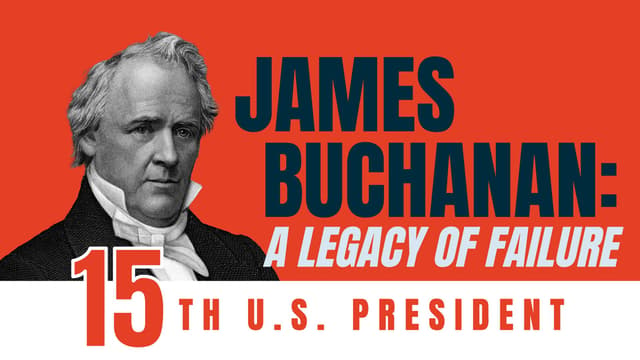
That’s not how the newly elected Democratic president James Buchanan saw it, however. This was the decision he wanted. He even worked behind the scenes to make it happen. In his view, the executive and legislative branches had long recognized slavery as a legally sanctioned institution. Now, the judicial branch had joined them in the same conclusion.
Slavery was here to stay.
But events would prove otherwise. As Lincoln predicted in a speech in 1858, "A house divided against itself cannot stand.”
Dred Scott solidified that division. If civil war wasn’t inevitable before Taney’s ruling, it was after.
This is one of the many reasons historians consider the decision as the low point in the Court’s 230-year history.
As for Dred Scott himself, his story had a happier, if short-lived, ending. His “owner” freed him after the Court decided his case. He died a year and a half later.
Every American slave would be freed by the Thirteenth Amendment, ratified in December 1865, and made a citizen by the Fourteenth Amendment in 1868, but not before the North prevailed in a brutal civil war that Dred Scott v. Sandford helped to provoke.
I’m Janice Rogers Brown former Associate Justice of the California Supreme Court, for Prager University.