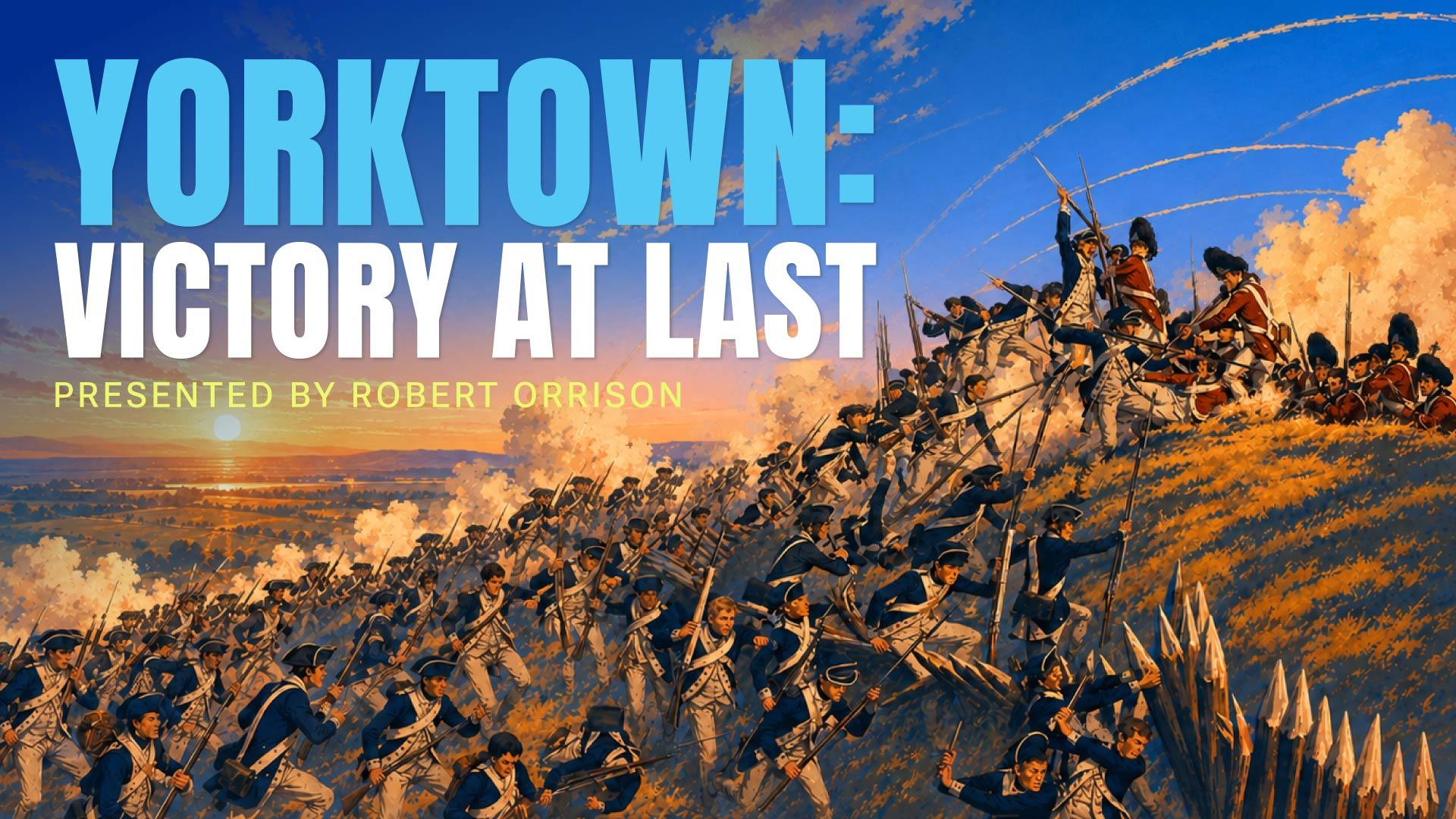
Yorktown: Victory at Last
After six long, bloody years, the American fight for freedom was at a crossroads. To end the Revolutionary War and bring King George to the negotiating table, the rebels needed a knockout punch. They got it at the Battle of Yorktown. Author Robert Orrison tells the story.
Topics
Hosted By
 Robert Orrison
The Battle of Yorktown effectively ended the Revolutionary War, securing the independence Americans had sacrificed so much to win.
This time it was the rebels who had all the advantages: in soldiers, in cannon, and in naval power. Getting those pieces in place, was a combination of brilliant generalship, the deep pockets of a Philadelphia businessman, and mind-bending luck.
The brilliant generalship was displayed by two men: George Washington and his most trusted subordinate, Nathanael Greene. It was Greene’s daring strategy at the Battle of Guilford Courthouse in North Carolina in March of 1781 that set the stage for the decisive showdown at Yorktown seven months later.
Greene knew he would likely lose the North Carolina battle, but that was okay because he could sustain losses, whereas his opponent, British General Charles Cornwallis, isolated from his supply lines, could not.
Indeed, Cornwallis held the field, but at a price he couldn’t afford. Badly depleted, he moved his army to the port city of Yorktown, Virginia. There, he could rest his men and wait to be resupplied or evacuated by the British fleet.
This made perfect sense if the British controlled the waters in Chesapeake Bay. It made no sense if they didn’t.
Although the Americans had no navy to speak of, their ally, the French, did. Unfortunately, the French fleet was in the Caribbean. Washington sent desperate letters to the Admiral of that fleet, the Comte de Grasse. The American general had a single request: sail your ships to the Chesapeake Bay. If you do, we can trap Cornwallis, and maybe — just maybe — end this war.
Given the time it took for his letters to get to de Grasse and the time it took for de Grasse’s letters to get back to him, Washington waited for weeks in anxious agony for the admiral's response. The wait was worth it: the Admiral would do as Washington requested.
Now Washington had a new problem. To preserve the element of surprise he had to make General Henry Clinton, the commander of British forces in New York City, believe that it was New York, not Yorktown, that he (Washington) was planning to attack.
To do this, Washington spread false rumors through his spy network and set up a dummy encampment across the Hudson River to suggest an action was imminent. Then, when his troops, and those belonging to his French counterpart, the Comte de Rochambeau, were ready, he marched them swiftly south, hoping Clinton wouldn’t notice. The ruse worked.
Washington’s first major stop was Philadelphia in August 1781. More problems — the greatest of which was that he had no money to pay his men. In fact, they hadn’t been paid in months, and they weren’t happy about it. Patriotism only goes so far. Giving them worthless paper “continentals” wasn’t an option. They demanded hard currency. That was a major reason Washington went to Philadelphia: to get money.
His pleas to the notoriously stingy Continental Congress, however, fell on deaf ears. The general despaired. To be this close to victory and throw it away because of a lack of funds? This might have been his own personal low point of the entire war.
At the last moment, Philadelphia merchant and patriot Robert Morris stepped forward and pledged his own considerable fortune. Morris’s hard money — Spanish pieces of eight and French silver — soon lined the pockets of Washington’s men.
It was on to Yorktown.
Now it was a question of timing, no small matter in late 18th-century warfare. Would de Grasse and his French fleet arrive soon enough to trap Cornwallis? A week or even a day’s delay might be fatal. But De Grasse, perhaps the best seaman on either side, was true to his word. Washington had his “cork” in the bottle.
Outside Cornwallis’s fortifications, the Americans and French immediately dug trenches and rolled in their artillery, setting up a classic siege. Washington lit the fuse of the first cannon fired. Soon, they were bombarding the port city day and night. Every day, they dug new trenches, bringing them ever closer to the city walls.
It got so bad that Cornwallis had to live in a bunker to save himself.
Still, he held out hope that Clinton would send a rescue fleet to dislodge de Grasse and free him from the onslaught. He waited until he could wait no longer.
On October 19, 1781, Cornwallis surrendered.
As historian Joseph Ellis has observed, the British knew how to win, but they had no idea how to lose. Cornwallis feigned illness, sending his second-in-command to accept Washington’s surrender terms. He neither credited Washington nor blamed himself for this stunning defeat. In his eyes, it was all Clinton’s fault.
The war would drag on for two more years before King George and Parliament officially conceded American independence with the Treaty of Paris in 1783, but Yorktown was the knockout punch that brought the British to the negotiating table and the United States of America into being.
I’m Robert Orrison, author of All That Can Be Expected: The Battle of Camden, for Prager University.