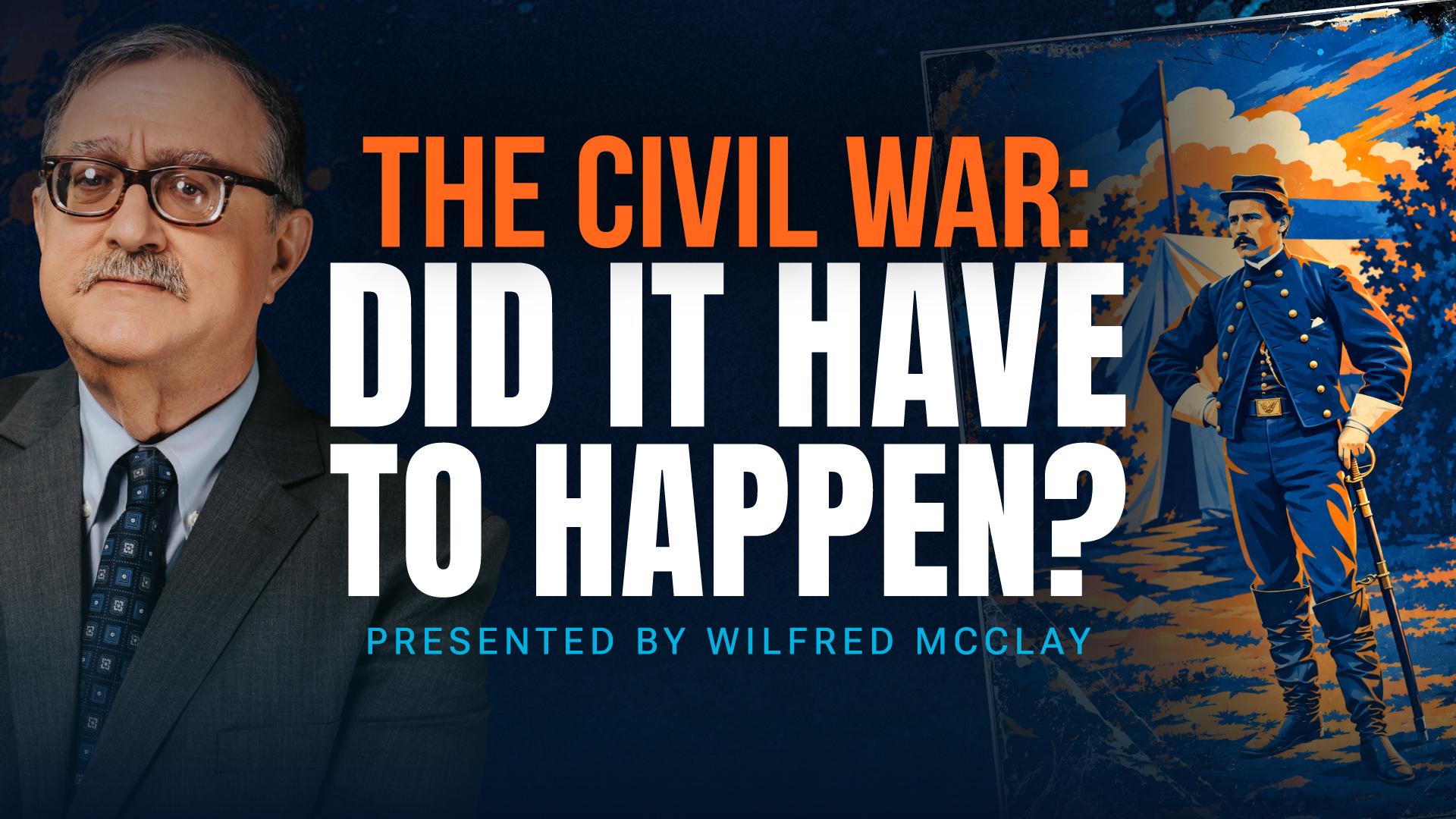
The Civil War: Did It Have to Happen?
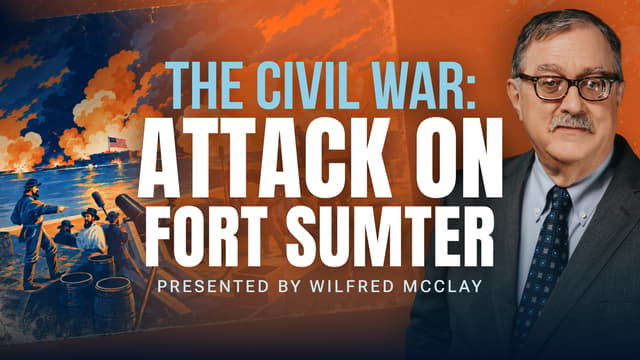
America came to the brink of civil war over slavery in 1820, 1850, and 1861. The first two times, the country pulled back from disaster. The third time, it went over the edge. Was the Civil War unavoidable, or could the bloodiest conflict in American history have been prevented? Wilfred McClay, professor of American history at Hillsdale College and author of Land of Hope, investigates this question.
Topics
Hosted By
 Wilfred McClay
Was the American Civil War inevitable?
From the founding of the country, the issue of slavery divided North and South.
That division brought the two sides to the brink of civil war three times: 1820, 1850, and 1860.
The first two times, they pulled back.
The third time, they went over the edge.
Let’s take a closer look at each of these turning points.
In 1818, there were 20 states in the Union — 10 free and 10 slave. That year, Missouri petitioned Congress to become a new state, a slave state, breaking that balance.
To resolve this dilemma, the great political pragmatist of the age, Kentucky legislator Henry Clay, promoted the idea that the territory of Maine could be admitted as a free state.
To prevent future conflict, a critical detail was added: a line would be drawn, extending westward at latitude 36°30′. Slavery would be prohibited in the lands north of this line and permitted in the lands south of it.
This became known as the Missouri Compromise, signed into law by President James Monroe in 1820.
And then another challenge arose. The land acquired by an overwhelming victory in the Mexican War (1846-1848) expanded the nation all the way to the Pacific coast. This blessing came with a curse: Would the additional states carved out of the newly acquired territories be slave or free? Many in the South insisted on the former; many in the North insisted on the latter.
Given that the balance of states at this point was 15 and 15, the stakes were very high.
Henry Clay proposed a new compromise, with concessions to both North and South: for the North, California would be admitted to the Union as a free state, and the slave trade would be abolished in Washington, DC; for the South, legal rights would be strengthened for southerners to reclaim fugitive slaves, and the North would be forced to cooperate in that effort.
In addition, the future states derived from the territories of Utah and New Mexico would decide for themselves whether they would be free or slave, a concept known as popular sovereignty.
The aging Clay, however, no longer had the power to push the proposal through Congress. It took a new rising star, Illinois Senator Stephen Douglas, with the help of President Millard Fillmore, to get it over the finish line.
The country greeted the Compromise of 1850 with wild enthusiasm. Once again, civil war had been averted. But throughout the decade of the 1850s, both sides hardened their positions. The underlying problem, the incompatibility of slavery with the fundamental American commitment to the rights and dignity of all human beings, had not been solved.
This became clear when Congress passed the Kansas-Nebraska Act in 1854, and the idea of popular sovereignty was put to the test. It didn’t go well. Partisans from both the North and the South flooded the territory, hoping to influence the outcome of the vote — would the new state of Kansas be slave or free? The two sides clashed. Blood was spilled, so much so that the conflict came to be known as Bleeding Kansas.
The violence was not confined to Kansas. In 1856, Massachusetts senator Charles Sumner was beaten nearly to death in the Senate Chamber by South Carolina congressman Preston Brooks. Brooks had become enraged when Sumner belittled the South’s defense of slavery and personally insulted Brooks’ relative, South Carolina Senator Andrew Butler.
But instead of condemning Brooks, many Southerners lauded him as a hero, mailing him gold-plated canes to replace the one with which he had battered Sumner. That was a measure of how far the two sections had drifted apart.
By the end of the decade, it was clear that many Southerners wanted out of the Union. They were convinced that the North wanted to destroy their “way of life.”
But few on either side believed it would actually come to secession and war. The newly elected president, Abraham Lincoln, hoped it would not. He had even promised that he wouldn’t interfere with slavery in the states where it existed. Surely, as in 1820 and 1850, a new compromise could be reached.
But Lincoln wouldn’t budge on two principles: one, no expansion of slavery into the new territories, and two, no secession. For him, as for Andrew Jackson, as for James Madison, the Union was “perpetual.”
For the South, however, non-expansion was a formula for slavery’s extinction. By 1860, the free state/slave state balance was already 18 to 15 against them. Secession appeared to be the only way to save their way of life.
So, was the Civil War inevitable? Did it have to happen?
Well, few things in history are truly inevitable. But it is hard to see how some form of conflict could have been averted, given the intransigence of the South, the incompatibility of slavery with American fundamental ideals, and Lincoln’s unwillingness to let the South secede.
Something had to give. And it did.
I’m Wilfred McClay, professor of American History at Hillsdale College and author of Land of Hope, for Prager University.