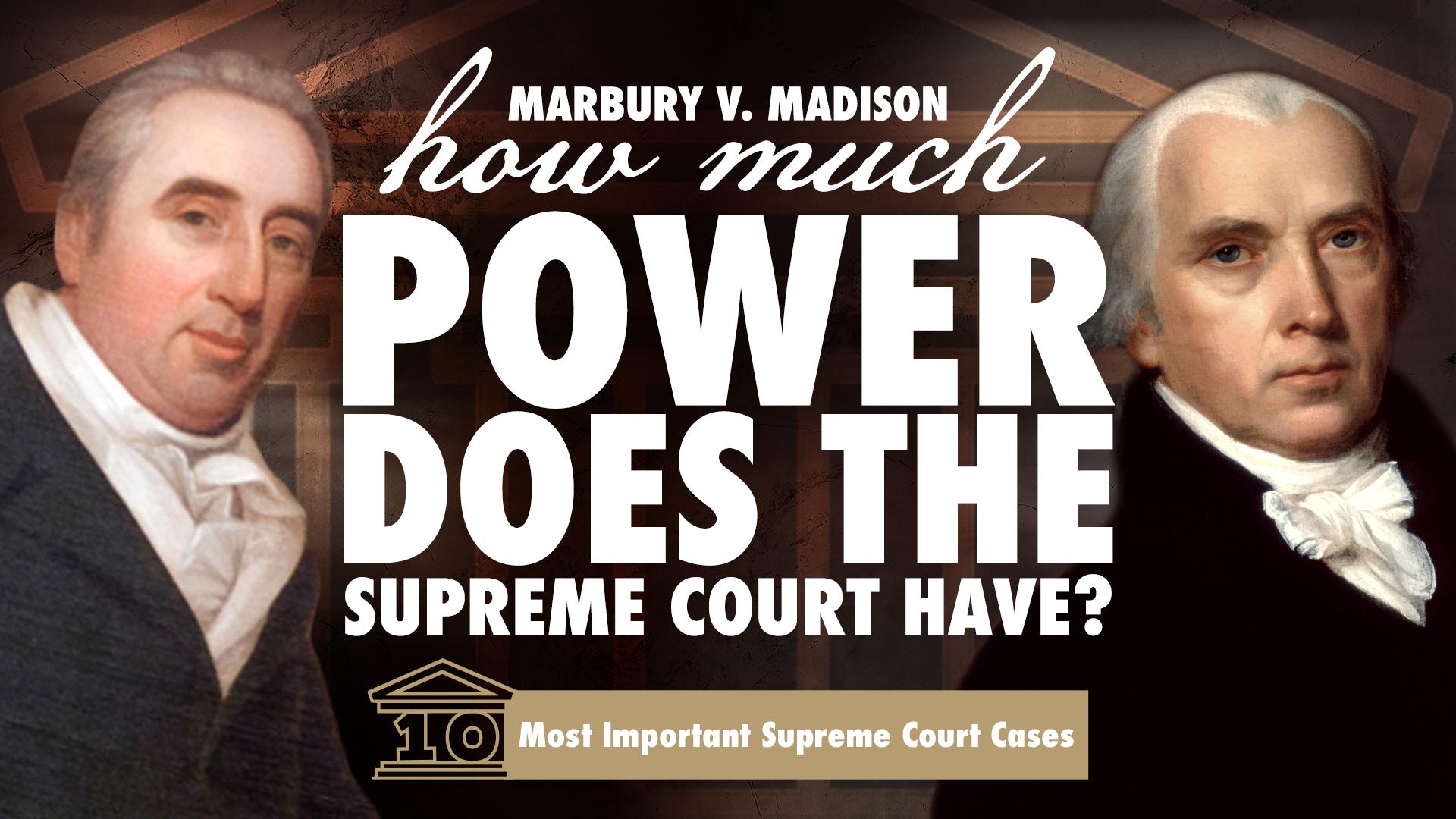
Marbury v. Madison: How Much Power Does the Supreme Court Have?
Legislative, Executive, and Judicial—three equal branches of government… right? Not at first. Haley Proctor, Associate Professor of Law at Notre Dame, explains how Marbury v. Madison (1803) redefined judicial authority and transformed the role of the Supreme Court.
Hosted By
 Haley Proctor
What is the function of the Supreme Court of the United States?
In other words, what is its job?
When the Court first convened in February 1790, no one really knew for sure.
Article III of the Constitution vested the Court with the “judicial Power of the United States.”
Okay.
But what does that mean?
The Constitution didn’t spell it out—which is why, in its first decade, the Court played only a small role in determining the nation’s direction.
This lack of clarity ended when John Marshall was appointed the fourth Chief Justice. Marshall had a clear vision of the judiciary’s role: that it was intended to be a co-equal branch of government, alongside the executive and legislative branches.
The opportunity to make this a reality arrived in December 1801 with the case of Marbury v. Madison.
This case would produce what may be the most influential Supreme Court decision in American history.
To understand why, we need to go back to the previous year’s presidential election. Thomas Jefferson, the leader of the Democratic-Republican Party, had just defeated incumbent President John Adams, the leader of the Federalist Party.
But Adams didn’t go quietly.
On March 2, 1801, just two days before he left office, Adams nominated dozens of Federalists to various judicial and administrative positions across the country. He hoped that these appointees, mocked as “Midnight Judges” by the Democratic-Republicans, would keep Jefferson in check.
The following day, the Senate—full of outgoing Federalists—approved the nominations, and Adams signed the commissions. In the rush, some commissions weren’t delivered to the appointees before Adams left office.
One of those appointees was Maryland Federalist William Marbury.
Adams’ actions infuriated Jefferson. He felt it was unfair to be saddled with a slew of Federalists hostile to his agenda.
When Jefferson discovered that some of the commissions had not been delivered, he ordered his Secretary of State, James Madison, to hold onto them.
Marbury believed this was illegal. Adams had signed his commission. How could an accident of timing render it worthless?
In December 1801, Marbury sued Madison, requesting that the Supreme Court issue a writ of mandamus—an order compelling a government official (in this case Madison) to perform a legal duty.
What would Marshall do?
If the Court issued the writ, it would be forcing a showdown between the Court and the president, one which it would almost certainly lose. And in losing, the judiciary would be further weakened, maybe even rendered irrelevant.
If the justices didn’t issue the writ—if they simply conceded that Marbury’s appointment was null and void—they would be confirming their own impotence.
It was a lose-lose, or so it seemed.
On February 24, 1803, the Court delivered its unanimous decision. Marshall wrote the opinion himself and read it aloud to an anxious audience.
He distilled the case down to three questions.
First, did Marbury have a right to his commission?
Marshall answered yes—the appointment was valid once Adams signed it.
Second, did Marbury have any legal remedy to obtain the commission?
Marshall again answered yes, there was a remedy—the very writ of mandamus that Marbury had requested.
Imagine the tension in the Court. It looked like Marshall was determined to challenge the President.
And then came the third question: did the Court have the authority to issue the writ?
Marshall's answer stunned everyone in the room.
No, he said, the Court did not have that authority.
How Marshall reached that conclusion is one of the most impressive feats of judicial reasoning in the history of law. And it changed the history of the United States.
Here’s how Marshall pulled it off.
He went back to a law passed by Congress a decade earlier, the Judiciary Act of 1789. That law gave the Supreme Court the power to issue writs of mandamus.
But it was a power, Marshall asserted, the Constitution had not granted to the Court. Congress had overstepped its bounds.
Do you see what Marshall did here? He gave up power to gain power.
He ruled that the Court did not have the power to give Marbury his remedy, but he established that the Court did have the power to decide what laws violated the Constitution. As Marshall wrote, “It is emphatically the province and duty of the Judicial Department to say what the law is….[in] particular cases…”
Marbury never received his commission. Jefferson and Madison had won. But the real victor was Marshall and the Court.
Thanks to Marbury v. Madison, the Court was now a co-equal branch of government.
Equal, not superior.
Our modern conception of the Court as the final arbiter of all legal questions is a 20th-century phenomenon. Whether that’s a good development is the subject of intense debate.
For Marshall, it was enough for the Court to take its rightful place among the branches of government.
I’m Haley Proctor, Associate Professor of Law at Notre Dame, for Prager University.