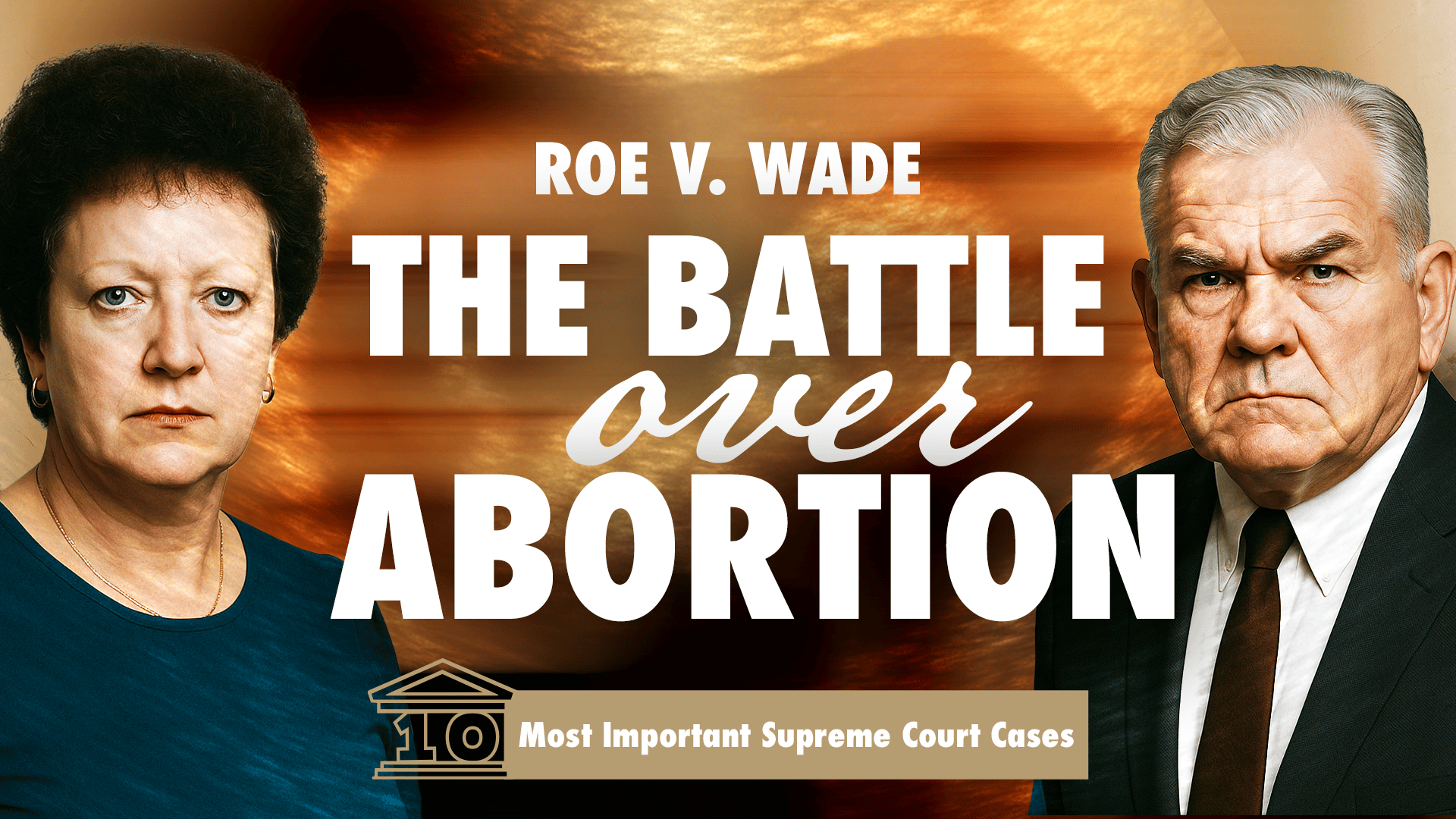
Roe v. Wade: The Battle over Abortion
No modern U.S. Supreme Court decision has aroused more passion than Roe v. Wade. A judicial earthquake, it shook the country to its social, political, and constitutional core. Stephanie Barclay, Professor of Law at Georgetown Law School, examines the impact and implications of this controversial case.
Topics
Hosted By
 Stephanie Barclay
Perhaps no modern U.S. Supreme Court decision has aroused more passion than Roe v. Wade, the 1973 case that announced the constitutional right to abortion.
A judicial earthquake, it shook the country to its social, political and constitutional core.
The aftershocks continue to this day.
Socially, it revolutionized how people thought about, talked about, and experienced abortion. In the words of UC Berkeley Professor Kristin Luker, “it changed everything.”
Politically, it gave rise to two opposing movements: pro-life and pro-choice.
Constitutionally, it suggested that the Court had the power to create rights that lacked any meaningful support in the text of the Constitution.
Roe concerned a Texas woman named Norma McCorvey—then kept anonymous under the pseudonym “Jane Roe.” McCorvey wanted to have an abortion but was prevented from doing so because of Texas’ abortion law.
In 1970, “Jane Roe” sued Dallas County District Attorney Henry Wade to overturn the Texas law. Her case, Roe v. Wade, reached the Supreme Court, and in January 1973, the Court ruled 7-to-2 in favor of Roe, declaring that Texas had violated Roe’s constitutional right to privacy.
That right had been loosely established in previous court cases, most notably Griswold v. Connecticut (1965). What the Court did in Roe was to expand the right to privacy to include the right to have an abortion.
The Court based its decision on the Fourteenth Amendment, ratified in 1868, primarily to guarantee the rights of people who had recently been freed from slavery.
At the time of ratification, roughly three-quarters of the states had statutes criminalizing abortion. When Roe was decided over a century later, the majority of states still had statutes placing strict limits on abortion, with many allowing exceptions in cases of rape, incest, or to save the life of the mother.
The Roe decision invalidated that entire legal framework.
To justify its reasoning, the Court cited the clause in the Fourteenth Amendment stating that no person shall be deprived of “life, liberty, or property, without due process of law…”
But this raised a new question, one specifically related to a woman’s pregnancy. Under the Fourteenth Amendment, is an unborn child a person?
If the child is a person, does that child have the rights articulated in that very same Amendment, including the right to life?
The court said no. An unborn child is not a person.
Writing for the majority, Justice Harry Blackmun reasoned that wherever the word “person” is found in the Constitution, it “has application only post-natally.” All of its references are to those already born. That fact “persuades us,” Blackmun wrote, “that the word 'person,' as used in the Fourteenth Amendment, does not include the unborn.”
This raised another question. At what point in a pregnancy does an unborn child become a “person”?
The Court effectively answered that question, too.
It decreed that until the unborn child had reached the point of “viability” — the beginning of the third trimester, when the child can survive outside the womb — the state can’t protect the unborn child’s “potential life.”
However, in an internal memo to his colleagues, Blackmun admitted that this trimester viability timeline he had developed was “arbitrary.”
Thus, to reach their conclusion, the Court engaged in legal gymnastics that few of Roe’s supporters were even willing to defend. As Constitutional scholar John Hart Ely put it, Roe was “not constitutional law and gives almost no sense of an obligation to try to be.”
If abortion wasn’t a major political issue before Roe, it soon became one after Roe. Many Americans, deeply disturbed by what they saw as the devaluing of innocent human life, organized in opposition to the decision.
Many others fiercely defended the decision. They saw abortion as a civil rights issue; that the government should not interfere with “a woman’s right to choose” or “control her own body.”
Thus, a new political line divided America.
That line extended to the Court. Every potential new Justice would be asked to explain their stance on this pivotal question during their confirmation hearing. Would they uphold or overturn Roe?
Thus, the Court, designed to be the most apolitical branch of the government, found itself at the center of an enduring political battle.
Later Supreme Court decisions modified Roe in significant ways. Eventually, the lower courts had conflicting guidance about what rule actually governed abortion decisions.
In 2021, 26 states expressly asked the Court to overrule Roe entirely. The Court did so the following year in the case of Dobbs v. Jackson Women's Health Organization.
This decision returned the abortion issue to the political process. The people, through their representatives, can once again determine what standards can govern their individual states.
Abortion still remains a hotly debated topic. That’s unlikely to change anytime soon.
But in Dobbs, the Supreme Court made clear that the democratic process is the best way to resolve difficult moral questions left open by the Constitution.
I’m Stephanie Barclay, professor of law at Georgetown Law School, for Prager University.