Brown v. Board of Education: Separate Is Not Equal
The 1954 Supreme Court decision of Brown v. Board of Education launched the modern Civil Rights movement. Sherif Girgis, Professor of Law at the University of Notre Dame, explains how and why the case has had such a lasting impact on American life.
Topics
Hosted By
 Sherif Girgis
It's no exaggeration to say that the modern Civil Rights Movement began with the 1954 Supreme Court decision of Brown v. Board of Education.
That the case reached the Court was a testament to a nation's desire to correct a longstanding injustice and, at the same time, an indictment for allowing the injustice to have existed for so long.
Although the Union victory in the Civil War freed black Americans from slavery, it did not free them from racism. Southern Democrats soon imposed Jim Crow laws to deny black Americans the right to vote and to segregate them from whites.
Even after large numbers of black Americans served in both World Wars, especially in World War II, social and material equality for white and black citizens was far from a reality.
For example, schools across the nation were, for the most part, segregated by race. These segregation policies had found their legal refuge in the infamous 1896 Supreme Court decision, Plessy v. Ferguson, which created the doctrine of separate but equal.
That was the legal theory. It was rarely the practice. Black schools were almost always inferior. That was still true in the late 1940s and early 1950s. And it outraged many fair-minded people.
One of those people was Thurgood Marshall, the founder of the NAACP Legal Defense and Educational Fund. That Plessy had to be confronted, Marshall had no doubt. Whether the country was ready for such an assault was the issue.
For several years he waited for the right opportunity to present itself.
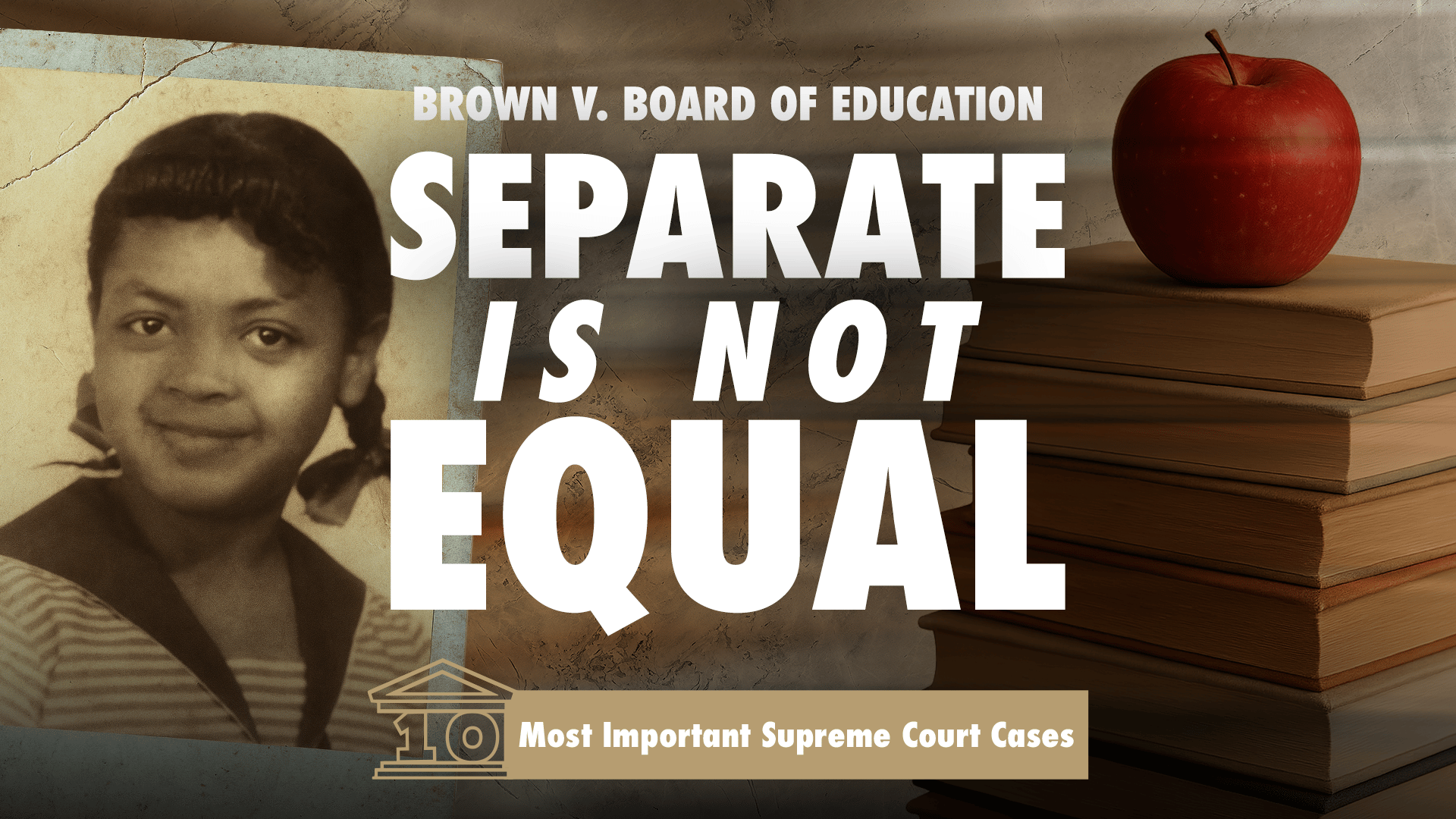
It came in 1951 when Marshall found a group of black parents from Topeka, Kansas who were ready and willing to challenge their local school board's policy of racial segregation. At the heart of this action was Linda Brown, a young girl forced to attend a racially segregated school twenty-four blocks from her home, despite living near a whites-only school.
Brown, Marshall argued before the court, was being deprived of her Constitutional rights. He based his argument on the Equal Protection Clause of the 14th Amendment. That Clause, ratified soon after the Civil War, declared that no state may deny to any person within its jurisdiction the equal protection of the laws. Segregated schools, Marshall insisted, clearly violated that clause and were thus unconstitutional.
The Supreme Court initially heard the case at the end of 1952. Had it reached a decision that year, it likely would have been a very close vote. That changed dramatically when President Dwight Eisenhower appointed Earl Warren, the Republican governor of California, as the new Chief Justice in 1953. Warren strongly favored abolishing segregation in public schools, and was determined that the decision be unanimous. If it wasn't, he thought, segregationists could use the dissenting opinions as an excuse for delaying desegregation.
Warren got his way. In May 1954, the Court unanimously decided in favor of Brown. Writing for the Court, Warren declared that in the field of public education, the doctrine of separate but equal has no place. Separate educational facilities are inherently unequal.
The era of Plessy was no more.
The decision's historic significance was immediately apparent. Charles Johnson, the president of Fisk University, proclaimed, If segregation is unconstitutional in educational institutions, it is no less so in other aspects of our national life.
Brown mattered not only legally but also morally and socially. It acknowledged the inherent dignity of all children and affirmed that quality education—the great equalizer—cannot be compromised.
However, not everyone, including some in the black community, believed the Court had fully thought through the ramifications of its decision. Was immediate integration the most effective way forward? Would a more gradual approach be less socially disruptive? Would such an approach lessen the hostility that black students would almost certainly encounter in predominantly white schools?
The Court rejected this incrementalist thinking. Racial integration could not be delayed.
Resistance to the decision was fierce, especially in the South. Local and state officials declared they would openly oppose school integration.
In September 1957, Arkansas Governor Orval Faubus ordered Arkansas's National Guard to prevent nine Black students—the Little Rock Nine—from entering the town's Central High School. A mob joined the Guard in blocking their entry. President Eisenhower responded by sending the US Army's 101st Airborne Division to protect the students.
Despite these challenges, the momentum Brown generated could not be stopped.
As Charles Johnson anticipated, Browns declaration of racial equality reverberated through the legal system. While Brown only dealt with segregation in public schools, courts applied it in case after case to desegregate other public settings, such as beaches, golf courses and buses.
All this laid the foundation for the Civil Rights Act of 1964 and the Voting Rights Act of 1965.
We take for granted now that government-imposed segregation is a thing of the past. But we should not forget that Brown made it possible.
I'm Sherif Girgis, Associate Professor of Law at the University of Notre Dame for Prager University.