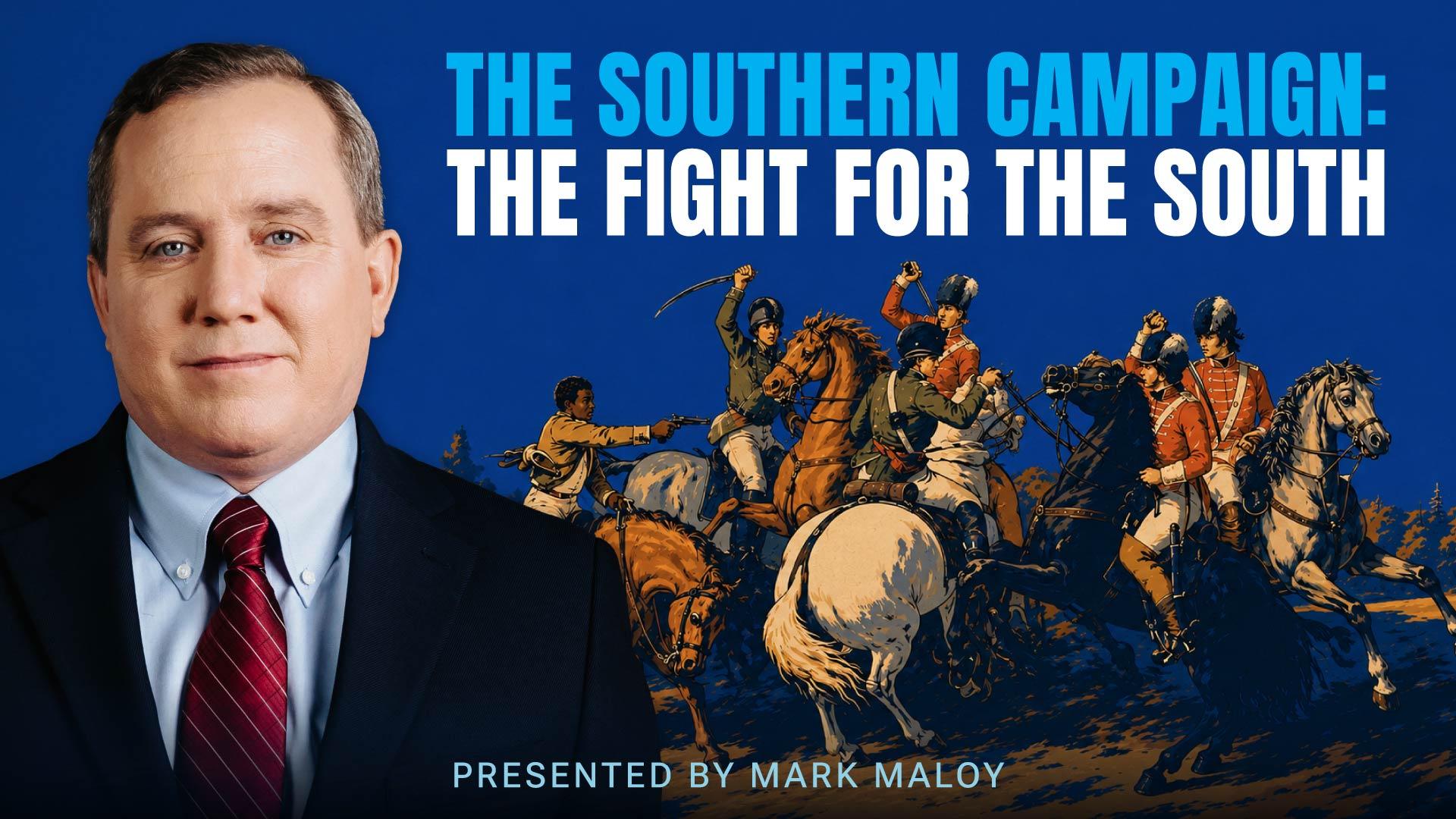
The Southern Campaign: The Fight for the South
When we think of the American Revolution, we think of the North: Lexington and Concord, Washington crossing the Delaware, the winter at Valley Forge. But it was in the South—in the swamps and backwoods of Georgia, the Carolinas, and Virginia—where the war was decided. Mark Malloy, author of To the Last Extremity: The Battles For Charleston, explains.
Topics
Hosted By
 Mark Maloy
When we think of the American Revolution, we think of the North: Lexington and Concord, Washington crossing the Delaware, the winter at Valley Forge.
But it was in the South—in the swamps and backwoods of Georgia, the Carolinas, and Virginia—where the war was decided.
By 1779, the conflict was at a stalemate. To break it, the British High Command shifted its attention to the southern colonies.
The campaign got off to a promising start. In May 1780, after a catastrophic siege, Charleston fell. It was the worst American defeat of the entire war, resulting in the surrender of over 5,000 men and the loss of the South's major port.
Leading the British force was General Charles Cornwallis. While his manner was genteel, his military strategy was aggressive and unforgiving. He fully expected to make short work of the rebels.
George Washington sent his most trusted officer, Nathanael Greene, to stop him.
Greene was one of those remarkable Americans who emerged out of the crucible of the Revolution. Born in Rhode Island in 1742, he rejected his pacifist Quaker upbringing to join the Revolution. Like many of his fellow rebel leaders, he had no formal military training. He learned tactics and strategy on the job. And at this point, he had a lot of job experience, having been in nearly every major engagement of the war.
When Greene arrived in the South, he found a motley collection of about 2,000 fighters. In his own words “…the shadow of an army in the midst of distress.” Cornwallis, in contrast, had a well-provisioned professional force more than twice that size.
Greene knew he couldn't win a conventional European-style contest.
So, he decided to break the rules.
He split his tiny force in two. The idea was to lead Cornwallis deeper into the wilderness, away from his supply lines, and harass him only when conditions favored it.
Greene took one-half of his army. The other half he gave to General Daniel Morgan.
Whereas Greene was educated and middle-class, Morgan was a rough-hewn frontiersman. His origins were murky—he wasn't even sure what year he was born. All he ever told anyone was that he hated the British.
He had a good reason. Years earlier, during the French and Indian War, a British officer had ordered Morgan to be disciplined for a minor insubordination. The punishment was 500 lashes. Morgan carried the scars, and the grudge, for the rest of his life.
Cornwallis sent his cavalry commander, Banastre Tarleton, to crush Morgan. They met in January 1781 at a South Carolina pasture known as the Cowpens.
Morgan knew Tarleton loved to charge his foe, sabers flashing. The fearsome sight invariably sent the rebels into a panic. This time, the wily Morgan ordered his men not to hold their ground. “Just fire two rounds, boys, and run for the trees.”
Tarleton saw the retreat and mistook it as the predictable panic. He ordered his horsemen straight into a trap. Morgan’s veteran Continental soldiers — cocked and ready — were waiting behind cover. They unleashed a wall of lead that decimated the British ranks.
It was a tactical masterpiece. In less than an hour, Tarleton’s force was effectively wiped out. Tarleton, himself, barely escaped.
Cornwallis reacted with fury. Bent on revenge, he chased Morgan and Greene across North Carolina.
But with the help of guerrilla-style fighters like the legendary “Swamp Fox” Francis Marion, Morgan and Greene managed to elude him and, in the process, stretched Cornwallis’s supply lines until they snapped. By mid-March, Greene was ready to make his stand. It happened at Guilford Courthouse near present-day Greensboro, North Carolina.
The battle was bloody, much of it hand-to-hand combat in dense woods. At one point, Cornwallis, seeing his lines faltering, ordered his artillery to fire grapeshot into the melee—killing his own men to stop the American advance.
Greene eventually retreated, leaving the British to take the field.
Technically, Cornwallis won. But it was a victory that crippled him. He had lost a third of his men. As a British politician in London noted, "Another such victory would ruin the British Army."
The general had no choice but to limp to the coastal port of Yorktown in southern Virginia to refit his shattered forces.
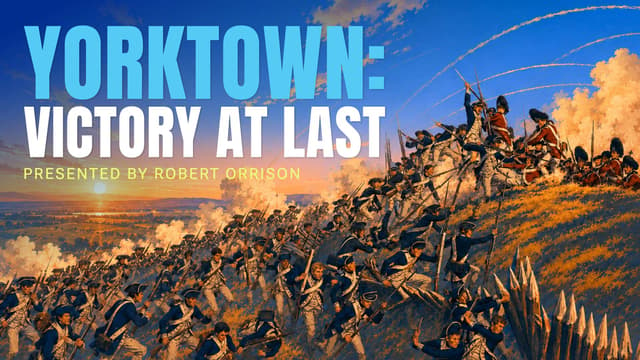
This was the opportunity George Washington had long been waiting for. He raced his army south as the French Navy blockaded the Chesapeake Bay. By the end of September, the trap was shut.
In October, Cornwallis surrendered.
The Southern Campaign changed the course of the war: from advantage Great Britain to advantage America.
It also teaches a vital lesson about the nature of winning.
Cornwallis believed that victory meant holding the battlefield. He thought that if he defeated the armies in front of him, he would prevail.
Nathanael Greene and Daniel Morgan understood that victory meant keeping the revolution alive.
As Greene himself famously wrote, "We fight, get beat, rise, and fight again."
Yes, the British won most of the battles. But the Americans won the war.
I’m Mark Maloy, author of To the Last Extremity: The Battles for Charleston, for Prager University.