West Virginia v. Barnette: Forcing the Pledge of Allegiance?
Can the government demand that you publicly declare your loyalty to the country? That was the question confronted by the Supreme Court in 1943 in the landmark case of West Virginia State Board of Education v. Barnette. Kurt Lash, Professor of Law at the University of Richmond, discusses why the answer to this question was so significant then and remains so now.
Topics
Hosted By
 Kurt Lash
Can the government demand that you publicly declare your loyalty to the country?
Can you or your children be punished for refusing to publicly salute the flag?
Your first reaction is probably an indignant, "Of course not."
But what about times when it seems like support for the government is critically important, for example during times of war?
That was the question confronted by the Supreme Court in 1943 in the landmark case of West Virginia State Board of Education v. Barnette.
As World War II raged in Europe and Japan, the West Virginia Board of Education passed a rule requiring children to salute the American flag at the beginning of the school day. The purpose of this rule was to instill patriotism in the students.
Though its intent was benign, failure to comply would result in the child being expelled, the parents fined, and possibly jailed.
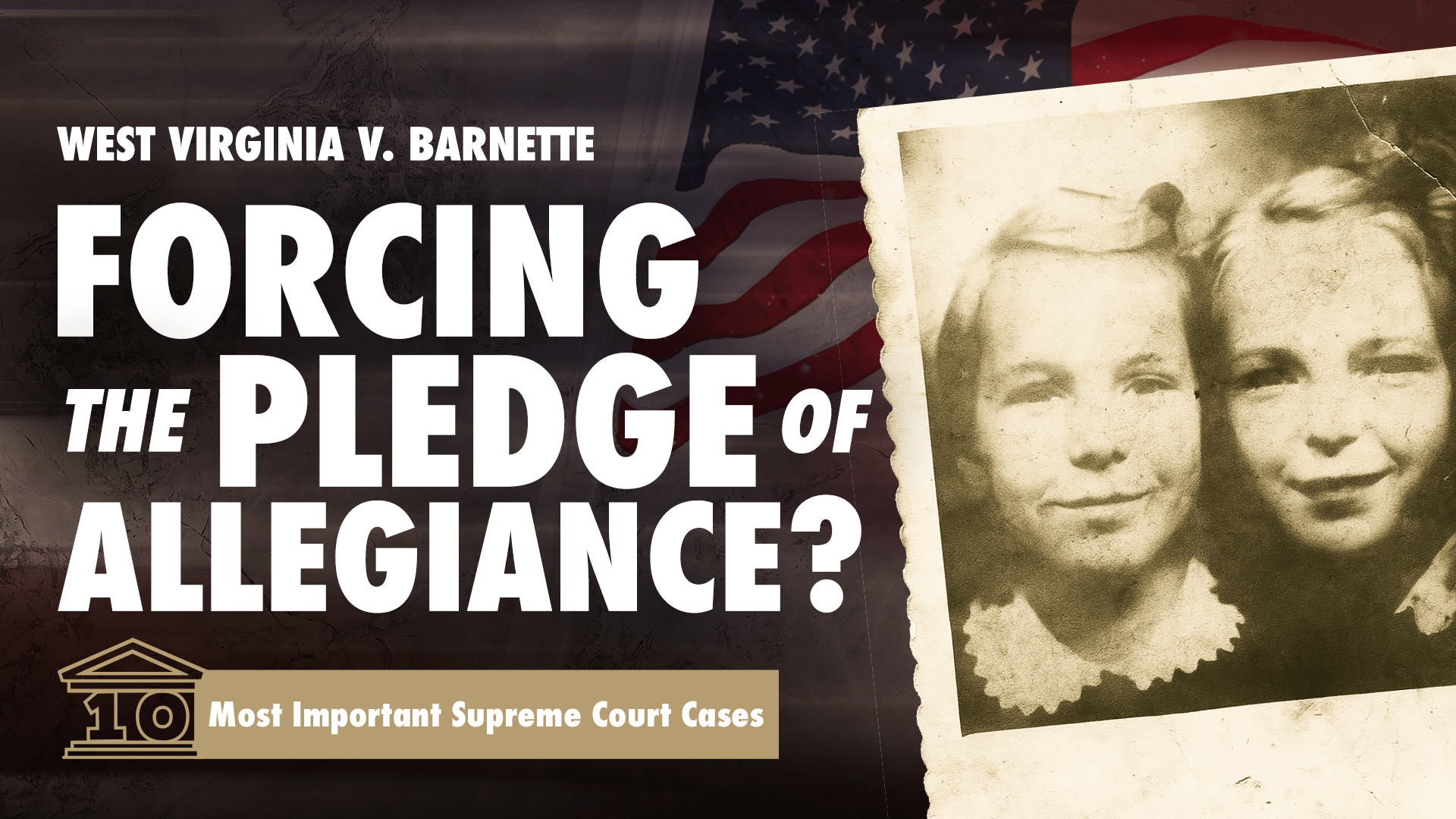
Marie and Gathie Barnett, members of the Jehovah's Witnesses church, strongly objected to the rule. They believed the salute and the pledge that went with it violated the biblical injunction in the Book of Exodus to never bow or honor any graven image:
You shall not make for yourself an image in the form of anything in heaven above or on the earth beneath or in the waters below. You shall not bow down to them or worship them.
When the Barnetts took their complaint to the federal court, the school board had every reason to believe the school would win. Only three years earlier, the Supreme Court ruled against the Jehovah's Witnesses in a similar case, Minersville v. Gobitis 1940.
In that case, the Supreme Court ruled that public schools could compel children to salute the flag and say the pledge. If Jehovah's Witnesses wanted their children excused from saluting the flag, Justice Felix Frankfurter wrote, then they would have to convince local majorities to vote in favor of special exemptions for objecting families.
In Barnette, however, the Court came to the opposite decision, deciding in favor of the Jehovah's Witnesses by a 6-3 vote.
So, what changed in just three years that caused the court to change its mind?
First, the publicity surrounding the earlier Gobitis case had sparked animosity against the Jehovah's Witnesses. Some Americans believed their refusal to salute the flag was disloyal and even traitorous. This led to church burnings and other acts of violence.
Whatever hopes the Court might have had that political discussion would lead to empathy and compromise were dashed in the face of discrimination and intolerance.
Second, since its decision in Gobitis, two members had left the Supreme Court. The justices who replaced them were less inclined to leave constitutional rights to the tender mercies of a public inflamed by the crisis of a World War.
So, three years later, the Supreme Court decided to revisit the issue. This time, a majority ruled that forced salutes and pledges violated the First Amendment's protection of freedom of speech.
In his opinion, Justice Robert Jackson rejected the idea that constitutional freedom depended on the votes of local school boards.
"One's right to life, liberty, and property," he wrote, "to free speech, a free press, freedom of worship and assembly, and other fundamental rights may not be submitted to vote; they depend on the outcome of no elections."
For the Court, forcing schoolchildren to parrot words of praise written by the government was antithetical to everything for which America stood.
If there is any fixed star in our constitutional constellation, Jackson continued, it is that no official, high or petty, can prescribe what shall be orthodox in politics, religion, or other matters of opinion.
Jackson's eloquence, however, did not persuade his colleague, Felix Frankfurter, the justice who had written the majority opinion in Gobitis.
Frankfurter had been placed on the Court by Franklin Delano Roosevelt. Frankfurter agreed with FDR's philosophy that courts should defer to the decisions of political majorities, whether local school boards or the legislation of the New Deal.
In Barnette, however, the majority of the Court insisted that federal courts exist to protect basic constitutional freedoms, especially in times of national emergency. Even when local patriotism and national unity seem critically important, even then, we remain a free people.
It was for such freedom that so many Americans were, at that very moment, giving their last full measure of devotion. The Supreme Court knew this.
And so, just to drive the point even deeper into the national consciousness, the Court delivered its decision in West Virginia Board of Education v. Barnette on June 14th, 1943—Flag Day.
I’m Kurt Lash, professor of law at Richmond University for Prager University.