What Is Birthright Citizenship?
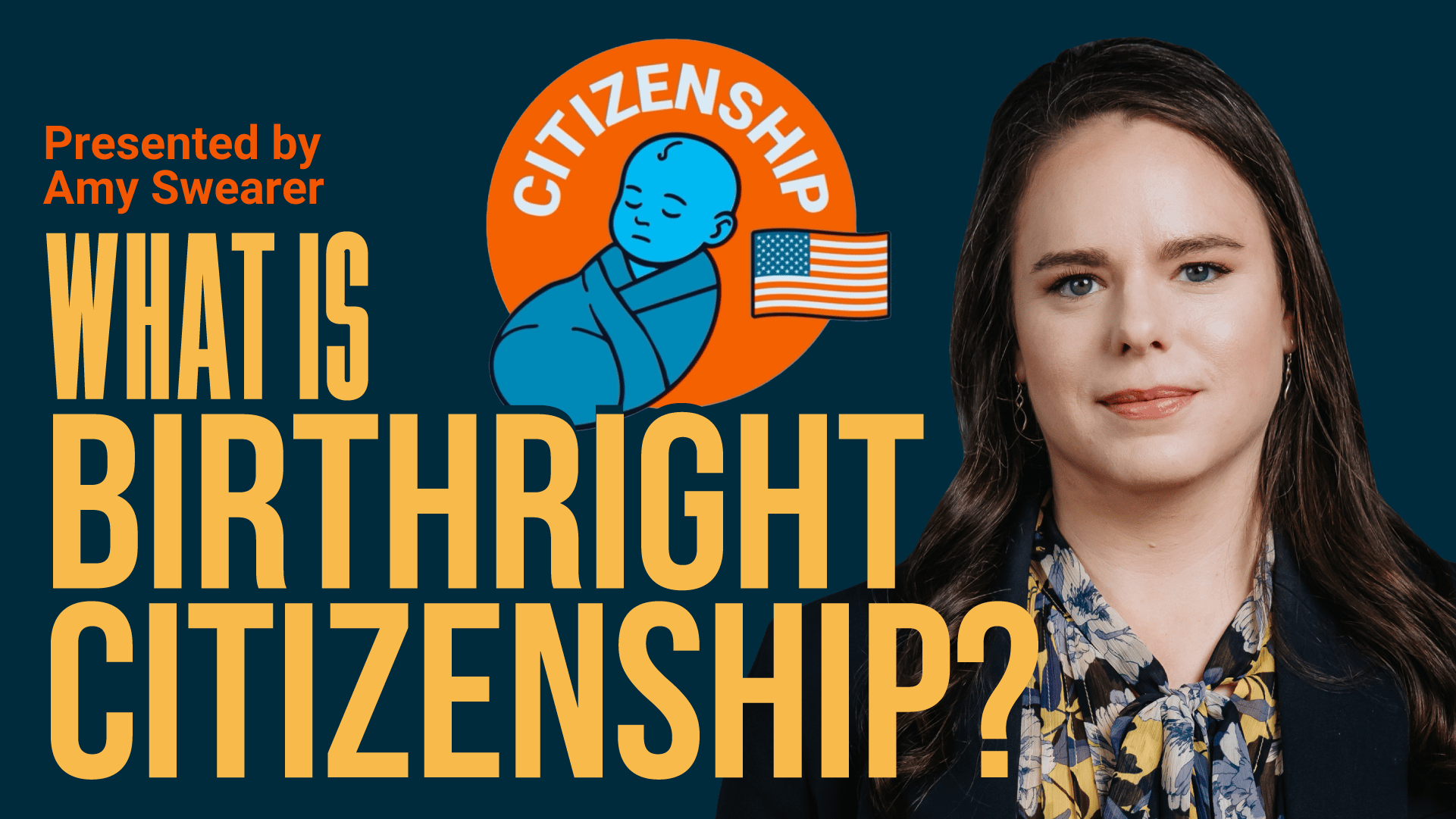
Do children born on U.S. soil automatically become American citizens? Many claim the Fourteenth Amendment of the Constitution guarantees that they do. Are they right? Amy Swearer, Senior Legal Fellow at the Heritage Foundation, confronts this question head-on.
Topics
Hosted By
 Amy Swearer
Does the Constitution grant citizenship to anyone born in the United States?
Even the children of people who’ve entered the country illegally? Or the children of foreign tourists who owe our country no allegiance?
That’s the question underlying the controversial issue of birthright citizenship.
Many people today take it for granted that the answer is yes: if you’re born on American soil, you’re an American citizen.
Period. End of issue.
But is that what the Constitution says?
Let’s first look at the text of that document, specifically the Fourteenth Amendment. It reads, “All persons born or naturalized in the United States, and subject to the jurisdiction thereof, are citizens of the United States...”
Case closed, right?
Not so fast.
The key phrase here is, “subject to the jurisdiction thereof…” — it creates a second condition for birthright citizenship beyond merely being born on American soil.
But it also raises another question: who is born subject to U.S. jurisdiction?
To answer that question, we need some historical context.
The Fourteenth Amendment was ratified in 1868, just three years after the end of the Civil War.
Its purpose was to rectify the infamous 1857 Supreme Court decision Dred Scott v. Sandford, in which the Court declared that black Americans were not and could never be citizens.
Even after slavery was abolished in 1865, Dred Scott technically remained the law of the land. Black Americans were left in limbo—they were no longer slaves, but they still were not citizens.
The Fourteenth Amendment resolved the issue, once and for all. These newly freed slaves and their descendants were certainly born “subject to the jurisdiction” of the United States. This had been their home for generations. If they were not American citizens, to which other nation did they still belong?
So while the Fourteenth Amendment resolved the issue as it related to race, its authors would have been shocked to learn that we now interpret these words to make citizens of virtually anyone born on U.S. soil, under all circumstances.
As Yale Law Professor William C. Robinson explained in his 1875 legal treatise, the Fourteenth Amendment grants citizenship only to those “born within the jurisdiction and allegiance of the United States”—a condition that requires, at minimum, lawful permanent residence in this country.
This was also the original understanding of the federal government. In 1885, for example, the State Department rejected the citizenship claim of a man named Richard Greisser. Yes, Greisser had been born in Ohio eighteen years earlier, but his German parents never intended to stay in the United States. They returned with their son to Germany shortly after his birth. Because Greisser’s parents did not owe the United States political allegiance, their son wasn’t born subject to its jurisdiction, at least not within the meaning of the Fourteenth Amendment’s citizenship clause.
Similarly, in 1890, the Justice Department considered the citizenship claim of a child born to one Mary Devereaux, a pregnant Irish woman being held on a ship in New York Harbor. While awaiting immigration approval, Devereaux left the ship for medical treatment and subsequently gave birth in a New York hospital. Authorities later denied her immigration application. Because Devereaux wasn’t eligible for lawful admission to the U.S., her U.S.-born daughter was not recognized as a U.S. citizen. Both mother and child were sent back to Ireland.
The Supreme Court addressed the question of birthright citizenship in the 1898 case of United States v. Wong Kim Ark. Wong was born and raised in San Francisco, the son of Chinese immigrants. In 1895, after a short trip to China, Wong returned to the U.S., only to be detained by authorities and threatened with deportation.
Wong sued, arguing that he was an American citizen by birth.
The Supreme Court agreed.
While this decision is often cited as proof that the Fourteenth Amendment mandates universal birthright citizenship, it proves nothing of the sort. Just as the amendment was meant to undo the immoral Dred Scott decision, the Wong decision was meant to undo the immoral Chinese Exclusion Act of 1882. That law prohibited immigrants of Chinese descent from becoming American citizens, no matter how long they lawfully lived, worked, and raised their families here.
Wong’s parents were what we might today call lawful permanent residents. San Francisco was their home. And according to the Court, Congress could prevent lawful Chinese immigrants from becoming naturalized citizens—but it could not subject their U.S.-born and raised children to perpetual alien status because of their race.
So, universal birthright citizenship isn’t required by the Fourteenth Amendment’s text or historical context. It’s inconsistent with the earliest legal interpretations of the amendment. And it isn’t compelled by Supreme Court precedent.
Why then are so many so confident in their assertion that universal birthright citizenship is established Constitutional law?
Maybe a better question would be:
What Constitution are they talking about?
I’m Amy Swearer, Senior Legal Fellow at the Heritage Foundation, for Prager University.