Get credit for watching this video with PragerU Premium. Start your streak.
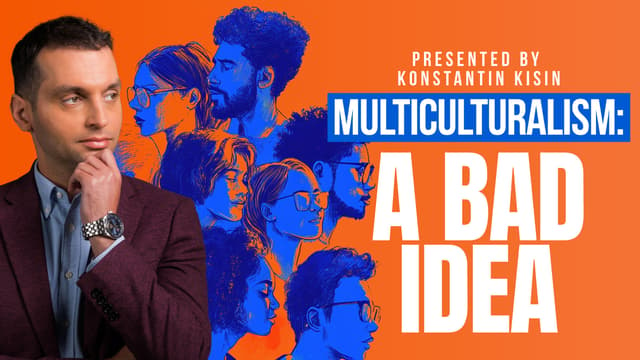
Multiculturalism: A Bad Idea
Is diversity our greatest strength? Ask Western Europeans, who over the last decade have endured a tidal wave of immigration from the Muslim Middle East and Africa. Konstantin Kisin, co-host of the Triggernometry podcast, explains why multiculturalism might bring more problems than benefits.
Topics
Hosted By
 Konstantin Kisin
Bad ideas never seem to die.
“Multiculturalism” is one of them.
“Wait a second,” I can hear you saying, “Multiculturalism is a beautiful idea.”
The mayor of London, Sadiq Khan, would agree with you. He talks with great excitement about London’s experiment in multiculturalism. He never tires of saying that “diversity” is our city’s greatest strength.
In Australia, people from all sides of the political spectrum talk proudly of being the most successful multicultural society in the world.
In Europe and in the United States, we are told to celebrate multiculturalism … or else be branded a xenophobe, a racist, or both.
And what, after all, is the problem with a society made up of different people all coming together to pull in the same direction? The answer is nothing.
But that’s not what multiculturalism means.
It’s not at all about “pulling in the same direction.” Multiculturalism is about people coming to the West and forming their own communities with their own rules and practices.
In the eyes of multiculturalists, e pluribus unum, “Out of Many, One”—the great goal of America, and until now the great achievement of America—is just another form of colonialism. It imposes American and Western values on the non-Western immigrants to America.
Immigrants therefore need to cling to the cultures of the countries from which they came—and stay separate.
Instead of e pluribus unum, the multiculturalists advocate for e pluribus pluribus: “Out of Many, Many.”
It is true that we live in multiethnic societies; that is, societies that are home to people from different ethnic and religious backgrounds. And that can bring huge benefits: Talented immigrants come to the West to open businesses, pay taxes, and start families.
The founder of Nvidia is from Taiwan.
The CEO of Microsoft is from India.
Elon Musk is from South Africa.
But multiculturalism is the exact opposite of this multiethnic merging—the e pluribus unum idea. It’s about encouraging immigrants not to merge.
American liberals have always looked to Sweden as the kind of society they want America to emulate—crime-free with a generous welfare system, free healthcare, and free college education. But that Sweden was a cohesive society based on shared values, one language, and social solidarity.
No longer.
Today, the “Swedish Dream” looks more like a Swedish nightmare.
Over two million of Sweden’s ten million people are now foreign-born, more than double the number in 2000. This experiment has not gone well.
Sweden now has the highest rate of gang killings in Europe. Several areas are officially classified as “especially vulnerable,” meaning areas where it is very difficult for the police to operate. The governor of the Bank of Sweden told the Financial Times the growing crime problem is so serious, it risks damaging the country’s long-term economic growth.
The problem is not confined to Sweden. All over Europe, crime is up sharply. One of the primary reasons is multiculturalism.
In Britain, hundreds of thousands of young women and girls have suffered horribly at the hands of so-called “grooming gangs”—groups of men from ethnic minority backgrounds who target vulnerable girls for sexual abuse.
When this abuse is reported to the authorities, instead of bringing the perpetrators to justice, these crimes are covered up by social workers, police officers, and local government officials afraid of being called “racist.”
The only way multiethnic societies can work is if we all play by the same rules and live by the same basic moral values.
People like me, who come from other places, must be encouraged to assimilate. Immigrants must learn the language, adapt to local customs, and become full citizens with both rights and responsibilities. The onus should be on the immigrant, not the host country.
At my doctor’s office in East London, I regularly encounter paperwork that has been translated into a dozen languages. That’s not what assimilation looks like.
When I first moved to England, my parents discovered that I had made friends with other Russian-speaking kids at my school.
“Well,” they said “if that carries on, we’ll have to find you a new school. You didn’t come here to be a Russian in Britain,” they explained. “You came here to be British.”
Does what I am saying sound controversial? If it does, you might be surprised to hear that former German Chancellor Angela Merkel admitted this truth back in 2010 when she said, “Multiculturalism has utterly failed.”
A year later, former British Prime Minister David Cameron said the same thing. So did former French President Nicholas Sarkozy and former Spanish President Jose Maria Aznar.
Multiculturalism has failed in Europe not because we did it badly, but because it’s a bad idea. It will fail in the US for the same reason. We either stand as one nation united by a common purpose and common values or we will fall as competing tribes.
Diversity is not our greatest strength. Unity is.
I’m Konstantin Kisin, co-host of the Triggernometry podcast, for Prager University.