Get credit for watching this video with PragerU Premium. Start your streak.
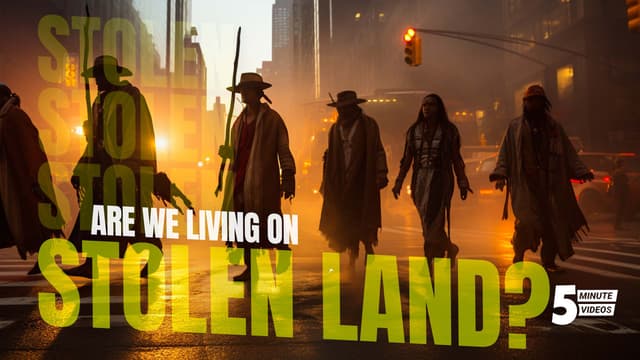
Are We Living on Stolen Land?
Are Americans living on stolen land acquired by nefarious means? Jeff Fynn-Paul, professor of economic and social history at Leiden University and author of Not Stolen: The Truth About European Colonialism in the New World, dispels this misleading and destructive myth.
Hosted By
 Jeff Fynn-Paul
If you attended college this is what you were likely taught:
America was founded through acts of genocide, accompanied by larceny on the grandest scale.
Columbus, and the Europeans who followed him, sailed to the New World with the intention of exploiting whomever they found—and, if necessary, enslaving or exterminating them.
Soon afterward, they began importing black bodies from Africa. They then built the world’s richest country out of a combination of slave labor, stolen land, and environmental destruction.
Did I miss anything?
As a historian, I can assure you this view is inaccurate in most particulars.
But getting the story wrong is only part of the problem. The bigger problem is this: if you teach generation after generation that their country, their society, and their history are uniquely awful, they are likely to believe you. This is a sure route to societal failure.
This has consequences not only for America but the entire world. Many in the US seem to have no clue just how much of a ‘city on a hill’ the US is still perceived to be, and how important that American beacon is to millions of people living under autocratic regimes.
If the image of the US is fundamentally delegitimized, if its entire raison d’être—its reason for being—is tainted, then increasing numbers of people will wonder whether democracy itself is worth the trouble.
So, let’s correct the record before it’s too late.
The narrative of the "stolen country" or "Native American genocide" does not stand up to scrutiny by any honest historian. It is a dangerously myopic and one-sided interpretation of history.
It puts one hundred percent of the burden on Europeans, who are held responsible for nearly all historical evil, while so-called indigenous people are mere victims—saint-like, innocent martyrs whose civilizations were close to ideal.
This is simplistic, anti-historic thinking that has gained currency only because most practicing historians and history teachers have either given into groupthink or else have been cowed into silence by fear of losing their jobs.
There is hardly a single civilization on Earth, which did not displace natives, or which did not engage in nasty wars or ethnic cleansings at many points during its history.
No matter who "discovered" the New World, it is inevitable that a large proportion of its inhabitants would have died within the first few decades after first contact.
The New World population was smaller and more homogenous than the Old World population. Thus, its people had less immunity to disease than the people of the Old World, where communities from Africa, Asia, and Europe had been intermingling for millennia.
So the claims of genocide by disease have almost nothing to do with European actions, apart from their simply reaching the New World. And of course, Europeans of the time had no way of predicting the continent-wide epidemic repercussions of their actions.
Let us also acknowledge that Native American society was just as warlike as any other in human history. The anthropologists’ vision of Native Americans as peace-pipe-smoking environmentalists which gained purchase in the 1970s has long since given way to a more Hobbesian portrait of pre-Columbian reality.
In North America, most Natives were primitive farmers. This means that (with some exceptions) they had no permanent settlements. They farmed in an area for a few decades until they wore out the soil. Then they moved on to greener pastures where the hunting was better and the land more fertile.
If somebody was already on those greener pastures, that meant war. If you won, the land was yours, and the tribe you defeated was destroyed or assimilated. This pattern repeated itself endlessly.
In most of North America, the idea that any one piece of land belonged to any one tribe, for more than 50 or 100 years, is highly doubtful.
The idea that the Europeans stole land which had belonged in perpetuity to any one tribe is ludicrous.
This is the basic math of all human history: if you can defend your land, you can keep it. If you can’t, you lose it. This was true five thousand years ago, 500 years ago, and to a very real extent, it is still true today. In almost every case, conquest happened without remorse. Caesar didn’t agonize over his conquest of Gaul.
What is unique is that in conquering North America, some Europeans expressed moral qualms about what they were doing. This was true from the very beginning.
The priest Bartholomé de las Casas wrote an eloquent plea to the monarchs of Spain as early as the 1540s, chronicling in detail how wanton adventurers had exploited natives against the express will of the Spanish Crown.
The priest’s concerns were picked up by countless others over the centuries and continue to this day. Yes, it was Western Europeans who made an issue of human rights, which is why we debate the morality of conquest in the first place.
But who wants to talk about that?
I’m Jeff Fynn-Paul, professor of economic and social history at Leiden University, for Prager University.