Get credit for watching this video with PragerU Premium. Start your streak.
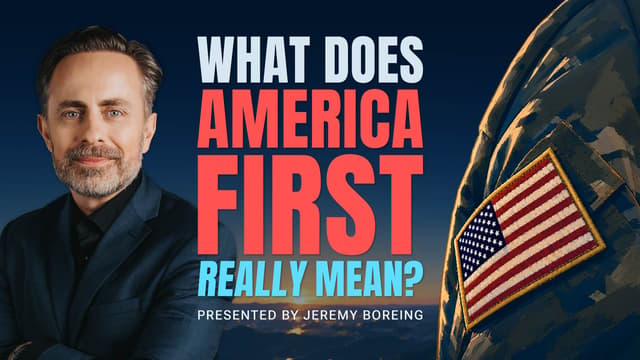
What Does America First Really Mean?
Growing movements on the left and the right says America should give up its place as the world’s lone superpower and share influence with rivals like China. Would this be wise? What would be the consequences of such a global shift? Jeremy Boreing, social commentator and host of The Jeremy Boreing Show, answers these critical questions.
Hosted By
 Jeremy Boreing
There’s a growing segment of the American Right that believes the US should surrender its status as the sole global superpower and enter into a power-sharing relationship with other major powers — most notably, China.
America, the thinking goes, cannot continue to dominate the world and should not. Cannot because we lack the financial and military wherewithal. Should not because we supposedly lack the moral authority.
If this sounds like a leftist critique of America… it is.
For the Left, America’s primary export is capitalist greed, along with oppression and patriarchy, which they claim our Christian society imposes on the noble people of the world.
For the dissident Right, America’s primary export is sexual license, along with global homogenization — they call it Globo-Homo — which they claim our post-Christian society imposes on the noble people of the world.
And both believe the enormous resources deployed to maintain America’s leadership around the globe would be better spent at home.
The Left’s position is that American decline and withdrawal from its perch atop the global order will lead to a more equitable world.
The Dissident Right’s position embraces a “spheres of influence” approach to global politics wherein America focuses geographically on the Western Hemisphere, China on the East, Russia in Europe, and Iran in the Middle East.
It isn’t hard to miss the irony that the Dissident Right proponents of this multipolar foreign policy love to cloak themselves in the term America First when, in fact, the policy they are pursuing is America Tied.
By the way, when you go from First Place to Tied, you’re losing.
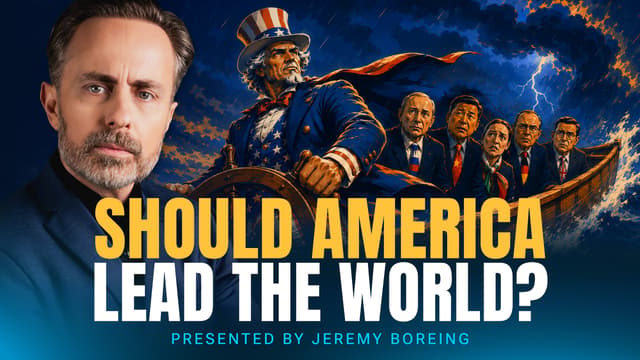
Both of these perspectives on multipolarity are either naive about or deliberately run cover for a fundamental truth: in the contest between great powers, there is no sharing. Not for long, anyway.
During the Cold War, two Super Powers contended for dominance, the United States and the Soviet Union. The two powers represented two completely distinct sets of values.
The US represented the West, with its traditions reaching back through Rome and Athens and Jerusalem. The West is democratic, representative, and concerned with the rights of the individual. The West is Christian, or at least, is a product of Christians. Its values are premised on belief in God and are derived from the Bible.
The Soviets represented something entirely different — the Not West: totalitarian, collectivist, and explicitly hostile to faith in God.
These values couldn’t coexist. And they didn’t.
In the great contest between nations, in the competition between states for wealth and power and influence, there ultimately had to be a winner and a loser.
And fortunately for the world, America won.
Bipolarity had its advantages, of course. Having an existential enemy does a lot to clarify one’s mission.
Since the collapse of the Soviet Union, America’s belief in the righteousness of its values has diminished.
Where we once saw our national creed as a calling, liberty and justice as causes worth defending and promoting, now we’re unsure. We’ve replaced patriotism with skepticism. Is America exceptional? Is America even good?
This self-doubt is driven on the Left by the fact that America doesn’t always live up to its values, and on the Right by the perceived domestic cost of pursuing its values beyond American shores—flying “pride” flags over our Middle East embassies while elected leaders ignore—or, worse, deny—the decline of our communities plagued by crime, inflation, homelessness, and failing schools.
A significant percentage on both sides argue it’s time for America to pivot, to turn its attention homeward and say to hell with the rest of the world.
But before we decide the whole enterprise hasn’t been worth it, we should ask what we got in return.
American hegemony has been responsible for the most extraordinary run of relative peace and prosperity in the history of human civilization. It bought the financial leverage to sanction adversaries into submission without firing a shot, freedom of the seas, and technological advancements no other country could match.
The price of this once-in-human-history era of peace and prosperity is strength, and strength is expensive, both in blood and treasure.
And it isn’t just the requirements of our military. What we call foreign aid is not charity. It is the price of influence. It’s what we pay to keep other countries in our orbit rather than Beijing's or Moscow's. Not every dollar is well spent, just like not every military action is wise. Not every deal is a good one. Some of it is waste. Some of it is worse than waste. There’s a reason people are tired of it. It deserves scrutiny and reform.
But the alternative — ceding that influence to powers who seek the West’s, and especially America’s, destruction — is not a savings. It’s a surrender.
And American surrender is not America First.
I’m Jeremy Boreing for Prager University.