Get credit for watching this video with PragerU Premium. Start your streak.
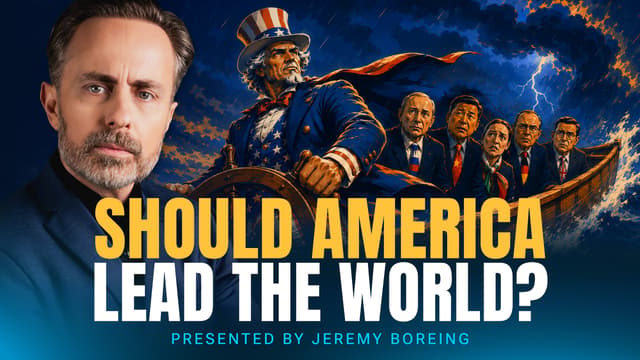
Should America Lead the World?
Some on the left and the right argue America should give up its preeminent place as the world’s sole superpower. China and Russia, they argue, should be given an equal share of the global stage. Is that in America’s best interest? Is it in the world’s best interest? Jeremy Boreing, social commentator and host of The Jeremy Boreing Show, answers these critical questions.
Hosted By
 Jeremy Boreing
On the world stage, if you’re not winning, you’re losing.
Once a nation fades, it continues to fade.
Egypt was at the top of the pyramid four thousand years ago.
Rome once ruled an Empire from Britain to the Red Sea.
England had an Empire so vast they said the sun never set upon it.
Today, each of these is a tourist destination.
There is no coming back once you cede your place as a superpower. Nature abhors a vacuum. Other nations will fill the void. And if America cedes global authority to others who don’t share our values, we may find that the values imposed on future generations of Americans aren’t American values at all.
We don’t want atheist China, with its complete government control of its people, to dominate the world. We don’t want radical Islam, with its subjugation of infidels and women to dominate the world, either.
Our obligation is to bequeath to our children a freer, more prosperous, and more virtuous nation than the one bequeathed to us. Not a poorer, weaker country under the heel of foreign tyrants and foreign gods.
Today, America is the sole global superpower. The American military ensures freedom of the seas. The American dollar is the global reserve currency. The world order is unipolar – and America is that power.
But the world hasn’t always been that way. During the Cold War, it was a bipolar world. Two superpowers – America and the Soviet Union.
Russian political theorist Aleksandr Dugin - often referred to as “Putin’s Brain” - is outspoken in support of multipolarity – more than one or even more than two global superpowers, each with its own spheres of influence. Dugin describes multipolarity as a postmodern rejection of Western colonialist, imperialist hegemony. He claims that truth is relative, not objective, and that different civilizations should be allowed to define their own truths.
And he calls for America to surrender its role as leader of the free world and instead share global power and influence with countries like Russia.
Chinese academic Jiang Xueqin (Jyang Shweh-Chin) echoes Dugin’s call for “multipolarity,” saying America should surrender its dominance and hegemony and instead enter into an equal partnership with countries like China.
Setting aside the inherent comedy of Russia and China politely asking for the US to cede global power to Russia and China, at least they are trying to win.
What are the purveyors of Multipolarity in our own country trying to do?
Do they really believe a world secured by American military might and the US dollar should give way to a power sharing arrangement with our adversaries? Do they really want to cede power to, as Dugin put it, “different truths?” We know what those truths look like in practice. We can look right now at the nations asking us to stand down. Is that the world we want to live in?
If history tells us anything, it’s that war is the norm. Powerful leaders don’t share power. America’s global hegemony keeps the peace, and it keeps conflict from our shores. The Pax Americana we’ve enjoyed since the end of WWII is an aberration. Are we sure we want it to end?
The Roman Republic experimented with multipolarity in the first century BC. In a secret, informal agreement, Julius Caesar, Pompey, and Crassus agreed to share power. It ended in blood, betrayal and a play by William Shakespeare.
The Romans tried to create a stronger, formalized Triumvirate a year later between Octavian, Lepidus, and Mark Antony. It ended with the end of the Republic and one man, Octavian, becoming Emperor.
The lesson here is that power is not easily shared.
Multipolarity always tends toward unipolarity over time.
It’s not a question of whether we’ll have a unipolar world. It’s a question of who will be in charge of it.
The reason so many were jarred by President Donald Trump’s action against Iran, for example, was because they didn’t fully understand the meaning of America First. When Trump says “America First,” he means America First Place. He wants America to be number one. He wants to win.
He knows something that some on the Dissident Right don’t seem to know: Every time America has lost faith in itself or failed to assert its interests, its enemies have jumped at the opportunity to seize more power for themselves.
Of course, we hate war. Of course, we pray for peace. And, yes, projecting power beyond our shores costs a lot of money. But that doesn’t mean we retreat into ourselves.
It also doesn’t mean we should abandon our confidence in the existence of the superior values of the West, the values of America, the values to which we aspire and for which we must continue to fight.
It means supporting leaders who look out for America’s interests, who actually want America to be number one.
It means having enough confidence in the American Way to say that, not only are we better off with America in charge, but so is the rest of the civilized world.
It means we — not our enemies — build the future.
I’m Jeremy Boreing for Prager University.