Get credit for watching this video with PragerU Premium. Start your streak.
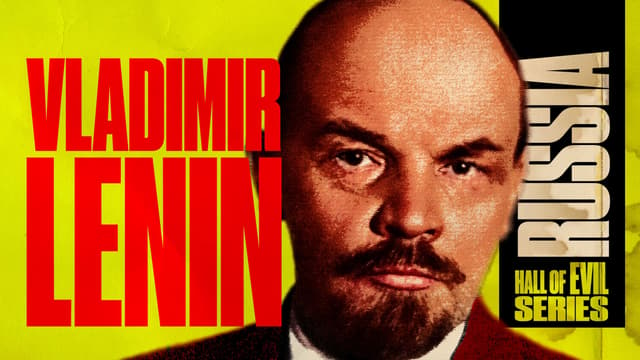
The Hall of Evil: Vladimir Lenin
The 1917 Russian Revolution changed the course of the 20th century. At its head stood Vladimir Lenin, a man who used terror and mass murder to realize his Marxist vision of a utopian society. How did he and a small band of communists overthrow an empire and create the first totalitarian state? Paul Kengor explains.
This video is part of the Robert W. Plaster Foundation Playlist: Free Enterprise Will Set You Free, which educates Americans on the virtues of our nation's founding principles and the consequences of straying from them.
This video is part of a 6-part series. Click here to watch the entire Hall of Evil series.
Topics
Hosted By
 Paul Kengor
The Russian Revolution of 1917 should never have happened. The reason it did was because one man, and one man alone, insisted that it must.
That man was Vladimir Lenin.
All the death, misery, and incomprehensible suffering that resulted from the creation of the first totalitarian state in human history would not have been possible without him.
Attempts to disassociate Lenin from the horrors of Soviet communism are disingenuous. First, and contrary to his apologists, there were no “good intentions” behind Lenin’s insatiable quest for power. Second, since those intentions never existed, it was impossible for Lenin’s successor, Joseph Stalin, to distort them. Stalin merely completed what Lenin started.
Lenin was born Vladimir Ilyich Ulyanov on April 22, 1870, in a small town on the banks of the Volga River.
By his own account, he had a happy childhood.
A brilliant student, young Vladimir won almost every academic contest he entered. He seemed to be fated for a successful career in the law.
His future took a sudden and fateful turn when his older brother Aleksandr got caught up in the anti-Czarist fervor sweeping Russia in the late 19th century. For his part in an audacious plot to assassinate the Czar, Aleksandr was executed in 1887. Many have speculated that his execution radicalized young Vladimir. Following in his brother’s footsteps, he soon became a full-time revolutionary.
For the next three decades, Lenin honed his craft, writing pamphlets, gathering supporters, and agitating for a Marxist revolution. Evading the Czar’s secret police, the Okhrana, was a full-time job. In this, Lenin was only partly successful. In 1897, he was exiled to Siberia for three years.
Fortunately for him, security was so lax — a mistake Lenin would learn from — he was able to run his communist clique remotely.
In 1900, he self-exiled to Europe where he continued to agitate and organize.
For all his efforts, he got nowhere. The Okhrana kept its eye on him but considered him little more than a minor annoyance.
And then, in 1914, World War I broke out. The war was a disaster for Russia. As the conflict dragged on for months and years, millions of poorly equipped Russian soldiers died on the front; millions more deserted. The hopelessly incompetent Czar Nicholas II took the blame and in March 1917 chose to abdicate.
Lenin saw his chance. Ironically, it was the Germans — Russia’s World War I enemy — who helped him seize it. Hoping Lenin would further destabilize the provisional Russian government and thus allow them (the Germans) to fight a one front war in the West, they put him on a special sealed train and deposited him in St. Petersburg.
The German plan worked and then some.
On October 25, in an act of incredible boldness, Lenin and his band of Bolsheviks took control from the provisional government. Bolshevik means “one of the majority” in Russian, but Lenin’s rebels were anything but. No matter. Lenin never let the truth get in his way. He promised the Russian people, “peace, land and bread.” He took their land, there was no peace, and soon there was no bread.
In November, yielding to popular pressure (it still meant something then), Lenin allowed a national election.
He knew he would lose.
He was right: the Bolsheviks received only 24 percent of the vote. This, however, was not a problem for Lenin.
When the Constituent Assembly, Russia’s new parliament, met in January 1918 and voted to reject the Bolsheviks’ takeover of the government, Lenin seized the building. Russia’s experiment with democracy was over before it began.
How would Lenin rule? Never one to mince words, he told the party leadership. “We can't expect to get anywhere unless we resort to terrorism…”
Within months of taking power, he established his own secret police, known as the Cheka, an early form of the KGB. To lead it, Lenin appointed his trusted fellow Bolshevik Felix Dzerzhinsky, a maniacally ruthless and efficient killer, a prototype of a kind of soulless bureaucrat that totalitarian systems never seem to lack.
The Czar’s Okhrana was bad; Lenin’s Cheka was ten times worse.
It wasn’t long before civil war broke out. A motley assembly of opposition parties, Czarists, and disenchanted peasants were on one side, and the Bolsheviks on the other. The Whites vs. the Reds.
Lenin welcomed the conflict: it allowed him to justify any action to consolidate his control. He shut down freedom of speech, assembly, the press and religion. He carried out mass arrests, held show trials and had whole villages massacred. He declared all-out war on the “kulaks,” a word that he applied to land-owning farmers, but it really referred to anyone Lenin didn’t like. Before it was over hundreds of thousands had died for the Marxist utopia.
By 1922, Lenin had Russia, now the Union of Soviet Socialist Republics, firmly under his thumb. The Bolsheviks, the Reds, ruled the largest country on earth.
Ordering mass murder, torture, and terror didn’t take any toll on Lenin’s conscience, but it did on his body. In 1922 and 1923, he suffered a series of strokes. He died on January 21, 1924, age 53.
There was no “good” Lenin. He was a monster.
Unfortunately for Russia and the world, another monster would soon take his place.
I’m Paul Kengor, Professor of Political Science at Grove City College and editor of The American Spectator, for Prager University.