Get credit for watching this video with PragerU Premium. Start your streak.
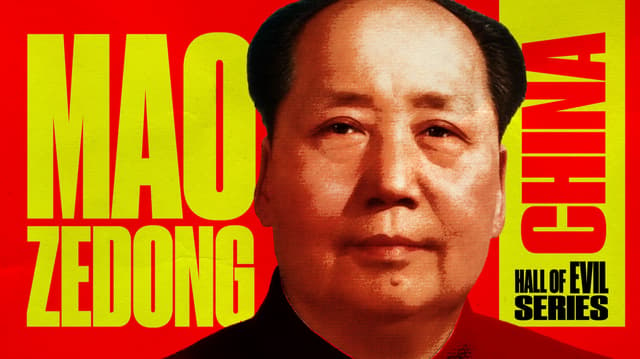
The Hall of Evil: Mao Zedong
One of history’s most brutal dictators, Mao Zedong all but destroyed China in the 20th century. As the leader of the Chinese Communist Party, he starved and oppressed his own people, causing the deaths of over 50 million and the suffering of countless more. Paul Kengor, Professor of Political Science at Grove City College, uncovers the chilling truth of Mao’s rule.
This video is part of the Robert W. Plaster Foundation Playlist: Free Enterprise Will Set You Free, which educates Americans on the virtues of our nation's founding principles and the consequences of straying from them.
This video is part of a 6-part series. Click here to watch the entire Hall of Evil series.
Topics
Hosted By
 Paul Kengor
The morbid distinction of being directly responsible for the death of more people than any human being in history belongs to Mao Zedong, the dictator of China from 1949 until his death in 1976.
Born on December 26, 1893, Mao was the son of a prosperous farmer who had lifted himself from poverty. From the time Mao learned to read, he was obsessed with books. His first job was as a librarian, and in his twenties, he ran a bookstore selling Communist Party propaganda.
Mao became a Marxist not out of idealism. His only ideal was Mao. The plight of the Chinese people meant nothing to him – not as a young man and not as a dictator. For Mao, other people existed to be used. Their lives didn’t matter at all.
In the early 1920s, Mao was one of a small group who joined together to form the Chinese Communist Party. The outlawed party grew slowly but steadily. But the Communists were no match for the Nationalist Party and its armed forces led by Chiang Kai-shek. While Chiang was your classic strongman, the Nationalist movement at least pointed toward a democratic future. No one could say that about Mao and the Communists.
By 1934, Chiang had Mao on the ropes. Mao escaped by virtue of his now-mythical “Long March,” the year-long, 6,000-mile trek, in which his force of 100,000 followers was reduced to a mere 8,000. Mao’s troops may have suffered every imaginable hardship, but Mao himself barely marched anywhere. Instead, he was carried on a litter, a portable couch, held up by a cadre of servants.
Even though only a remnant survived, it proved to be enough to keep the Communist cause going.
Ironically, it was the Japanese invasion of China in 1937 that saved the Communists. Chiang reluctantly diverted his attention away from Mao to fighting the Japanese.
This gave Mao a chance to rebuild his forces in the countryside. By 1949, he had amassed an army of 1.5 million men. That was more than enough to defeat Chiang and establish himself as the absolute ruler of all China.
Half a billion people – a fifth of the world’s population – were thrust into one vast ideological laboratory. In rural areas, families were herded into collective farms. They no longer would work for themselves, they would work for the government.
This was as true for women as it was for men. In a perverse way, Mao believed in the equality of the sexes. If men could do back-breaking labor in the fields and factories, why couldn’t women?
Of course, there was no real equality in China for anyone, male or female, and no chance of improving one’s condition. If you were assigned to a village, you had to stay in that village. If you were assigned to a city, you had to stay in that city. Whatever job the party gave you, that was your job. You couldn’t say, “I would rather be a teacher than a farmer.”
Well, you could say it, but if you did, you’d be shot.
There was also no equality between the proletariat and the elite. Mao lived in total luxury and hedonism. He had a dozen custom-built homes scattered throughout the country. Peasant girls were brought to him for his sexual satisfaction. He refused to bathe, brush his teeth, and had chronic venereal disease. He ate whatever his heart desired: meat, vegetables, and pastries.
Meanwhile, peasants starved in mud huts.
Why couldn’t the peasants feed themselves like they had for centuries? The truth was they could. Mao was exporting food all through this period. He believed China had to be a great military power, so he traded food for industrial hardware and armaments. The Soviets and Eastern Europe got the grain; Mao got the guns. The peasants got nothing.
And then they got less. From 1958 to 1962, during the Great Leap Forward, Mao pushed the peasants even harder. Their suffering is impossible to describe.
First they ate the dogs, then the rats, then the bark from the trees, then in some cases, human flesh.
According to a contemporary account, “The life we had to endure in those days was worse than the life of primitive societies. We lived like animals...”
Tens of millions died before Mao finally backed off. But he was never far from another disastrous social experiment. In the mid-1960s, he instigated the so-called “Cultural Revolution,” encouraging Chinese college students to denounce anyone not sufficiently “revolutionary.” This included their own parents and grandparents. And then, when he felt the college students had gone far enough, he turned on them. Thousands were sent to labor camps. And, of course, many were tortured and executed. It wasn’t a Maoist purge if that didn’t happen.
After being directly responsible for the murder of between 50 and 70 million of his own people, after impoverishing the most populous country in the world, after killing anyone who opposed him, Mao died in his bed in September 1976.
It’s hard to think of him having done one good thing in his entire life.
I’m Paul Kengor, Professor of Political Science at Grove City College and editor of The American Spectator, for Prager University.