Get credit for watching this video with PragerU Premium. Start your streak.
Did Europe Destroy Native American Culture?
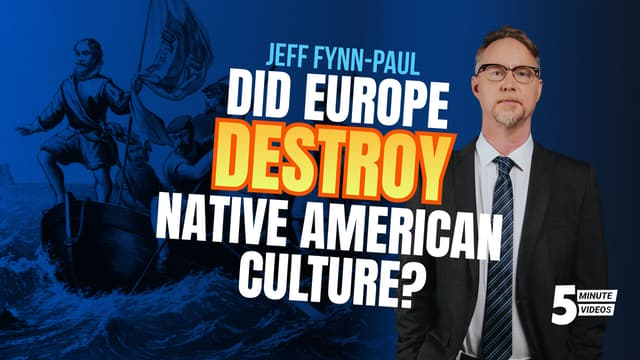
It is undeniable that Native Americans suffered terribly after the arrival of European settlers, but was this the result of malice or tragic inevitability? Jeff Fynn-Paul, professor of economic and social history at Leiden University and author of Not Stolen: The Truth About European Colonialism in the New World, explores what happened when the Old World met the New.
Topics
Hosted By
 Jeff Fynn-Paul
Let’s say Columbus and his flotilla of three small ships never made it to the Western hemisphere. Do we imagine he would have been the last explorer to head west from Europe looking for a new trade route to India?
Of course not.
Once the New World was discovered, the maritime European powers—England, the Netherlands, Spain, and Portugal had a strong motivation to establish colonies. If they didn’t, they’d be at a competitive disadvantage to their rivals.
It’s human nature to move toward new opportunities. Often in frantic, haphazard ways. Think of the California Gold Rush. No one convened a conference and said, “How can we best extract gold from the American River without disturbing the natural beauty of the land?”
No, masses of people rushed into the area at the first opportunity.
So it was with the discovery of the New World. As soon word got out that the world didn’t end in an abyss somewhere in the middle of the Atlantic Ocean, fishermen and traders sailed across the sea on their own, in hopes of scoring a fortune.
Yes, their superior technology in firearms gave them an edge over Native Americans in a fight. But who wanted a fight? Most of these early adventurers did everything they could to avoid a confrontation.
Of course, no one anticipated that the natives would have almost no defense against the microbes that these adventurers brought with them. It wasn’t planned and it couldn’t have been prevented.
It just happened.
By the time Jamestown was founded in 1607, disease had already reaped its terrible toll.
Even before the Europeans arrived, the population of North America was sparse. Farming without draft animals and hunter-gathering can only support a tiny population at the best of times. In contrast, the barley, wheat, and rye culture of the Old World can support far greater numbers.
Add this to the fact that the population of Europe was rapidly expanding while arable land on the continent was declining and the movement west across the Atlantic was inevitable.
Nothing could have stopped it.
This brings us to the question of cultural adaptation and how it works. It is now commonly believed that Europeans destroyed Native Culture. The problem with that narrative is this: whenever a good idea comes along, one which clearly increases living standards, people tend to adopt it.
Even as they discovered America, Europeans were in the process of adopting dozens of superior Chinese inventions and ideas: paper money, gunpowder, pasta, and fine porcelain are only the most famous.
Should we accuse China of ‘cultural imperialism’ when they ruined ‘native’ Italian cuisine by introducing Marco Polo to spaghetti?
Likewise, Native Americans were quick to adopt the many useful Old World ideas which Europeans happened to carry with them.
Again, most of these had not even been invented by Europeans but had been adopted by Europeans from other cultures.
Why grind corn laboriously by hand for several hours a day, when you can use millstones instead?
Why hunt with bow and arrow, when you can use a rifle?
Why run when you can ride a horse?
Why not domesticate cattle when they provide huge boosts in caloric intake for your family?
Why refuse to adopt the wheel, for goodness sake?
By the time Columbus set sail the Old World had dozens of clear technological and institutional advantages, which for the most part, New World populations were eager to adopt as soon as they saw them.
Rather than jealously guard their technological superiority, many Europeans were ready to trade anything that Native Americans might want, including firearms. This made it inevitable that New World societies would change beyond recognition once sustained contact was initiated.
There is little mystery as to what happened to the Native Americans as a culture.
They were certainly not exterminated at the behest of any concerted ideology of hatred or grand plan.
After the initial deaths from disease, and in spite of a few sensational wars and small-scale massacres, remaining Native Americans took on so many Old World technologies and customs that most of them gradually assimilated into European culture.
Only a minority stayed ‘native’ enough to be placed on reservations. Even after that, many enterprising people left the reservation for a better life elsewhere. This was done on an individual basis, for the most part willingly, leaving little trace in the historical record.
It is undeniable that Native Americans suffered terribly—but this suffering was more a product of tragic inevitability than malice. The only way any native societies could have survived intact would be if no one ever came to where they lived. And that would require human nature to be something other than what it is.
It's time to stop the apology parade.
Would it not be more productive and more nuanced to acknowledge that there have been points of goodwill, friendship, and—shudder the thought—even mutual benefit, since the Old World met the New?
I’m Jeff Fynn-Paul, Professor of Economic and Social History at Leiden University, for Prager University.