Get credit for watching this video with PragerU Premium. Start your streak.
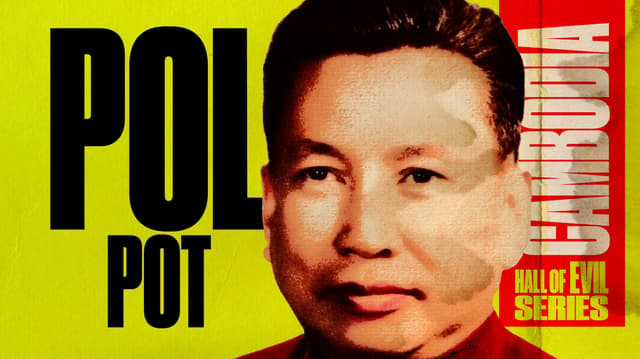
The Hall of Evil: Pol Pot
How did Pol Pot turn 1970s Cambodia into a living nightmare? Under his brutal regime, nearly a quarter of the population was wiped out through execution, starvation, and forced labor in his infamous “killing fields.” Paul Kengor, Professor of Political Science at Grove City College, tells the true story of Pol Pot’s reign of terror.
This video is part of the Robert W. Plaster Foundation Playlist: Free Enterprise Will Set You Free, which educates Americans on the virtues of our nation's founding principles and the consequences of straying from them.
This video is part of a 6-part series. Click here to watch the entire Hall of Evil series.
Topics
Hosted By
 Paul Kengor
On April 17, 1975, the Communist Khmer Rouge took control of Phnom Penh, the capital of Cambodia. That same day, they ordered the evacuation of the entire city.
The inhabitants were allowed to take only what they could carry.
It didn’t matter if you were sick or infirm, young or old; you had to leave. No exceptions.
Where were you going? The soldiers couldn’t tell you.
If you protested, you’d be beaten with rifle butts or simply shot.
The Khmer Rouge had a slogan for troublesome people: “to keep you is no profit, to destroy you is no loss.”
Cambodia’s communist revolution would prove to be, per capita, the most radical, bloodiest revolution of the twentieth century, maybe of any century.
About two million people, or 25 percent of the Cambodian population, perished during the Khmer Rouge’s four years in power. Countless were murdered outright, countless more were worked or starved to death.
Not even Mao on his worst day could match that ratio.
The Khmer Rouge, the Cambodian communist party, was led by the enigmatic figure Pol Pot. His real name was Saloth Sâr, but like his hero, Joseph Stalin, he took a revolutionary nom de plume. Fittingly, “Pol Pot” has no meaning in Cambodian. Nothing in his revolution ever made sense.
He was born on May 19, 1925, the eighth of nine children. Well off by Cambodian standards, he received a privileged private education, including at both Catholic and Buddhist schools.
In 1949, the 24-year-old Sar went to Paris to study “radio electricity.” There he quickly fell in with a group of Cambodian communists. Radicalized by their French professors, their goal was to throw off Cambodia’s French colonial past and establish a new socialist government along Marxist-Leninist lines. In 1953, Sar returned to Cambodia to lead the revolution.
That same year Cambodia did achieve independence from France, but Sar had nothing to do with it. The man responsible was the cagey, chameleon figure Prince Norodom Sihanouk.
The prince played the US off against the Soviet Union and China to keep himself in power. For a while, he succeeded, but in 1970, while he was visiting Moscow, he was ousted by his prime minister, Lon Nol, who opposed Sihanouk's leftward tilt.
Nol, supported by the US, led the country for five years. That support abruptly ended when Richard Nixon resigned following the Watergate scandal and liberal Democrats swept Congress.
The new Republican President Gerald Ford predicted disaster if the Democrats cut off aid to Nol, but they ignored him.
Even Ford had no idea how bad it would be.
For a brief period, after Nol fled the country, Cambodia had no government to speak of. Sar — now Pol Pot — stepped into the chaos. He was as shocked as anyone when his militia, the Khmer Rouge, took over the capital city virtually unopposed.
Most Cambodians believed Pol Pot would be a variation on the Sihanouk/Nol regimes, maybe even an improvement. No surprise, The New York Times thought the same thing.
Correspondent Sydney Schanberg wrote four days before the Khmer Rouge took over that, “Wars nourish brutality and sadism…but it would be tendentious to forecast such abnormal behavior as a national policy under a Communist government...”
Of course, The New York Times thought Castro would be great for Cuba.
Instant utopia. Not tomorrow. Today. That was Pol Pot’s fever dream.
And that could only happen if everything from the “old world,” the world the day before the revolution, was wiped away.
Everything.
Money, mail, markets, music, law courts, property, newspapers, sports, cosmetics, even toys were banned. The human being as an individual, marriage, the family, all simply erased. Even the calendar was reset — 1975 was declared Year Zero.
Thus, Pol Pot hurled Cambodia backwards into a new dark age.
“Cars, including Mercedes and other luxury vehicles,” writes one Pol Pot biographer, “were cut in two by village blacksmiths: the metal … was melted down to make ploughshares… the wheels were attached to oxcarts.”
Doctors, religious leaders, business owners, teachers, government workers, academics and intellectuals were marched into the countryside to become peasant farmers.
Within months, much of Cambodia was starving. Bo Meng’s story is typical. He lost six siblings and his father in Pol Pot’s “killing fields” where a bowl of watery rice or a spoonful of corn kernels served as a family meal.
In classic communist fashion, Pol Pot blamed famine and the breakdown of Cambodian society on the “parasites,” the “counterrevolutionaries.”
For them, Pol Pot built over 100 concentration camps — death camps really — where prisoners were subject to hideous tortures before being executed.
While the world remained largely ignorant of Pol Pot’s atrocities — he had cut the country off from all external communication — horror stories began to seep out.
After four of the worst years any country has ever endured, it finally came to an end. Pol Pot got into a border dispute with Vietnam. In 1978, the Vietnamese army invaded and sent Pol Pot and the Khmer Rouge into exile.
It would be another fourteen years of sporadic fighting before Cambodia re-established itself as an independent country.
As for the mass murderer, Pol Pot, he died in his bed aged 72. He never acknowledged he had done anything wrong.
The evil never do.
I’m Paul Kengor, Professor of Political Science at Grove City College and editor of The American Spectator, for Prager University.