Get credit for watching this video with PragerU Premium. Start your streak.
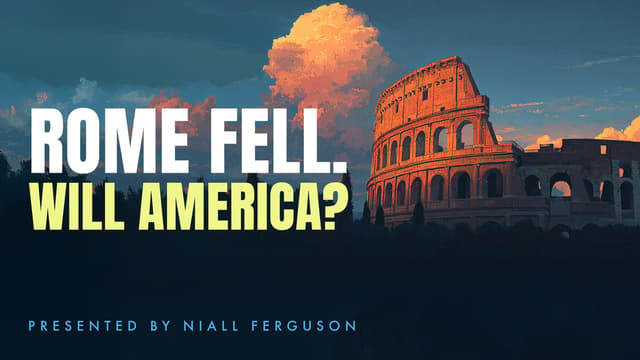
Rome Fell. Will America?
The Roman Empire began as a model of Republican Government, but eventually descended into an autocracy. Is America headed for the same fate? Niall Ferguson, Senior Fellow at the Hoover Institution, examines this question.
Topics
Hosted By
 Niall Ferguson
At some point in 2023, the number of views of the #hashtag romanempire on TikTok passed a billion. This social media craze originated when girlfriends began asking their boyfriends how often they thought about the Roman Empire. The typical answer was supposedly: “Every day.”
“Are We Rome?”
American historians and public intellectuals may not ask this question every day, but they ask it quite frequently. In 2007, Cullen Murphy published a book with that title. He revisited the subject in April 2021, drawing breathless parallels between the scenes at the Capitol the previous January 6 and the sack of Rome. “Outside,” Murphy wrote, “a pandemic raged, recalling the waves of plague that periodically swept across the Roman empire.”
This kind of historical hyperventilation has been a recurrent feature of the Trump Era. Writing for Time in December 2018, Edward Watts asserted that, “The most significant danger old republics like ours face, is not the sudden assault of an aspiring autocrat but the slow erosion of their cultural and institutional defenses.”
Tim Elliott drew an even more direct connection in his November 2020 essay for Politico in which he compared Donald Trump to Julius Caesar. Elliott argued that the American republic must be on its last legs because Trump, like Caesar, “promise[s] to return [us] to an imagined ancient glory,” while “bulldozing democratic norms, ignoring checks on his power and eroding political debate.”
Of course, all these authors neglect to mention the ways in which Trump is not like a Roman emperor. For example, the president is preoccupied with reducing the size of government — not something autocrats are known for — and reducing the regulations on business. He is for free speech and against censorship. He’s against foreign wars.
But Trump should not take it too personally. The habit of comparing Ancient Rome to contemporary America has been a feature of political discourse for much longer than most of us realize. It goes back more than 200 years — indeed, to the time of our republic’s founding.
The Founders were as obsessed with Rome as anyone today, maybe even more so. The writers of The Federalist Papers, Alexander Hamilton, James Madison, and John Jay, all took the pen name Publius, evoking Publius Valerius Publicola, one of the Romans who in 509 BC overthrew the monarchy and established a republic. George Washington was often compared to the Roman general Lucius Quinctius Cincinnatus who, after leading the defense of Rome against attack in 458 BC, preferred to return to his farm rather than retain dictatorial powers.
The Founders took their Roman history seriously. So should we. Consider, for example, what Polybius is telling us in book VI of his Histories (written from around 168 BC). He sets out to show “in what manner, and under what kind of constitution, it came about that nearly the whole world fell under the power of Rome.” His explanation was that the Roman Republic enjoyed a mixed constitution that combined elements of monarchy, aristocracy, and democracy. Each element balanced out the others, and prevented the system sliding into tyranny, oligarchy, or anarchy.
The Founders got the message. In their republic, the monarchy became the presidency, the aristocracy became the Senate, and the democracy became the House of Representatives. Each would check the power of the other. And, like Rome, America has thrived under this mixed constitutional system.
So, how, then, did the Roman Republic go wrong? The Roman historian Tacitus, writing around 116 AD, gives us our answer: Recurrent and bloody civil war, exemplified by the assassination of Caesar, led Rome to the brink of chaos.
Caesar’s adopted heir Octavian, Tacitus writes, “brought a world exhausted from civil dissension under his authority, with the title of ‘First Citizen’” — and the impressive new name, Augustus.
“By seducing the military with bonuses, the masses with grain allowances, and everybody with the pleasure of peace,” Tacitus tells us, Augustus “gradually increased his powers, drawing to himself the functions of Senate, magistrates, and laws.”
Tacitus was disgusted by the way “they all rushed into servitude—consuls, senators, and knights. The higher the rank, the greater the hypocrisy and haste.”
So are Trump’s critics right? Are we where Romans were in the late Republic — maybe around 29 BC, a few years before Octavian became “princeps senatus” and “augustus”?
Or is the American republic, thanks to the genius of our Founders, incapable of mutating into an empire and a tyranny the way Rome did?
I am confident we’re not Rome.
And we can take comfort in the fact that Americans have been worrying about turning Roman ever since the founding. Maybe the time to start seriously worrying about “Are we Rome?” will be the day we stop asking ourselves that question.
I’m Niall Ferguson, senior fellow at the Hoover Institution, for Prager University.