Get credit for watching this video with PragerU Premium. Start your streak.
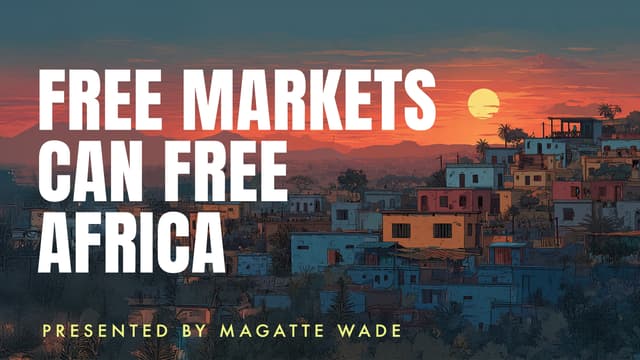
Free Markets Can Free Africa
Why is Africa poor? Is it because of its colonial past or is it because of present-day policies? Senegalese-American entrepreneur and philanthropist Magatte Wade answers these questions, and offers a new path for a brighter, more prosperous future for the continent.
Topics
Hosted By
 Magatte Wade
Is colonialism the source of poverty in Africa?
The answer to that question is a resounding…
No!
If you think it is, put the idea out of your head.
It’s a falsehood.
So, what is the source of Africa’s problems, you might ask?
That’s another easy one to answer.
Most people in Africa don’t have enough money.
And why is that?
(Such easy questions!)
Because they don’t have jobs.
And why don’t they have jobs?
Because they don’t have capitalism and free markets.
They don’t have enough entrepreneurs.
Entrepreneurs create jobs.
Free markets allow them to do so.
This should be obvious.
Sadly, it’s not.
Instead people — you may be one of them — are blinded by ignorance — ignorance about how the world works not just in Africa but everywhere and for all time.
In the 1950’s, Singapore was a swamp with zero natural resources.
No minerals.
No precious metals.
No oil.
Today its income per capita is twice that of the United Kingdom.
What created Singapore’s wealth?
Capitalism!
The free market!
And the property rights and business friendly environment that go along with it.
In the 1990s Dubai was a patch of bleached sand.
Now, it’s one of the great financial centers in the world.
Why?
Capitalism. Free markets. Light regulation.
The strongest economy in Africa right now is a country that you’ve never heard of: Mauritius.
One of the fastest-growing economies is Rwanda.
They have both embraced free market ideas and encouraged local entrepreneurs by making it easy for them to start businesses.
News flash: only one economic system lifts people out of poverty.
Capitalism.
Here’s the topper.
It works every time!
And one economic system guarantees people will be poor.
Socialism.
Venezuela was once the wealthiest country in South America. Socialists took over and turned it into a basket case.
Guess which continent has been overrun with socialism.
Answer: the poorest — Africa.
Colonialism didn’t impoverish Africa. The West didn’t pillage Africa of its natural resources. Those natural resources are still there in magnificent abundance.
What pillaged Africa was government domination of the economy.
After the colonial powers, mainly Great Britain and France, pulled up stakes in the 1950s and 60s, the new leaders of Africa had a choice: embrace the free market concepts of the West or the socialism of the Communist East. Tragically, they chose the latter.
I understand why. “The West enslaved us,” they said. “We want nothing to do with them anymore. Whatever they do, we will do the opposite.”
It may have been understandable, but it was foolish, tragically so.
But what is even more foolish is that, with a few exceptions, nothing has changed.
Top-down, government-controlled economies remain the rule.
Excessive regulations suffocate entrepreneurs, making it almost impossible for them to create profitable enterprises.
How do I know all this?
Because I lived it.
I was born and raised in Senegal and later in Germany and France. As an adult, I moved to the United States and lived the American Dream (don’t tell me that dream doesn’t exist. I’m proof that it does).
Then, I decided I wanted to open a beverage business in my native country.
The manufacturing side would be in Senegal, where the ingredients I needed were sourced, and the marketing and sales side would be in the US.
To open my business in the US took me twenty minutes.
To open my business in Senegal took two years, involved endless paperwork and endless meetings with meddlesome government officials.
Eventually, my business became a success.
But that was despite the unnecessary, useless, make-work obstacles the Senegalese government put in my path.
Africa doesn’t need charity.
It needs capital: Investment dollars. And entrepreneurs.
It has plenty of the latter and not nearly enough of the former.
Every year, African universities graduate tens of thousands of eager, energetic students. But there are no jobs for them.
There’s a bitter African joke that the first job of a college graduate is street vendor.
These young people have no opportunity to make use of their talents, so they flee their countries, sometimes on small, leaky boats.
They don’t become entrepreneurs. Instead, many become fish food at the bottom of the Mediterranean Sea.
It’s tragic.
So, what’s the answer?
I’ve already given it to you.
Special Economic Zones. What I call Startup Cities. A few have already begun. More are on the way.
Like Singapore and Dubai, these are places that African nations designate as favorable to business formation: places where the free market can work its magic, free from government interference.
You can find out more about these new cities at my website MagatteWade.com
Don’t worry about the mineral wealth of Africa. That’s small potatoes.
We need to develop the continent’s human capital. That’s where the gold is!
And the only way we can unlock it is through the free market.
No to socialism.
Yes to capitalism.
Yes to the only viable route to Africa’s abundant future.
I’m Magatte Wade, author of The Heart of A Cheetah: How We Have Been Lied to about African Poverty, and What That Means for Human Flourishing, for Prager University.