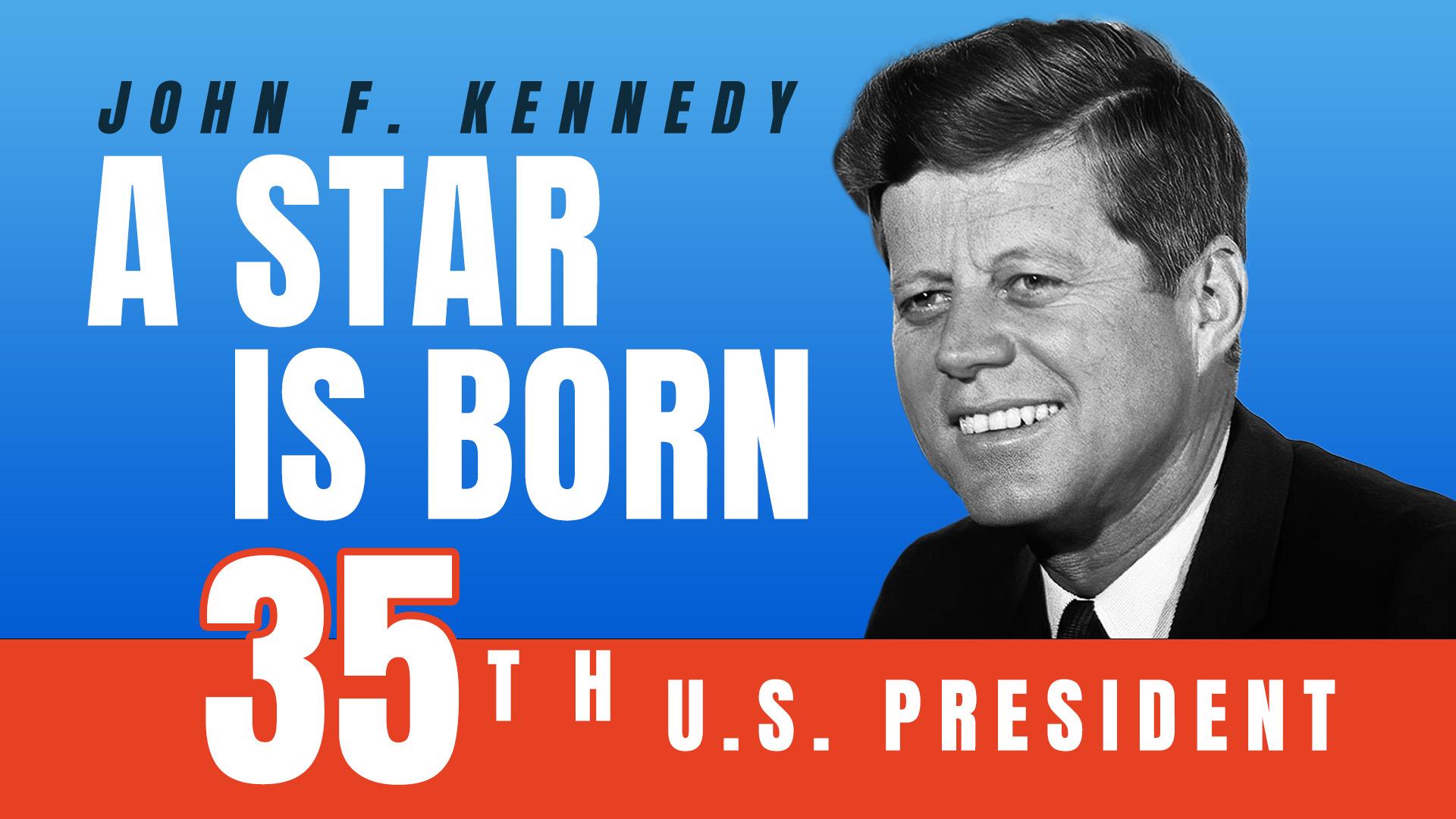
John F. Kennedy: A Star Is Born
With his movie star looks and beautiful young family, John F. Kennedy was the picture-perfect president of the television era. But some critics said he was too young and inexperienced to be president in a dangerous Cold War world. Were they right? Larry Elder recounts the remarkable political ascent of JFK.
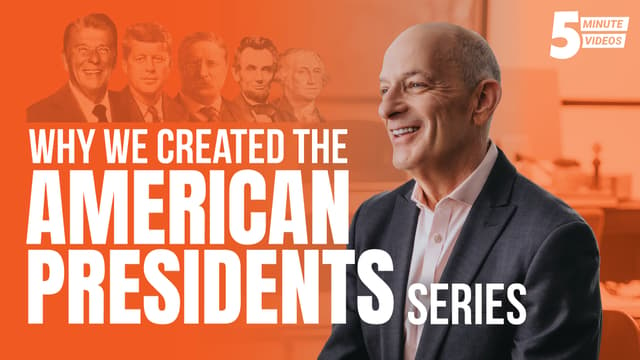
This video is part of the American Presidents 5-Minute Video Series.
Once you've seen them all, take our Presidents Quiz.
Topics
Hosted By
 Larry Elder
On the morning of November 22, 1963, the United States was at the peak of its power. It dominated the world in every respect—militarily, economically, and culturally. Nothing seemed out of America’s reach, even the moon.
The man guiding the ship of state was movie-star handsome, youthful (only 46), and always seemed to know what to say and how to say it.
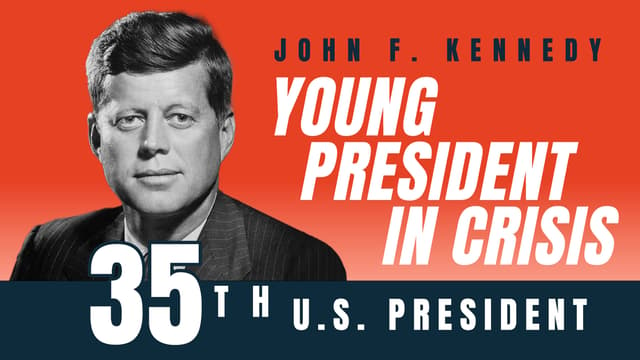
That man was John F. Kennedy, the 35th president of the United States.
JFK was born just outside of Boston on May 29, 1917, the second of nine children. His father, Joe Kennedy, made a fortune trading stocks, selling whiskey, and financing movies. A noted philanderer, his affair with actress Gloria Swanson was the stuff of Hollywood legend.
He parlayed his financial success into political success, eventually serving as Franklin Roosevelt’s ambassador to Great Britain.
Joe expected much from his sons, but most especially from his eldest son, Joe, Jr.
When young Joe died in Europe during World War II, the burden of the father’s ambitions fell on his second son.
But there was no certainty that John, known to his family and friends as “Jack,” would survive the war.
Some months earlier, when his PT boat was rammed by a Japanese destroyer in the South Pacific, it was assumed that he and his entire crew had been killed. But through Kennedy’s heroic efforts, all but two were rescued.
For his bravery, Jack was awarded the Purple Heart.
Living up to his father’s expectations and using the connections of his maternal grandfather, John “Honey Fitz” Fitzgerald—a former mayor of Boston—Kennedy was elected as a Democrat to Congress in 1946.
Kennedy was just 29.
But he already had his eyes on a bigger prize. In 1952 he was elected to the U.S. Senate.
One year later, he married the beautiful socialite, Jacqueline Bouvier. Their wedding was the major event of the 1953 social season. There were 700 guests at the ceremony and 1,200 at the reception.
With his new wife and new Senate seat, Kennedy was making all the right moves. Bored by the endless committee meetings in Congress, he focused on increasing his national profile, traveling around the country, giving speeches, and appearing on talk shows to discuss current events.
With his distinct Boston accent, he developed a dynamic speaking style which, coupled with his good looks and beautiful young family, made him picture-perfect for the new age of television.
He positioned himself as a centrist on domestic policy and a staunch anticommunist on foreign policy.
By 1960, he was ready to make his presidential move. While his critics argued that, at age 43, he was too young and inexperienced for the nation’s highest office, Kennedy argued that it was time for a new generation to take charge.
With his shrewd and loyal brother Bobby running his campaign, Kennedy won the Democratic nomination. But the race against Richard Nixon, Dwight Eisenhower’s vice president, would prove to be much tougher.
Two things stood in his way. One was his Catholic faith: More than a few Americans wondered whether Kennedy would be more loyal to the Pope than to the Constitution. The other was the charge that he was much less experienced than his opponent.
He dealt with the first problem by confronting it head-on.
“No one asked me my religion in the South Pacific,” was his mic-drop response. It worked.
He dealt with the second objection by debating Nixon four times – the first televised presidential debates ever. Positioning himself to the right of Nixon on the communist threat, his command of the facts was impressive.
Even more impressive was how he looked on camera: cool, collected, and charismatic. Nixon, in contrast, looked tired and pale.
Still, with all that, Kennedy barely managed to squeak out the win.
It was so close that many urged Nixon to contest the results, but Nixon refused. He didn’t want the country distracted in the middle of the Cold War.
Kennedy got off to a great start with one of the most stirring inaugural addresses in American history. The most famous line was, “Ask not what your country can do for you – ask what you can do for your country.”
Lines like this inspired millions, not only in the U.S. but around the world, and helped to create the Kennedy mystique.
There were muscular lines too, such as America would “pay any price, bear any burden, meet any hardship, support any friend, oppose any foe to assure the survival and success of liberty.”
But lofty rhetoric, Kennedy soon learned, was no substitute for rigorous planning.
His first attempt to promote liberty was a disaster—the April 1961 Bay of Pigs invasion to oust Cuban communist leader Fidel Castro. Concocted by the CIA, it was supposed to look like a homegrown Cuban uprising, but nothing went as planned and Kennedy soon became disenchanted.
When the CIA-trained invaders, Cuban exiles, failed to secure a beachhead, Kennedy refused to order air support.
Many of the exiles were slaughtered. The rest were captured by Castro’s military.
It was a humiliating defeat and bolstered the critics who said that he was too young and inexperienced to be president.
Were they right?
The nation wouldn’t have to wait long to find out.
I’m Larry Elder for Prager University.