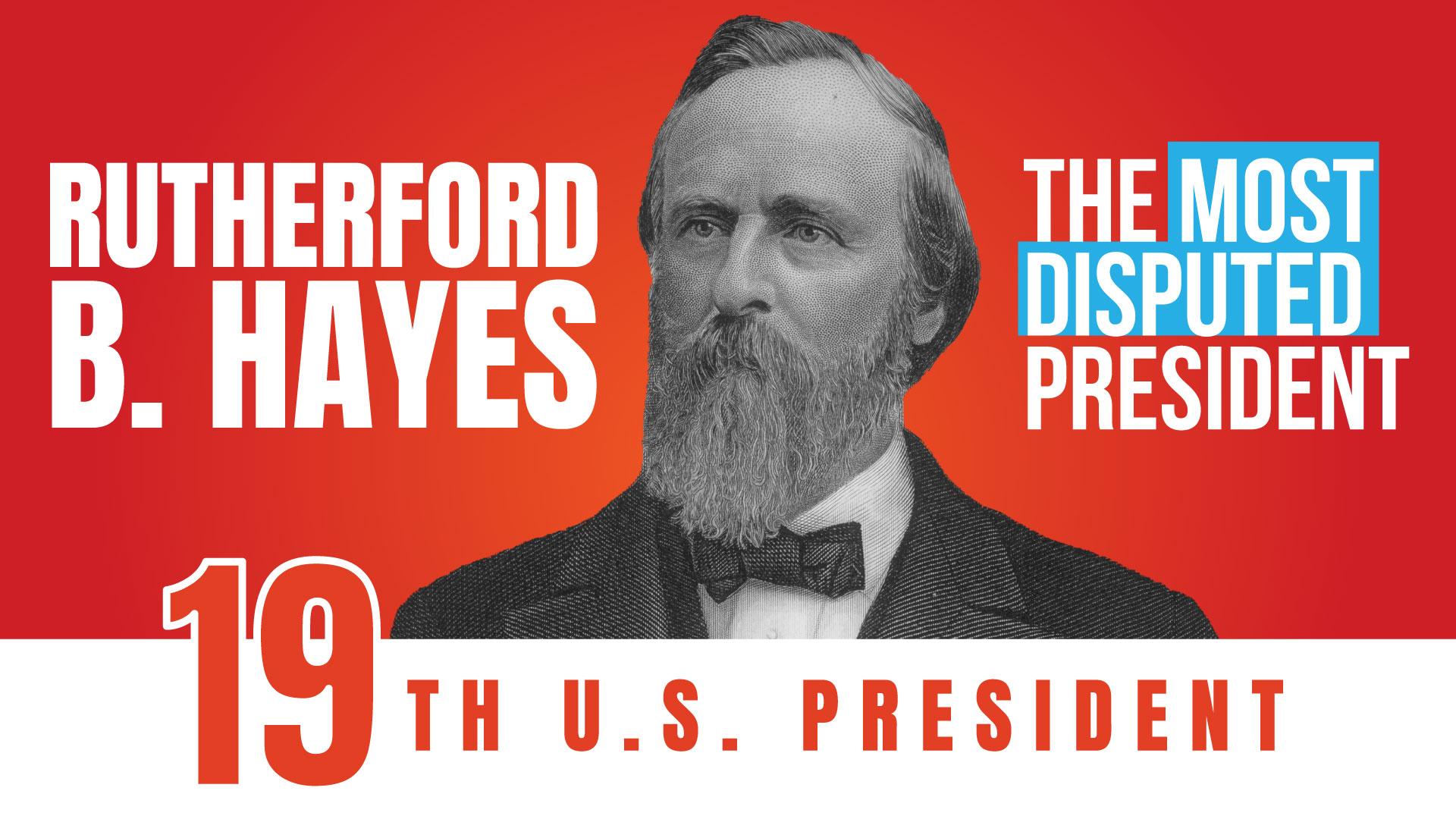
Rutherford B. Hayes: The Most Disputed President
The election of Rutherford B. Hayes remains the single most disputed presidential outcome in American history—even more than the elections of the 21st century. What happened, and what were the consequences?
This video is part of the American Presidents 5-Minute Video Series.
Once you've seen them all, take our Presidents Quiz.
Topics
Hosted By
 Jason R. Edwards
On election night 1876, Rutherford B. Hayes, the Republican candidate for president, went to bed firmly convinced he had lost.
Four months later, he walked into the White House as the 19th president of the United States. His ultimate victory remains the single most disputed presidential outcome in American history–more than Bush v. Gore in 2000, more than Trump v. Biden in 2020.
Hayes, the youngest of five children, was born on October 4, 1822, in a small town near Columbus, Ohio. His father had died two months earlier. His bachelor uncle, Sardis Birchard, a businessman and banker, became his guardian and surrogate father.
Like so many young Americans of his day, “Rud,” as he was called, was imbued with a tireless work ethic. He was a conscientious student, graduating from Kenyon College in Ohio in 1842 at the top of his class. Thanks to his uncle’s generosity, he graduated from Harvard Law School, where he also excelled.
By 1849, Hayes had started a successful law practice in the rapidly growing city of Cincinnati. Strongly opposed to slavery, he defended many runaway slaves in court.
When the Civil War broke out, Hayes was nearly 40, married, a father of three with a fourth on the way, and a leading figure in southern Ohio. He had everything to lose and nothing to gain by volunteering for the Union cause. But he did so anyway.
His leadership qualities were immediately recognized by his superiors and the soldiers under his command.
Hayes saw action at the Battles of Antietam, Winchester, and Cedar Creek, among others. Badly wounded in the first of those battles, he stayed on the field issuing orders. Had his men not carried him to safety, he would have died.
Entering the war without any military experience, he left it as a general. He also left it as a member of Congress, being elected by his fellow Ohioans in 1864.
In 1867, he resigned his congressional seat to run for governor of Ohio, his status as a war hero helping him carry the day.
After taking office in 1868, he pushed hard for black voting rights, first in his home state and then nationally by supporting the ratification of the Fifteenth Amendment. A popular governor, he was elected to two more terms.
With the 1876 election looming and the Grant Administration mired in financial scandals, the party needed a candidate free of any taint of corruption–and Hayes fit the bill.
But the election was an uphill battle.
First, Hayes faced a formidable opponent, the Democratic governor of New York, Samuel Tilden.
Second, the Republican Party had been losing votes in the South because the Democrats were making it increasingly difficult for blacks to vote.
The election indeed turned out to be a photo finish. The New York Times reported that Tilden had won 184 electoral votes–just one vote short of victory–while Hayes captured 181. The wildcards were South Carolina, Louisiana, and… Florida.
Sound familiar?
A stalemate ensued, with each side bitterly accusing the other of cheating. Without any precedent or guidance from the Constitution, Congress set up a commission to settle the issue.
Finally, in February 1877, after some of the nastiest mudslinging in American history, the commission decided for Hayes. Congress ratified the decision on March 2. But many Democrats never accepted the result as legitimate, and perpetually referred to Hayes as “Rutherfraud.”
The big issue facing the new president was the status of the South.
The war had been over for twelve years. The Democrats desperately wanted federal troops to be recalled from the region. But, those troops protected the rights of the freedmen.
Hayes had two choices: keep the troops in, or pull them out.
Hayes pulled them out, but only after securing assurances from the southern governors that black voting and property rights would be protected. But perhaps he was naive. The governors largely failed to hold up their end of the bargain.
Should Hayes be blamed for the unsatisfactory results of Reconstruction and the subsequent rise of racist Jim Crow laws? He frequently is, but should he be? The country wanted to put the war behind it. There was little popular will for the occupation to continue and it’s doubtful that Congress would have consented to keeping federal troops in the South for much longer, no matter who was president.
It wasn’t that Hayes was afraid to use force. He used it to put down a massive, nationwide rail strike in 1877, the first president to use the military in a labor dispute. But that was a specific, one-time action. Occupying a whole region of the country indefinitely was simply not sustainable.
Sectional issues were not Hayes’s only concern. A committed advocate of civil service reform, he helped to restore honesty to government operations. And under his steady hand, the economy found its footing after suffering years of depression following the Panic of 1873.
In fact, Hayes seemed a shoo-in for re-election, except for one thing: he was committed to the idea that presidents should only serve one term. So, despite any attempts to draft him, he adamantly refused. Afterward, he said, “Nobody ever left the Presidency with less regret [and] less disappointment[.]”
I’m Jason Edwards, Professor of History and Humanities at Grove City College, for Prager University.