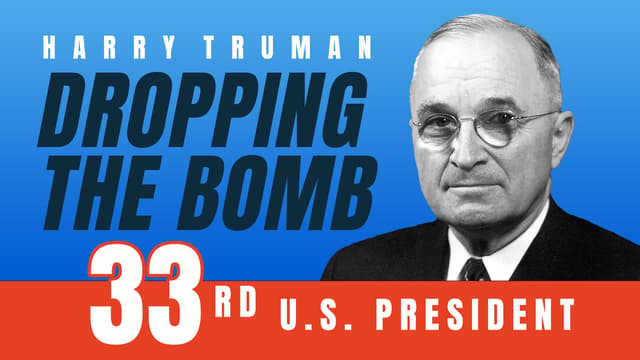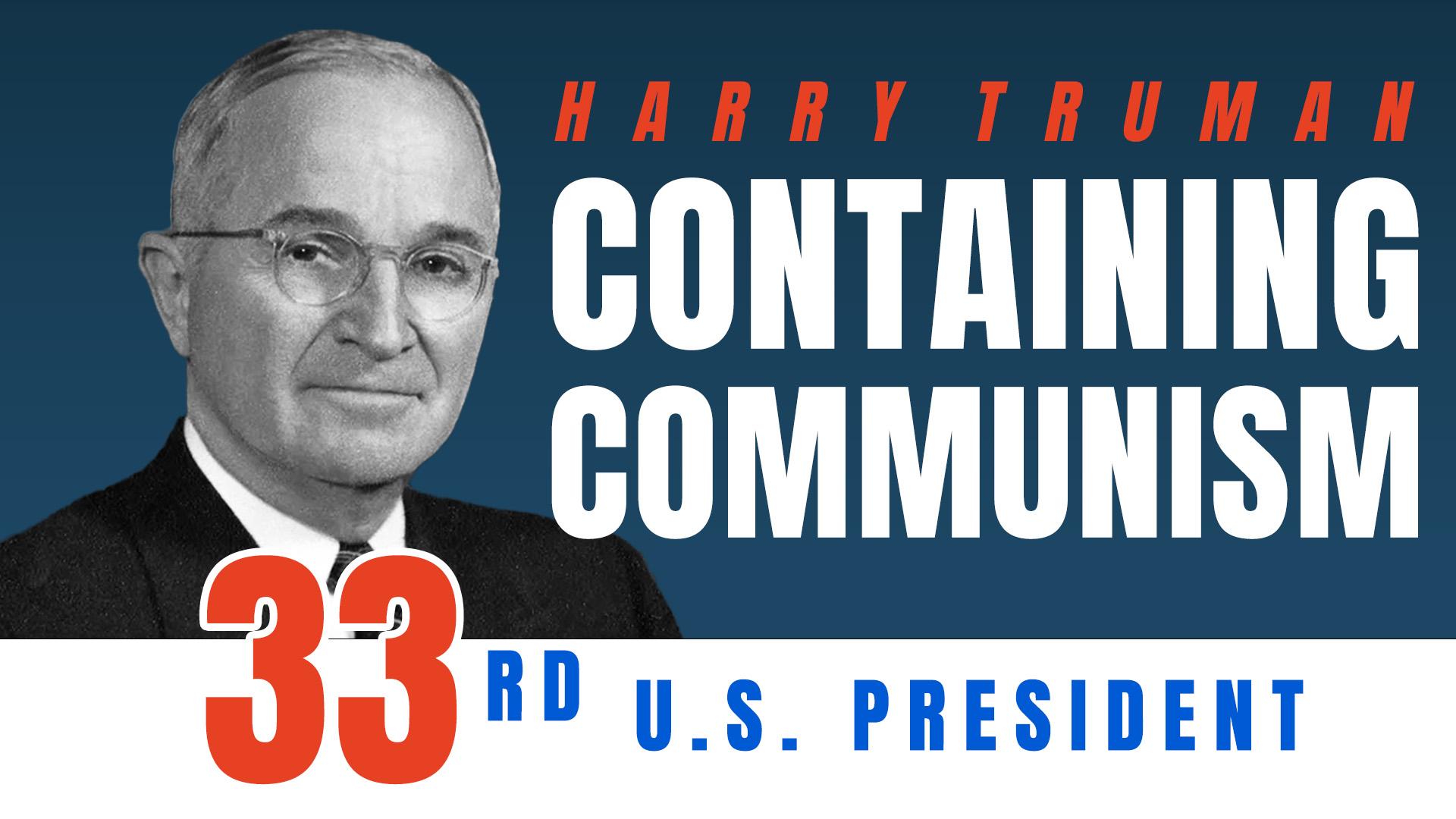
Harry Truman: Containing Communism
Harry Truman led America to victory in World War II, but a new challenge was looming: the spread of communism across the globe. Would America’s 33rd president retreat into isolation, or fight the new threat head-on? Elizabeth Spalding, senior fellow at Pepperdine University School of Public Policy, describes his decision and what it cost him.
This video is part of the American Presidents 5-Minute Video Series.
Once you've seen them all, take our Presidents Quiz.
Topics
Hosted By
 Elizabeth Spalding
Upon learning of Franklin Roosevelt’s death on April 12, 1945, Harry Truman was reported to have said, “I felt like the moon, the stars, and all the planets had fallen on me.”
It was only a slight exaggeration.
The decisions the 33rd president had to make in just the next four months would have crushed any normal person.
Managing the German surrender in May 1945, authorizing the use of the atomic bomb to end the war in the Pacific in August, and converting the economy from wartime to peacetime are just a sample of what he had to contend with.
It was also becoming clear that the Soviet Union was not going to be a partner in the postwar world. It was going to be an adversary bent on world domination.
Truman wasn’t about to let this happen.
The first order of business was to save Western Europe. Eastern Europe was already gone.
As Winston Churchill vividly described in March 1946, “...an iron curtain has descended across the Continent.”
Truman agreed with Churchill, committing the United States to containing the Soviet threat. This became known as the Truman Doctrine.
Around the same time, Truman’s most trusted advisor, Secretary of State George Marshall, returned from Europe deeply concerned. He found Germany in ruins, England bankrupt, and France and Italy in chaos. Marshall reported it would take an unprecedented effort by the United States to breathe life into a moribund European economy. Failure to do so would hand over the Continent to the Soviets.
Truman authorized $13 billion in economic aid, a phenomenal figure for the time. This became known as the Marshall Plan. And indeed, it accomplished its goal: the recovery of Europe, thwarting Soviet expansionism.
In May 1948, a new crisis emerged: a war was raging between the Arabs and the Jews. The UN was looking for a solution. The question before Truman: should the United States recognize the new state of Israel?
Marshall argued “No.” It would further antagonize Arab states. But Truman saw a moral issue – the Jews had suffered enough over the centuries, most especially in the recent Holocaust – as well as a Biblical and historical issue – this was the Jews’ ancient homeland.
Thanks to Truman, on May 14, 1948, America became the first country to recognize the Jewish state.
One month later, Soviet leader Joseph Stalin took aim at the Marshall Plan. He cut off access to the free, western half of Berlin, located deep in Soviet-dominated East Germany.
The communist dictator was gambling that the American president wouldn’t defend the city, but Truman called his bluff. “We stay in Berlin. Period.”
Truman ordered an airlift that, over fifteen months, completed more than 250,000 flights and delivered over 2 million tons of food, fuel, and supplies to beleaguered Berliners.
Stalin backed down.
One might therefore assume that Truman would have had an easy time winning the presidency in the upcoming 1948 election.
But so much economic turmoil at home – one labor strike after another – and one crisis after another abroad made it difficult for Americans to appreciate Truman’s accomplishments.
He didn’t help himself by insisting that the Armed Forces and the federal judiciary be racially integrated. These were controversial decisions, but Truman thought they were right.
Facing a popular Republican opponent, New York Governor Thomas Dewey, and with his own party split by pro-segregationists and progressives, Truman was in a very deep hole.
Undaunted, he embarked on a whistlestop campaign across the country, giving fiery speeches and traveling some 22,000 miles — almost the equivalent of circling the globe.
It all seemed to no avail. When Newsweek polled 50 pundits three weeks before the election, everyone predicted a Truman defeat – which made his upset victory all the sweeter, a moment immortalized by his gloating over a Chicago Tribune headline that prematurely declared, “Dewey Defeats Truman.”
Truman hardly had time to catch his breath before the next crisis.
The following year, 1949, the Soviets acquired the atomic bomb, and the communists took over China, the most populous country in the world. Fortunately, that April, Truman had overseen the creation of the North Atlantic Treaty Organization, to defend against the Soviet threat.
Then, in June 1950, the North Korean communists invaded South Korea, seeking to impose their totalitarian system over the entire peninsula.
It was another agonizing decision: to yield Korea and, consequently, much of Asia to the communists or fight.
Truman chose to fight. The price was very high. Almost 37,000 Americans died in a conflict that lasted three years. South Korea was saved. And America’s commitment to defending freedom could no longer be questioned. But it cost Truman his popularity.
When he left office, his approval rating was 22%, the lowest in American history.
It would take decades before Truman’s reputation recovered. Churchill, who knew him well, never had any doubts about the man from Missouri’s place in history, declaring in early 1953 that Truman “more than any other man… saved Western civilization.”
I’m Elizabeth Spalding, senior fellow at Pepperdine University School of Public Policy and author of The First Cold Warrior, for Prager University.