Franklin Pierce: A Torn President in a Torn Country
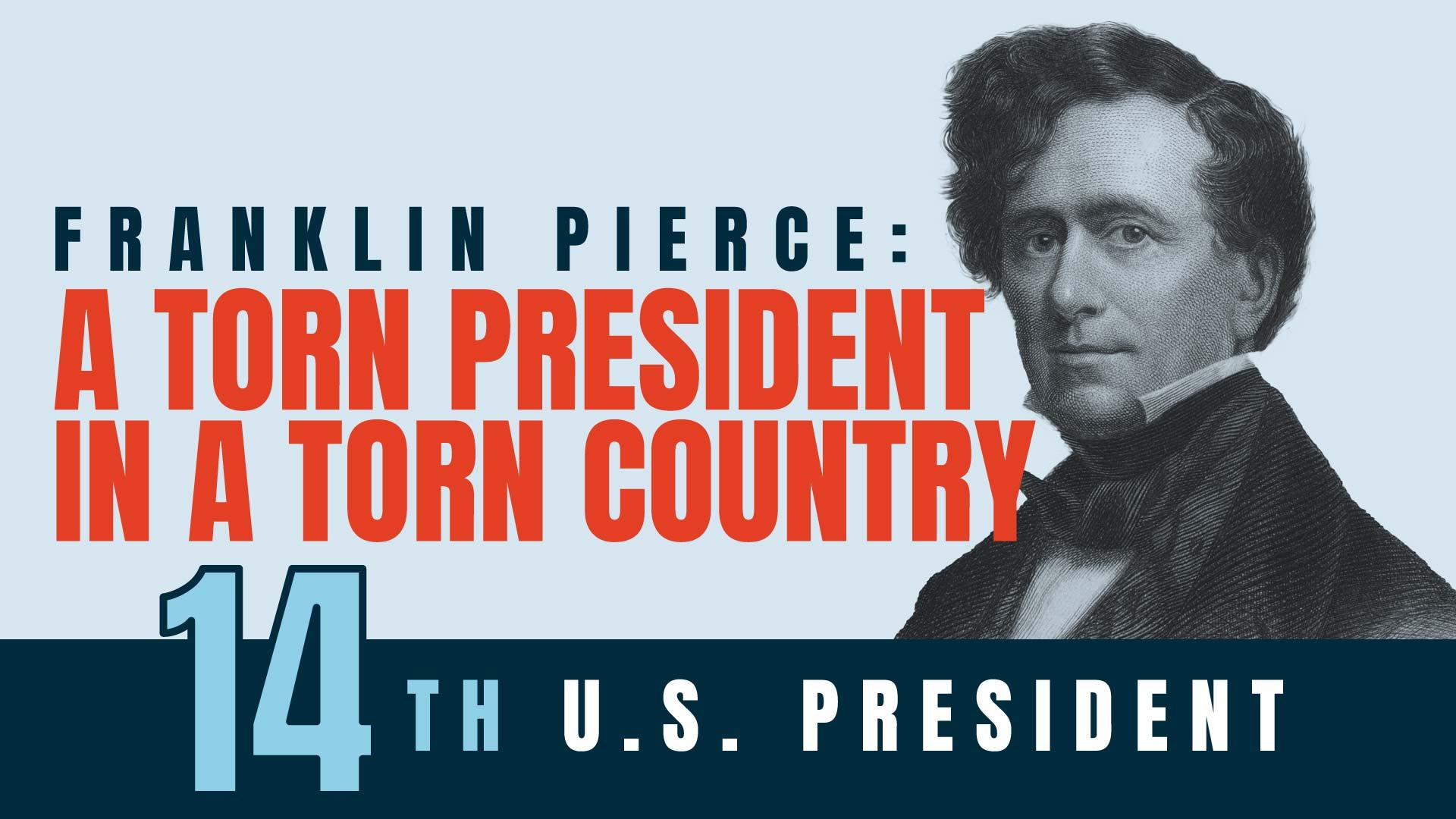
Franklin Pierce, America’s 14th President, had two simple goals: keep his party together and keep his country calm through the storm of the slavery debate. Simple, but not easy. Joseph Fornieri, Professor of Political Science at the Rochester Institute of Technology, explains how Pierce’s leadership (or lack thereof) pushed America toward civil war.
This video is part of the American Presidents 5-Minute Video Series.
Once you've seen them all, take our Presidents Quiz.
Topics
Hosted By
 Joseph Fornieri
By all accounts, Franklin Pierce, the 14th President of the United States was a fine person: charming, caring, deeply empathetic. These are all characteristics you want in a friend—and Pierce had many—but they don’t necessarily make for a strong leader. Unfortunately, Pierce’s appointment with history came when such a leader was sorely needed. Try as he might to fill the role, Pierce couldn't do it.
Franklin Pierce was born November 23, 1804, in Hillsborough, New Hampshire. Raised in the shadow of his prominent father, Benjamin, a Revolutionary War hero, Franklin began his political career shortly after graduating from Bowdoin College in 1824.
He was a political natural. In addition to his good looks, he was an eloquent speaker. Gifted with a photographic memory, he almost always spoke without notes, connecting directly to his audience. He won his first election in 1829 to the New Hampshire State Legislature. In 1832 he was elected to Congress, and by 1837, he was a US senator, the youngest member at the time.
The overriding political issue of the day was slavery. To understand Pierce, we need to understand his position on this issue. While not a slave owner himself, Pierce believed that the Constitution committed the federal government to protecting slavery. Not surprisingly, Pierce’s position endeared him to his Southern colleagues. This support was key to his political career.
By 1842, Pierce was ready to leave Washington. He needed to make more money and care for his chronically ill wife. He did both without ever truly leaving politics. In fact, he became more influential during this period by becoming the Democratic Party boss of his home state of New Hampshire. He might have happily stayed there were it not for the outbreak of the Mexican-American War in 1846.
The Americans won that war decisively, acquiring vast new territories in the west, including California. But the victory also had the unintended consequence of stirring up the slavery issue. What would happen to these new territories? Would they become slave or free?
After fierce debates, the Compromise of 1850 resolved the issue—or so it seemed. California would be admitted into the union as a free state while the status of the new territories of New Mexico and Utah would be determined at a later, unspecified time. And that’s where things stood when Franklin Pierce, through an improbable series of circumstances, became America’s 14th President.
When the Democratic Convention opened in June 1852 in Baltimore, Pierce was not even a dark horse candidate; he wasn’t a horse at all. But when the convention repeatedly deadlocked between Michigan Senator Lewis Cass, former Secretary of State James Buchanan, and Illinois Senator and the mastermind of the Compromise of 1850, Stephen Douglas, Pierce saw his chance. On the convention’s 49th ballot, Pierce emerged as the compromise candidate everyone North and South could get behind. With the opposition party, the Whigs, hopelessly divided between their own northern and southern wings, Pierce easily took the White House.
Pierce’s goal for his presidency was to do everything he could to keep the Democratic Party united and the country calm. As modest as this sounds, it proved very difficult to achieve.
To keep his party united, he appointed Northerners and Southerners to key government posts. Jefferson Davis of Mississippi, for example, was his secretary of war, and Caleb Cushing, a Massachusetts moderate, was his Attorney General. To keep the country calm, Pierce strongly endorsed the 1850 Compromise.
And then one Sunday in January 1854, it all began to unravel.
Stephen Douglas showed up at the White House with a new idea he promised would resolve the slavery issue once and for all. It was deceptively simple: let new territories—future states—determine by popular vote—Douglas called this “Popular Sovereignty”—whether they would be slave or free. This principle became the core of the Kansas-Nebraska Act, perhaps the most disastrous piece of legislation in American history. It repealed the Missouri Compromise of 1820 that banned slavery above latitude 36 30, thereby opening up the rest of the Louisiana Territory to slavery. And it shattered the tenuous peace achieved by the 1850 Compromise.
Almost immediately, anger, often violent, exploded across Kansas, across Congress, and across the nation, as both sides—free and slave—battled to control that state’s destiny. From 1854 on, in a glimpse of the conflagration to come, “Bleeding Kansas” was a virtual war zone.
Why did Pierce agree to Douglas’ plan and help him push it through Congress? One answer is that Douglas was the stronger personality. Pierce simply lacked the fortitude to say no. But there’s a second possible answer: Pierce sincerely believed that the Kansas-Nebraska Act would work and reunite the country. It did just the opposite, of course, and it cost him a second term. He couldn’t even win his party’s nomination in 1856.
Four years and one more failed president later, the country would be engulfed in a catastrophic war. It would take an entirely different kind of leader to save the nation.
I’m Joseph Fornieri, professor of Political Science at the Rochester Institute of Technology and Director of The Center for Statesmanship, Law, and Liberty, for Prager University.