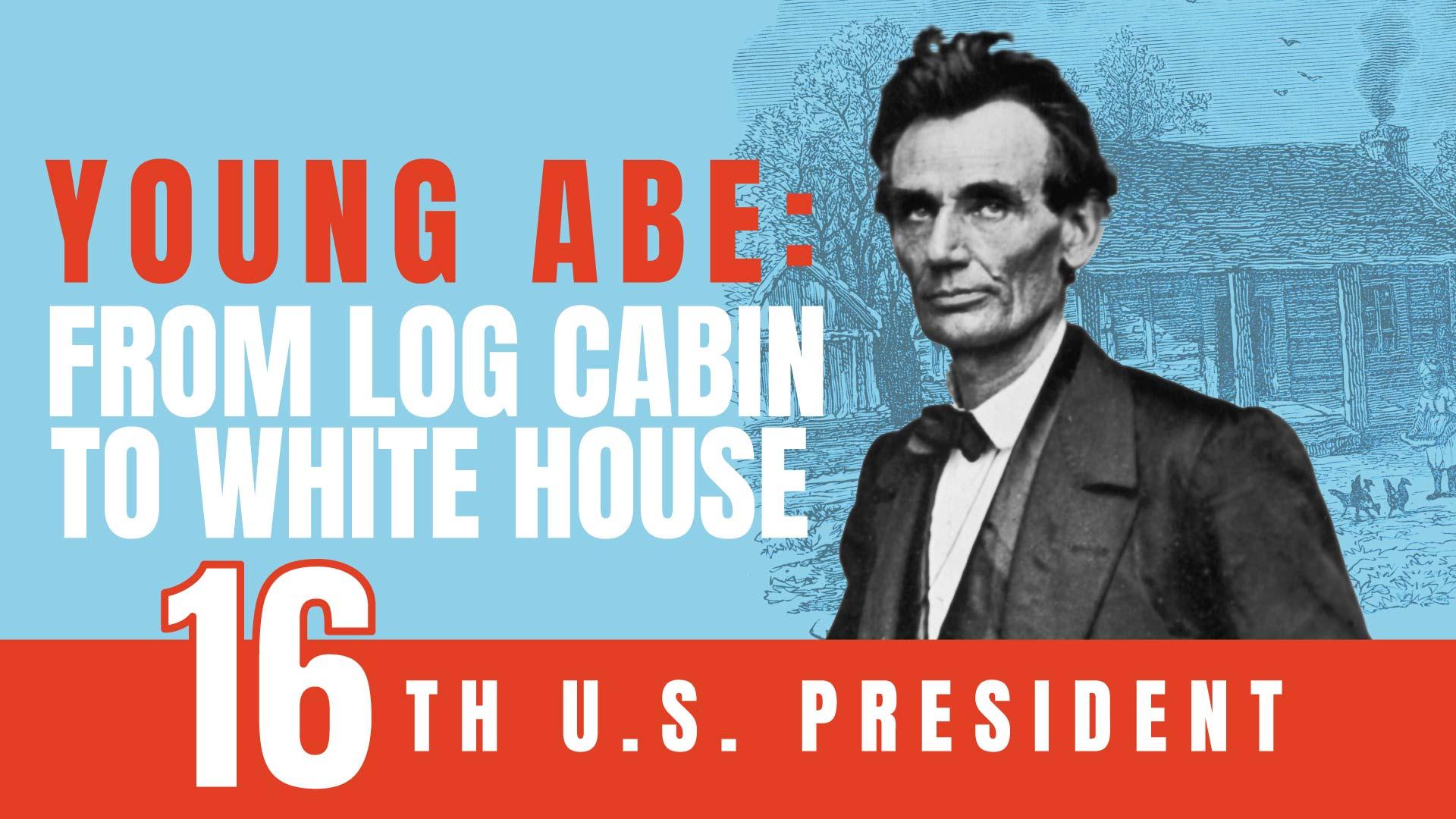
Young Abe: From Log Cabin to White House
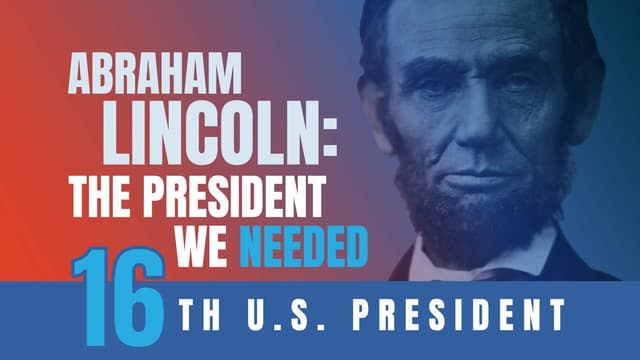
Abraham Lincoln was born in a log cabin in the middle of nowhere. He had almost no formal schooling but rose to become the 16th President of the United States. Allen Guelzo, author of Abraham Lincoln: Redeemer President, shares the remarkable journey of this remarkable man.
This video is part of the American Presidents 5-Minute Video Series.
Once you've seen them all, take our Presidents Quiz.
Topics
Hosted By
 Allen Guelzo
If the best of America could be embodied in one man, that man would be Abraham Lincoln, the 16th President of the United States.
Born on February 12, 1809, Lincoln lived his early years in a log cabin with a dirt floor. He described his childhood and adolescence in Kentucky and later Indiana in bleak terms, as “the backside of this world.”
His father, Thomas Lincoln, didn’t see much practical value in formal education and his son received almost none.
But young Lincoln’s instincts pointed in an entirely different direction. He devoured every book he could get his hands on. And, aided by a near-photographic memory, he retained everything he read. His goal was always (what he called) “improvement.”
At age 19, now 6 feet 4 inches tall, he worked on flatboats carrying cargo down the Mississippi river finally settling as a store clerk in New Salem, Illinois. There, Lincoln quickly established a reputation for good humor, scrupulous honesty, and a fierce determination “to make the most of himself.”
In 1832, following a stint in the state militia, he decided to pursue a legal career.
Like many lawyers, he was drawn to politics. In 1834, he won election to the state legislature.
Lincoln endorsed the tenets of the Whig party, which had been organized by Senator Henry Clay as a breakaway from the dominant Democratic party. Clay and the Whigs supported policies which would build national commercial infrastructure like roads and canals, create a national bank to stimulate investment and expansion into the west, and build tariffs around struggling American industries to protect them from foreign competition.
For many Northern Whigs like Lincoln, slavery was also an issue; and in 1837, Lincoln made his first public statement against slavery, condemning it as “founded on injustice and bad policy.”
In 1846, Lincoln was elected to Congress to represent the newly created Seventh District in central Illinois. What he hoped would be the start of a career in national politics quickly fizzled. Lincoln criticized President James Polk, a Democrat, for goading Mexico into war. It was a principled but unpopular stance and cost him re-election.
He returned to Illinois in 1849 at the end of his solitary term to devote himself to his law practice. He quickly established himself as one of the top attorneys in the state. His ability to master the facts of a case no matter how complex and then weave those facts into a coherent narrative—always leavened by his inexhaustible supply of funny stories—made him irresistible to juries.
But in 1854, he was pulled back into politics. The passage of the Kansas-Nebraska Act, which would open the door to the expansion of slavery into the new territories west of the Mississippi River, “aroused him,” he said, “as he had never been before.”
In 1856, Lincoln found a new political home with a new anti-slavery party, the Republicans. Running as a Republican for the first time, he contested the U.S. Senate seat held by Illinois’ favorite Democratic son, Stephen Douglas, who had authored the Kansas-Nebraska Act.
What was supposed to be an easy win for Douglas turned into a hard-fought campaign. In seven open-air debates across the state—sometimes before as many as 15,000 people—the two men hammered each other over the slavery issue. Lincoln narrowly lost the election but won wide recognition as a rising star.
His star burned even brighter after he gave a speech at Cooper Union in New York City. There he articulated how the original intent of the Founders had been for the steady elimination of slavery.
The time had now come to act on that intent.
When the Republican National Convention met in Chicago in May 1860, it was assumed that William Seward, a prominent senator from New York would be the party nominee. But Lincoln, to the delight of the “hometown” Illinois crowd, slipped past him on the third ballot.
The Democrats, in contrast, could not unite behind one candidate. They splintered into two factions, a moderate one led by Lincoln’s old nemesis, Stephen Douglas, and a radical pro-slavery one led by John Breckenridge of Kentucky. Lincoln’s victory was thus assured. On election day, November 6, 1860, Lincoln received only 39% of the popular vote, but 59% of the Electoral College.
The Southern States, however, refused to accept this outcome.
The civil war the country had avoided for six decades—through one compromise after another—could be avoided no longer.
The heavy burden of leading the nation through that war would fall on the broad shoulders of a man about whom few knew anything, but many would soon come to revere.
I’m Allen Guelzo, author of Abraham Lincoln: Redeemer President, for Prager University.