People Over Climate
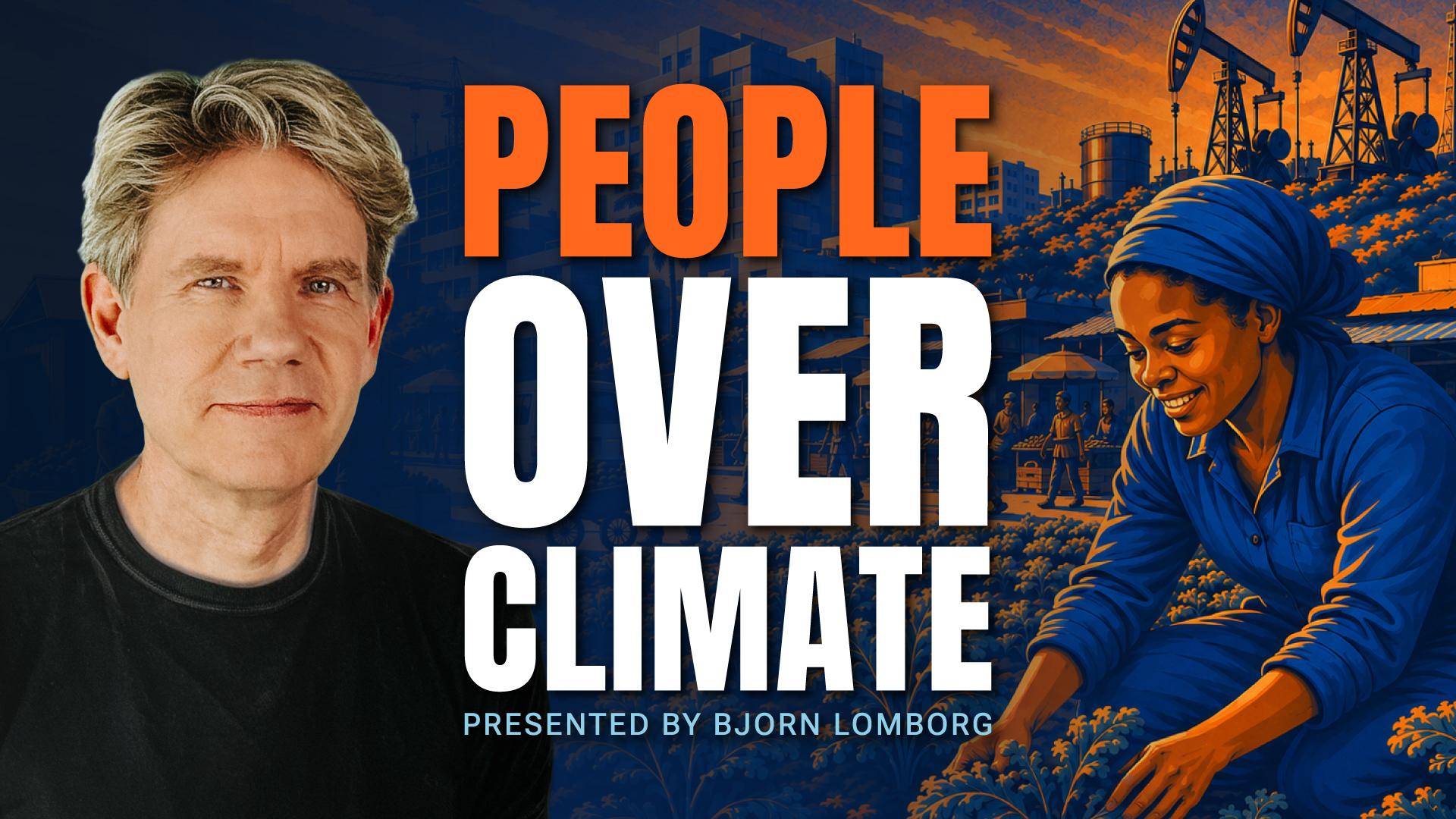
We are about to spend trillions of dollars to make the planet slightly cooler by 2100. For a fraction of that, we could save millions of lives today, fighting malaria, hunger, and disease. One approach barely moves the needle. The other transforms lives for the better right now. So which should come first? Copenhagen Consensus president and Hoover Institution Fellow Bjorn Lomborg investigates.
Topics
Hosted By
 Bjorn Lomborg
Here’s an idea: instead of spending trillions of dollars trying to slightly lower global temperature in a hundred years; let’s first spend a fraction to save millions of lives right now.
Every year, we use more energy than the year before. Why? Because energy makes the world better. It keeps us cool in summer and warm in winter, transports us, and lights the world. Energy allows us to escape poverty.
We increasingly get electricity from solar and wind. But of all energy — not just electricity — solar and wind contributed less than 3% in 2024. More than 80% of our energy comes from fossil fuels — coal, oil, and natural gas. Even by 2050, according to the International Energy Agency, solar and wind will provide less than 16%.
Yet, living on planet Earth is getting safer and cleaner. Over the past century, deaths from climate-related disasters — storms, floods, droughts and wildfires — have declined by more than 97%. This has nothing to do with climate and everything to do with development and innovation. Many more people have access to air conditioning, better housing, and advanced weather warning systems.
There has also been great progress in reducing air and water pollution. When Earth Day debuted in the 1970s, the world faced grim challenges: highly polluted rivers catching fire and cities choking on smog, especially in the industrialized West. Today, those cities are dramatically cleaner, and the risk of dying from air pollution has declined by 70% in three decades.
Pollution is mostly a product of poverty. 90% of air pollution deaths are in low- and middle-income countries. But prosperity means people can afford to improve their environment. In these countries, air pollution death risk has nearly halved since 1990. Almost none of this resulted from the trillions spent on green energy.
If you want a world better for the environment — cleaner air and water, more forests— encourage the whole world to break free of poverty. And if you want a world better for people — less disease, hunger, and better education — again, encourage the whole world to break free of poverty.
This requires much more energy, much of it from fossil fuels. It is easy in the rich world to think the poor just need a solar panel. But even “green” Germany gets 79% of its energy from fossil fuels. The average German uses 200 times as much fossil fuel energy as the average person in the poor Democratic Republic of Congo. Africans want to live like Germans do.
Of the money dedicated to help poor nations, the World Bank and similar organizations now tragically waste almost half on financing climate projects. We can do much better.
Together with the Copenhagen Consensus, I’ve worked with over a hundred top economists – including Nobel Prize winners – to find the policies that do the most good per dollar spent. We found that focusing on the 12 best policies would cost just 35 billion dollars a year. They would save 4.2 million lives every year and generate 1.1 trillion dollars in economic benefits every year.
These policies would be hundreds of times more efficient than current climate policies, and hundreds of times cheaper.
Each year, for just 1.1 billion dollars, we could fight malaria, preventing 200,000 deaths. For 2.8 billion dollars, we could dramatically cut deaths around childbirth — 166,000 mothers and 1.2 million infants could be saved.
Another 1.7 billion dollars could deliver childhood vaccines to the most marginalized and save half a million kids annually. We could also combat hunger: 5.5 billion dollars on agricultural research and development will increase food yields by another 10%, cutting hunger for a hundred million people.
Billions of dollars, not trillions, will achieve these phenomenal results.
Chasing “Net Zero” — a world without fossil fuels — does hardly anything to improve the lives of real people suffering now. Rich-world climate policies will cost trillions of dollars but even if all the rich world goes net-zero by 2050, the UN’s own climate model shows it will cut temperatures by less than 0.2 degrees Fahrenheit in 2100.
That’s because most future emissions will come from China, India and Africa. They are understandably more concerned about poverty alleviation than climate change. For them, more energy means people can cook and heat their homes with natural gas instead of polluting their homes by burning wood or animal dung. It means refrigerators to store food, tractors for agriculture, and machinery for industry.
We should address climate change, but not in the costly and ineffective way we do now, and not at the expense of the poor. The smart policy is to invest in green energy R&D. This will be much cheaper than current policies. And we’ll eventually fix the climate without sacrificing the vulnerable.
If we want to make the world better, let’s focus on doing the best things first.
I’m Bjorn Lomborg, president of the Copenhagen Consensus, visiting fellow at Stanford University’s Hoover Institution, and author of Best Things First for Prager University.