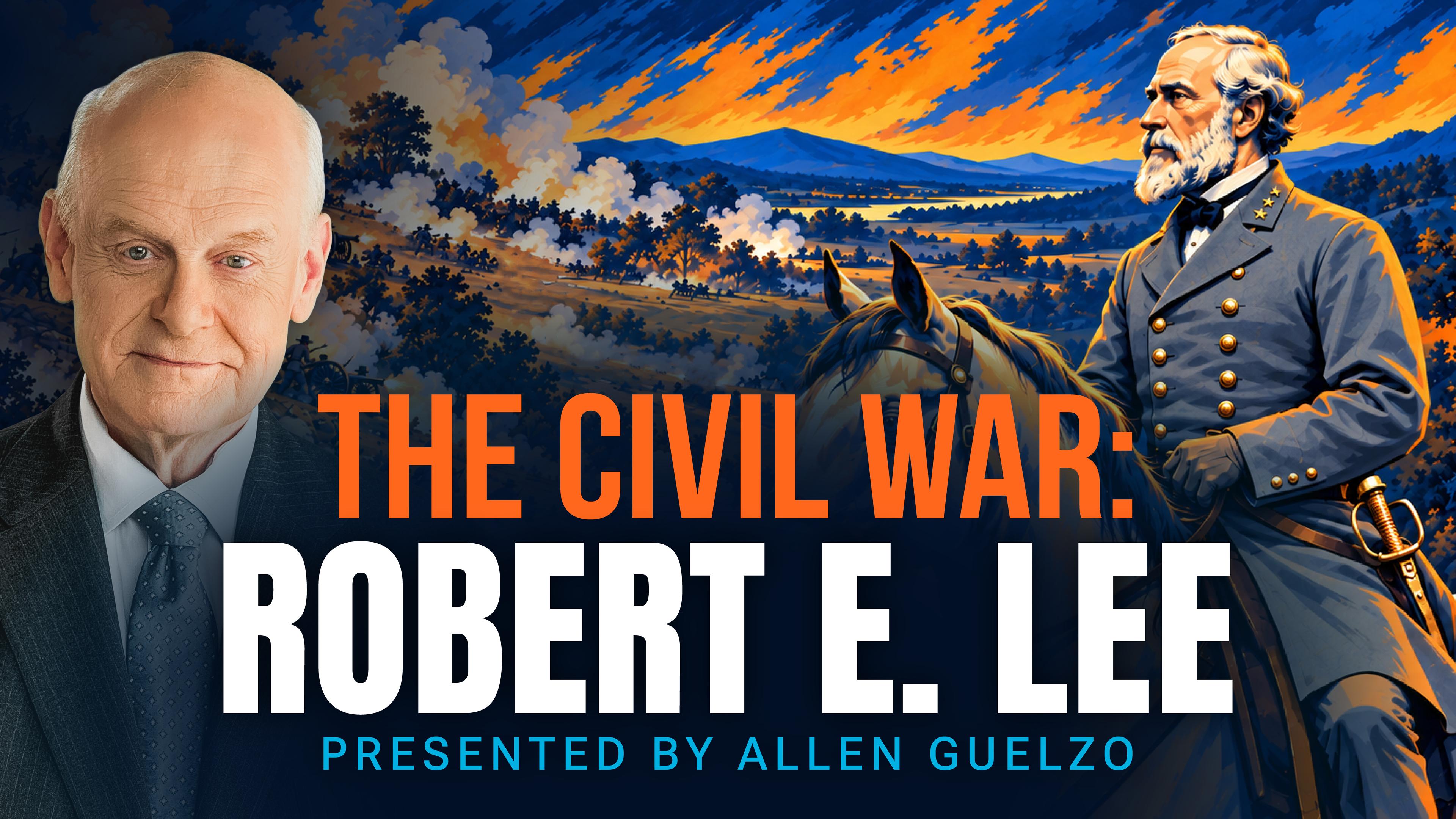
The Civil War: Robert E. Lee
On the eve of the Civil War, Robert E. Lee received from President Abraham Lincoln the offer of a lifetime: command of the United States Army. But Lee turned Lincoln down. His loyalty to his state, Virginia, superceded his loyalty to the Union. It was one of the most fateful decisions in American history. Allen Guelzo, renowned historian and author of Robert E. Lee: A Life, tells the story.
Topics
Hosted By
 Allen Guelzo
When the American Civil War broke out in the spring of 1861, Col. Robert Edward Lee rejected one of the greatest offers ever made to an American soldier. Abraham Lincoln authorized a proposal that would have given Lee command of the United States army which would subdue the new, breakaway Southern Confederacy.
Instead, in one of the greatest refusals in American history, Lee threw in his lot with the Confederacy, and commanded an army which fought against the United States for four bloody years.
Robert E. Lee was born in Northern Virginia on January 19, 1807. There ought to have been a silver spoon in his mouth, since he was a relative of Richard Henry Lee, a prominent signer of the Declaration of Independence, and the son of the swashbuckling cavalry commander of the Revolution’s army, “Light-Horse” Harry Lee.
But hard realities undercut the silver-spoon image. After the Revolution, “Light-Horse Harry” lurched from one awful investment to another and eventually abandoned his family to escape his creditors.
Redeeming the good name of the Lees became young Robert’s obsession. He went to West Point (largely because it was free), graduated with almost perfect honors, and took up a commission in the elite Corps of Engineers.
He became the right-hand staffer of General Winfield Scott in the Mexican War, and his performance there moved Scott to declare that American “success… was largely due to the skill, valor, and undaunted energy of Robert E. Lee.”
Yet, even that image was surrounded by difficult questions. Lee deplored slavery; yet he married into a prominent, slaveowning family, the Custises of Arlington. In 1857, he wrote that slavery was “a moral & political evil…” But two years later, he ordered three slaves who ran away from his father-in-law’s estate to be whipped.
With the coming of the Civil War, Lee received the command offer of a lifetime. But he turned it down, arguing that he was a Virginian first and foremost. If Virginia was going to leave the Union, so was he – despite the fact that he had spent most of his army career living in other places, from New York to Texas.
Lee’s first military responsibility of the war was as an advisor to Confederate President Jefferson Davis. But in June 1862, Davis put Lee in charge of the defense of the Confederate capital of Richmond, Virginia, as it was threatened by a federal army.
Lee not only drove back the federal threat, but launched a counter-offensive across the Potomac River, briefly threatening even the federal capital in Washington.
Lee fended off two more Union campaigns into Virginia in December 1862, at Fredericksburg, and in May, 1863, at Chancellorsville.
By this point, many observers on both sides wondered if Lee was invincible. In the South, he was becoming a living legend.
But when Lee launched yet another strike northwards into Pennsylvania in the summer of 1863, the aura of invincibility cracked, and Lee and his Army of Northern Virginia were defeated at the battle of Gettysburg.
From that point, the fortunes of the Confederacy ebbed steadily. Lee struggled to shunt-aside fresh federal campaigns into Virginia in 1864. But this time, he could not prevent a Union army under Ulysses Grant from clamping a siege around Richmond that Lee predicted could only have one end.
In April, 1865, Lee and his army abandoned Richmond and bolted westward. But Ulysses Grant’s Federals hung close to their flanks, and on April 9th, Lee was finally cornered at Appomattox and offered to surrender. In one of the most unpredictably generous moments in American history, Grant paroled Lee’s entire army and sent them home.
Within a few weeks, the devastated Confederacy had evaporated.
If the Civil War marked Lee’s greatest failure, the postwar years were actually the moment of Lee’s happiest success. As a college president, he rebuilt Virginia’s war-ravaged Washington College, later Washington and Lee University, into a model for Southern higher education; and he called upon Southerners to forget resentment and embrace reconciliation.
But that wisdom has to be balanced against the terrible fact that the Confederacy was a rebellion against the Constitution, and even after the war, his public calls for reconciliation did not always match his private hope that black and white Americans would occupy sharply segregated spheres in public life.
That Robert E. Lee could, in the end, rise above the taint of defeat, is the most important tribute that can be paid to him. But the debit side of the equation ultimately defines Lee’s legacy. He used his military talents in the service of those who championed human bondage and against the Constitution he had once sworn to defend. The word – the only word for that -- is treason.
I’m Allen Guelzo, author of Robert E. Lee: A Life, for Prager University.