The Civil War: Attack on Fort Sumter
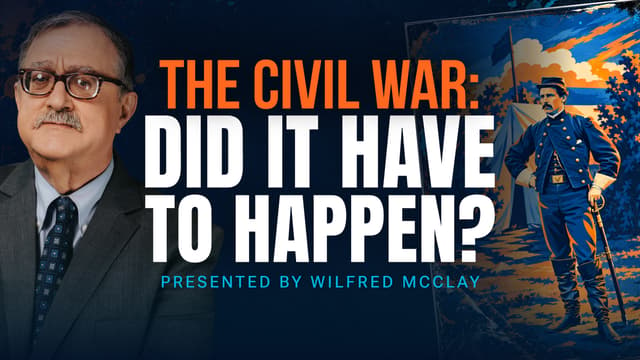
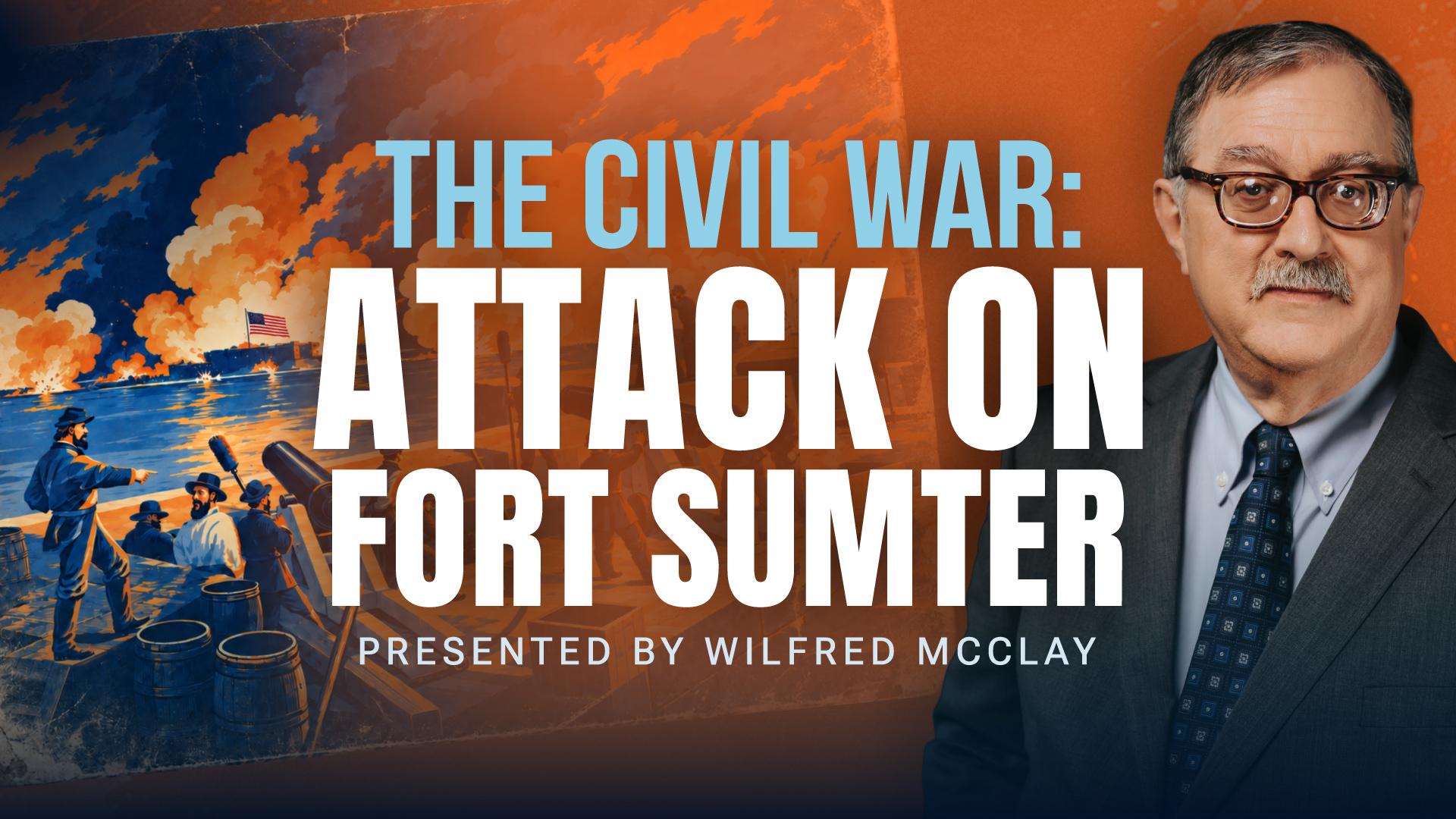
For decades, tensions over slavery, states’ rights, and the future of the Union had been building. By the spring of 1861, the country had reached its breaking point at Fort Sumter. One final question remained: who would fire the first shot? Wilfred McClay, author of Land of Hope, tells the story of how the Civil War began.
Topics
Hosted By
 Wilfred McClay
When Abraham Lincoln took the presidential oath of office on March 4, 1861, seven Deep South states had already seceded from the Union. South Carolina, Mississippi, Florida, Alabama, Georgia, Louisiana, and Texas came together to form the Confederate States of America.
As the new rebel government seized federal forts, armories, and navy yards across the South, the question on everyone’s mind was: Would the nation descend into civil war?
Ever the realist, Lincoln fully understood the gravity of the situation. Nevertheless, he harbored hopes for a compromise.
It worked in 1820. It worked in 1850. Maybe it could work again in 1861.
In his inaugural address, he insisted that he would avoid “bloodshed or violence… unless it be forced upon the national authority.”
But he also affirmed that, as the nation’s chief executive, he had a constitutional obligation to “hold, occupy, and possess the property and places belonging to the Government…”
These two goals created a terrible dilemma for the new president. Each new Confederate confiscation of federal property eroded the integrity of the Union. But an assertion of federal power risked war.
This dilemma became a full-scale crisis in Charleston Harbor, South Carolina. The Confederates had clamped a siege on the federal garrison at Fort Sumter. On March 5, the fort’s commander, Major Robert Anderson, reported to the new president that he could hold out for no more than six weeks. Lincoln’s top general, Winfield Scott, hero of the Mexican War, estimated it would take 25,000 soldiers to secure the fort — at a time when the entire Union army numbered 16,000.
Lincoln had to make a fateful decision: either send a force to secure the fort, or let it go. When he turned to his cabinet for advice, a clear majority—five out of seven—argued for giving up the fort in the hopes of avoiding war.
Of that group, William Seward, his secretary of state, was the most insistent. In fact, Seward went so far as to open negotiations with southern leaders without even informing Lincoln. When Lincoln learned of Seward’s plot, he shut it down cold. Even more than that, he used Seward’s betrayal to establish his authority over his cabinet.
He, and he alone, would be making all of the executive decisions.
For the rest of Lincoln’s tenure, there was no question as to who was in charge.
None of this, of course, resolved the situation in Charleston. Lincoln continued to agonize over what to do. Surrender of the fort, he worried, would effectively legitimize the Confederacy. The stress on the new president was almost unbearable. Suffering from migraine headaches, Lincoln nearly collapsed from exhaustion.
He later wrote that the trials of this period “were so great that could I have anticipated them, I would not have believed it possible to survive them.”
Part of his agony was that while trying to avoid war, he had to prepare for it. With regard to the former, there was one thing Lincoln had resolved to do: ensure that the Federal forces didn’t fire the first shot. He knew the side that started the war would be seen by the nation, by the world and by history, as the aggressor.
Ironically, the new Confederate president, Jefferson Davis, a former senator from Mississippi and Secretary of War for President Franklin Pierce, shared the same ambition for the South. He didn’t want to fire the first shot any more than Lincoln did.
For Lincoln, the answer to the crisis was clear cut: resupply the fort, which would maintain its status as federal property, but take no further action. For Davis, the answer was equally straightforward: take the fort, which was now on Confederate property. To do otherwise would make a fiction of Confederate sovereignty.
The two were headed toward a collision.
On April 4, Lincoln announced his decision: he would not give up Fort Sumter, but he wouldn’t send the massive force of 25,000 men that Scott had suggested. Instead, he sent an expedition of about 200 men, without weapons, but with food and other necessities.
To emphasize the peaceful intent of his actions, Lincoln notified the South Carolina governor of the mission.
On April 9, the SS Baltic, a civilian steamship, departed New York Harbor, bound for Charleston, for the relief of Fort Sumter.
But for Jefferson Davis, any Federal presence on Southern territory was an assault on the sovereignty of the new Confederate states. On April 11, he ordered Confederate Brigadier General P. G. T. Beauregard to demand that Anderson surrender Fort Sumter. The union commander refused. Before dawn the next morning, with the Baltic still offshore, Confederate batteries opened fire.
The fort fell the following day.
The shrewd American president had achieved his goal: the South had fired first.
But what he feared most had also come to pass.
The Civil War had begun.
I’m Wilfred McClay, professor of history at Hillsdale College and author of Land of Hope, for Prager University.