Christians: Still the World's Most Persecuted Minority
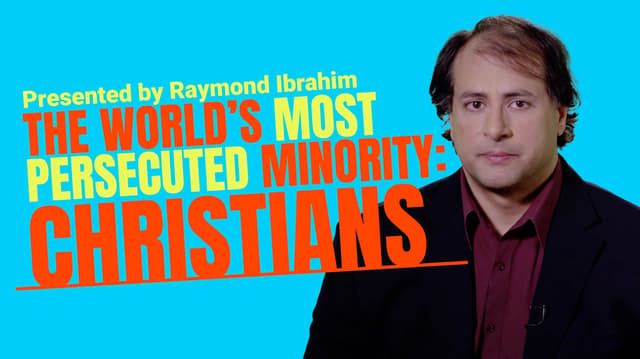
There is a religious group being harassed, imprisoned, and killed for their faith in record numbers, some millions of people worldwide. Most of it happens in the Muslim world. You would expect a story this big to lead the news. Instead, it barely gets mentioned. Why does the West look away? Middle East historian Raymond Ibrahim explains.
Substack: LINK
Book: Crucified Again: Exposing Islam's New War on Christians
Topics
Hosted By
 Raymond Ibrahim
Some years back, PragerU asked me to explain why Christians are the most persecuted religious group in the world.
I documented a shocking reality: hundreds of millions of Christians were under assault, the vast majority in Muslim-dominant nations.
Is it better today?
No.
It’s worse.
The persecution has intensified, spread, and become even more normalized. Christians are attacked, displaced, and killed somewhere in the Islamic world every single day.
In Nigeria alone, Muslims kill one Christian every two hours, on average.
And the West continues to look away.
I’m a historian of Islam and the Middle East. For over fifteen years, I’ve compiled monthly reports on Muslim persecution of Christians using sources — including foreign and Arabic — the mainstream media ignores.
Christians remain the world’s most victimized religious group. Of the top 50 countries where Christians face very high or extreme persecution, about 37—or 75%—are Muslim or have large Muslim populations.
Somalia, Yemen, Sudan, Libya, Afghanistan, Mali, Democratic Republic of the Congo — the list is depressingly long.
In Nigeria, Fulani militants and Boko Haram jihadists continue their genocidal campaign.
Entire Christian villages are burned.
Pastors are beheaded.
Thousands of Christians have been slaughtered in recent years alone, with churches torched and women taken as sex slaves.
This isn’t random crime — it’s jihad against 'infidels.' That’s how the perpetrators frame it — even if the media refuses to quote their own words.
In Pakistan, blasphemy laws remain a death sentence. Accusations — often false — trigger mob lynchings and church burnings. Christian girls are routinely abducted, forcibly converted to Islam, and married off. The authorities do little and sometimes are even complicit.
Egypt’s Coptic Christians, one of the oldest Christian communities on earth, have long endured church attacks after Friday prayers, forced displacements, systemic discrimination, and the abduction and Islamization of their daughters.
In Syria and Iraq, ancient Christian populations that survived centuries of Islamic rule have been nearly wiped out by ISIS and its successors. Many who remain live as frightened dhimmis — barely tolerated subjects who pay tribute for the “privilege” of existing within an Islamic state.
In Iran, Muslim converts to Christianity—apostates—are regularly arrested, and their underground churches closed.
Why does this persecution persist? Is it because of poverty or politics? No, it’s because of Islamic doctrine.
The Koran, Hadith, and 1,400 years of history make this clear: the “People of the Book”— Islam’s terminology for Christians and Jews — must submit to Islamic supremacy. If they don’t, the pressure turns to violence, abduction, and even murder.
This isn’t “radical” Islam. It’s mainstream Islam—from the 7th-century conquests of Christian North Africa, the Middle East, and Spain, to the Ottoman genocides, to today’s jihadism.
Wherever Sharia-minded forces gain ground, Christians suffer. The same supremacist mindset drives it all.
All of this was once well known. Over a hundred years ago, President Theodore Roosevelt correctly observed that,
“…Wherever the Mohammedans have had complete sway, wherever the Christians have been unable to resist them by the sword, Christianity has ultimately disappeared.”
And the mainstream media remains silent.
A record 388 million Christians are suffering persecution. Thousands are killed yearly. You would think this would dominate headlines, but these stories barely make it to page 23 in the New York Times or a passing mention on a nightly newscast — if even that. This willful blindness does not just hide the truth; it enables more suffering.
Analysts, academics and left-leaning politicians in Europe and the US insist that every outburst of Islamic violence and intolerance is a product of isolated “extremism.” They blame colonialism and Western foreign policy. What they never do is connect the dots to Islamic teachings. Instead, they protest that highlighting Christian persecution — citing the facts — promotes “Islamophobia.”
This denial isn’t compassion. It’s complicity. It leaves persecuted Christians without allies and imports the same problems into the West through unchecked migration and failed integration.
More than a decade after I made my first PragerU video on Christian persecution — ISIS didn’t even exist then — the evidence is stronger than ever. Christianity is disappearing from its ancient heartlands in the Middle East and parts of Africa and Asia. Entire communities that predated Islam by centuries are being extinguished.
And now Muslims are in Europe doing the same thing — beheading people in the streets in London and Belfast, driving trucks into Christmas markets in Berlin, and desecrating and burning churches in Paris.
The time has come to reject passive Christianity — turning the other cheek while our brothers and sisters are crucified again. True Christian charity includes defending the innocent and speaking truth about evil. The West needs to wake up: this isn’t a “Middle East problem.” It’s a civilizational one. The same ideology that targets Christians abroad is already compromising Western freedoms here at home.
The persecution of Christians isn’t ancient history. It’s happening right now — today — on a massive scale, even though it’s being hidden from you. Ignoring it doesn’t make it go away. It only guarantees more desecrated churches, more martyrs, and less freedom.
I’m Raymond Ibrahim, author of Defenders of the West: The Christian Heroes Who Stood Against Islam, for Prager University.