Lexington and Concord: The Shot Heard 'Round the World
It was the “shot heard round the world”, the spark that officially set off the American War for Independence. But on that cold morning, neither the colonial militia nor their redcoat opponents were looking for a fight. So how exactly did an unplanned confrontation become the opening volley of the Revolution? Robert Orrison, author of A Single Blow: The Battles of Lexington and Concord, explains.
Watch Road to Liberty: Battles of Lexington and Concord
Watch Leo & Layla's History Adventures—Paul Revere: The Revolutionary Legend
Hosted By
 Robert Orrison
Of all the battles of the Revolutionary War, the very first one—Lexington and Concord—is probably the most famous. It’s where we get the idea of the Minuteman (ready for action at a moment’s notice), Paul Revere’s midnight ride (“the British are coming”), and the “shot heard round the world” (the first musket fire that ignited the War of Independence).
Despite its renown, it’s also, ironically, the least typical.
First, George Washington was not involved. He had yet to be named commander of the Continental Army.
Second, all the other major battles were fought in a conventional, late-18th-century European way: two forces confronting each other at a specific battlefield location.
Third, nobody planned a battle at Lexington and Concord. It’s only by looking back that it seems inevitable.
By April 1775, tensions between the British and the Americans had reached a boiling point. From the colonists’ perspective, the British were making their lives intolerable. A year earlier — to reassert its control over the colonies — Parliament had passed the so-called Coercive Acts: closing Boston Harbor in the aftermath of the Boston Tea Party, ending self-rule in the Massachusetts colony, and forcing Americans to house the king’s troops.
From London’s perspective, the colonials were flirting with treason. Not only did they refuse to accept the new laws; they violently resisted them.
British general, Thomas Gage, knew he was sitting on a powder keg. He ordered his troops not to provoke the locals. One false move could set the continent ablaze.
So, why were the British in Lexington in the first place?
Gage had information that the rebels were storing arms in Concord and sent a detachment to confiscate them. By this point, the Americans, with their surprisingly sophisticated spy network, knew almost every move Gage was going to make before he made it.
Here’s where Paul Revere comes in. Along with fellow patriot William Dawes, Revere set off on the night of April 18 to warn of the impending raid.
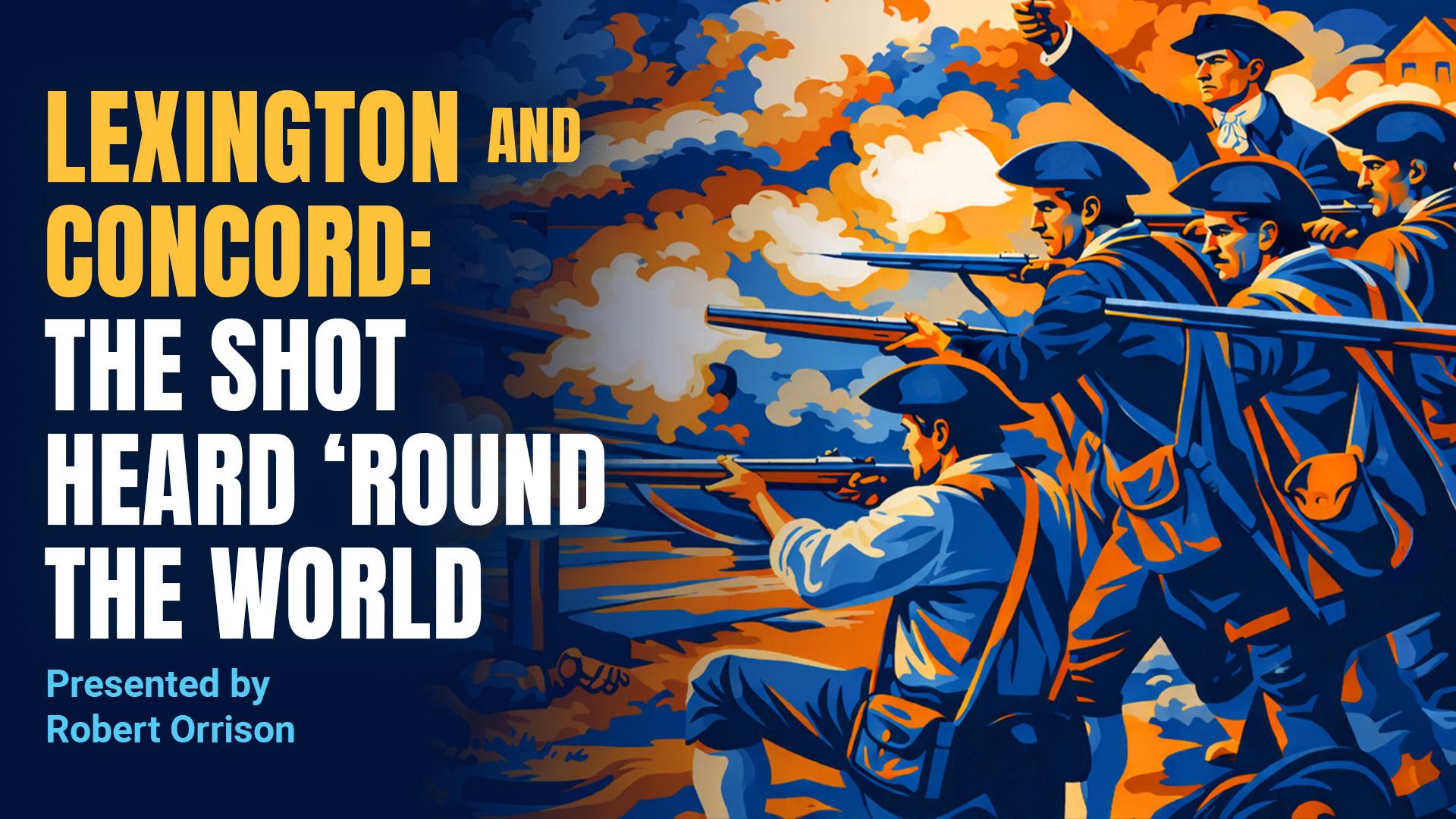
At 5 a.m., the next day, the British advance guard of two to three hundred redcoats arrived at Lexington, a town on the way to Concord. There in the village green, they encountered their first resistance: 70 to 80 American militia. It was an obvious mismatch. British Major John Pitcairn ordered the patriots to disperse. As they began to do so, a shot rang out. From which side, remains one of the great mysteries of American history.
We do know what happened next: a slaughter. The British fired a volley of gunfire, followed by a bayonet charge. It was over in minutes. Eight militiamen lay dead, with ten wounded. The king’s men barely suffered a scratch.
Gage’s caution notwithstanding, this was the lesson that King George III and his advisors had waited months to administer. As the Earl of Sandwich, First Lord of the Admiralty, said of the Americans, “They are raw, undisciplined, cowardly men… the very sound of a cannon would carry them off.”
They may have been raw and undisciplined, but cowardly they were not. Hundreds of minutemen gathered in Concord. When the British arrived at 9 a.m., they found a very different scene from Lexington. Now, they were the ones outnumbered and outgunned. Both sides began firing. This time, it was redcoats who lay dead. It was this scene that was later immortalized as the “shot heard round the world” by Ralph Waldo Emerson in 1837.
Lieutenant Colonel Francis Smith, the British overall commander, quickly realized he was in trouble. The Americans had flanked the road out of town. If the British dispersed into the countryside, they would be picked off one by one. Their only chance was to stay together on the road and fight their way back to Boston.
That road turned into an eighteen-mile gauntlet from hell. By 2 p.m., a little over ten miles from Boston, with their numbers dwindling fast, the British faced surrender or annihilation. And then came salvation: the arrival of a relief column armed with two cannon sent out by General Gage. But even with these new forces, brutal house-to-house combat still lay ahead.
At 7 pm, the exhausted British force staggered back to the city.
The final toll was 73 British killed, 174 wounded, while the Americans suffered 49 killed, 41 wounded.
The battles of Lexington and Concord would change history.
Ironically, both sides would draw the wrong lessons.
The British believed that they could win with more force—more men, more arms, more ships.
The Americans believed that they could win by fighting what we now call a guerrilla war.
They were both wrong.
The Americans would not be cowed into submission.
And the British could not be defeated until the Americans could field a disciplined, conventional army.
The result was a war far longer and bloodier than either side anticipated. In the words of the famed British philosopher and statesman Edmund Burke, “Where, when, or how it will be stopped God only knows.”
I’m Robert Orrison, author of A Single Blow: The Battles of Lexington and Concord, for Prager University.