Get credit for watching this video with PragerU Premium. Start your streak.
Dwight Eisenhower: War Hero to President
Jun 24, 2024
·As the Korean War intensified, war-weary Americans turned to a new leader, General Dwight D. Eisenhower, the hero of World War II, to bring them peace. “Ike,” as he was known to everyone, didn’t disappoint them.
This video is part of the American Presidents 5-Minute Video Series.
Once you've seen them all, take our Presidents Quiz.
Topics
Hosted By
 John Yoo
The Allies defeated the Axis powers—Germany and Japan—in World War II in no small part because of America’s brilliant generals—men like George Marshall, George Patton, Douglas MacArthur, Omar Bradley, and Dwight Eisenhower.
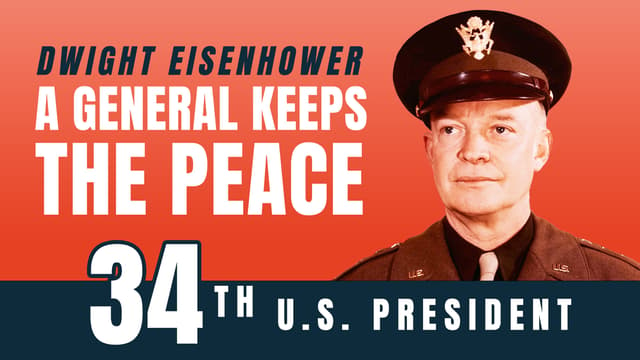
Of that illustrious group, only one—Eisenhower—reached America's highest office, serving as the 34th president of the United States.
What made him stand out among his contemporaries?
Dwight David Eisenhower was born on October 14, 1890. Young Dwight, or “Ike” as he came to be known to everyone, was the third of seven children—all boys.
Of his childhood, the future president would later say, “We were very poor, but the glory of America is that we didn't know it...”
Looking for a ticket out of his hometown of Abilene, Kansas, Ike entered the U.S. Military Academy at West Point in 1911. He did little to distinguish himself academically, focusing more on football than his studies.
Upon graduating as a second lieutenant, he was posted to Fort Sam Houston in San Antonio, Texas. There, he met the petite, vivacious, and charming Mamie Doud. The daughter of a prosperous businessman, Mamie was used to cooks and servants but gave it all up for the spartan life of a military spouse when she married Ike in 1916. She would spend the next two decades moving from one dreary Army base to the next. But as long as she was with her husband, she was happy. “Ike was my career,” she said years later.
When America entered World War I in 1917, Eisenhower, to his frustration, was ordered to remain stateside to train others for combat. It was a bitter blow, and it set the pattern of Eisenhower’s life for twenty years. As others rose to senior positions, his career stalled. He seemed destined to serve great men, not to be one.
From 1935 to 1939, Eisenhower worked as Douglas MacArthur’s top aide in the Philippines, where they helped train the local army, giving the young man from Abilene his first real taste of international politics.
MacArthur was an extremely difficult personality who almost drove Ike to his wit’s end.
But in retrospect, dealing with hard cases like MacArthur proved to be a blessing in disguise. If he could handle the egotistical general, he could handle anyone, including Winston Churchill, Franklin Roosevelt, and even Joseph Stalin. But that was in the future.
When the Japanese bombed Pearl Harbor on December 7, 1941, Eisenhower was a brigadier general. As impressive as that might sound, he was hardly at the top of anyone’s list. His leadership skills, however, had not escaped the notice of the ever-shrewd George Marshall, Roosevelt’s top military advisor.
In June 1942, much to the surprise of almost everyone, Marshall appointed Eisenhower the commander of all U.S. troops in Europe, elevating him over 366 more senior officers. It proved to be one of the best, if not the best, personnel decisions of the war.
Over the next thirteen months, Eisenhower oversaw the invasions of North Africa, Sicily, and Italy. There were many setbacks, many unforeseen disasters, many miscalculations, but Eisenhower never lost his composure, never lost his confidence that his men would prevail. And in each case, they did.
The main event, the invasion of France, however, was still ahead, and it needed a commander. President Roosevelt had no shortage of accomplished generals to choose from—MacArthur, Patton, Bradley—but he went with Ike.
Operation Overlord, or D-Day, as it is famously known, would be the largest amphibious invasion in history, with 150,000 men from over a dozen countries, 50,000 vehicles, 11,000 planes, and 6,000 naval vessels attacking the Nazis head-on.
But how to get them all across the English Channel before Hitler and his Nazi forces could counterattack?
It was a logistical and strategic nightmare, a high-stakes roll of the dice. And the outcome fell on one man’s shoulders.
No one knew that better than Eisenhower. He prepared a letter assuming full responsibility in the event of failure. Tucking it in his wallet, he gave the go-ahead on June 6, 1944.
That letter never saw the light of day. The invasion succeeded. The letter is now archived in Eisenhower’s presidential library.
The war ended eleven months later on May 8, 1945.
Eisenhower returned to the US a hero.
Both parties saw him as a future political star. However, no one knew whether he was a Republican or a Democrat. Sitting President Harry Truman so respected Eisenhower that he offered to serve as Eisenhower’s vice president if the general wanted to run on the Democratic ticket in 1948. But Ike turned everybody down. Instead, he accepted an offer from Columbia University to be its new president.
By 1952, however, he was of a different mind.
The worsening Cold War with the Soviet Union convinced him that he had to get back into the fray.
Waiting until the last possible moment, he declared himself a Republican and entered the presidential race. The Grand Old Party was elated. It quickly made him its standard bearer.
Eisenhower’s campaign slogan, “I Like Ike,” fit the mood of the nation perfectly.
His opponent in the general election, the Democrat, Adlai Stevenson, the erudite governor of Illinois, had little chance.
Eisenhower won easily.
America had elected a warrior to bring them peace.
I’m John Yoo, Professor of Law at the University of California, Berkeley, for Prager University.