Get credit for watching this video with PragerU Premium. Start your streak.
Dwight Eisenhower: A General Keeps the Peace
The 1950s are widely regarded as a period of undisputed American greatness. The United States dominated the world in almost every respect, from science to culture, from John Wayne westerns to commercial aviation. What was Dwight Eisenhower’s role in this decade of prosperity? John Yoo, Professor of Law at the University of California, Berkeley, has the answer.
This video is part of the American Presidents 5-Minute Video Series.
Once you've seen them all, take our Presidents Quiz.
Topics
Hosted By
 John Yoo
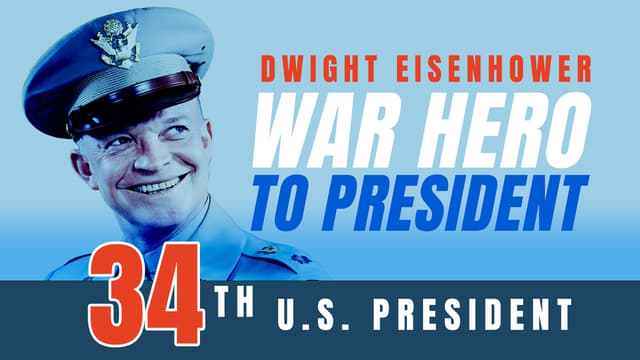
When Dwight Eisenhower, or “Ike,” as he was universally known, was elected the 34th president of the United States in 1952, the American people weren’t exactly sure who they had voted for.
He ran as a Republican, but was he a conservative? A moderate? A liberal?
Ultimately, it didn’t really matter. The decorated World War II general who had waged war now promised to wage peace. And the voters trusted he would keep that promise.
Their trust was not misplaced. His first major act as president was to resolve the conflict in Korea that had begun in 1950 and cost America 36,000 lives.
Here’s how he did it: he made it clear to the Chinese, North Korea’s patron, that if they didn’t agree to a cease-fire, he would not hesitate to use nuclear weapons.
Soon after, an agreement was reached, drawing a line between North and South Korea at the 38th parallel. That agreement stands to this day.
Would Eisenhower have actually followed through on his threat? We’ll never know, but that was the whole point.
“After Ike made peace in Korea,” Eisenhower biographer Jean Smith wrote, “not a single American died in combat for the next eight years.”
Throughout his time in office, he was urged to use American military power to resolve conflicts. And for eight years he resisted.
In 1953, the French wanted him to come in on their side in Vietnam.
In 1955, Chiang Kai-shek, the ruler of Taiwan, wanted America’s help to take on Communist China.
In 1956, the Hungarians wanted him to back their revolt against Soviet rule
Each supplicant made a good case for American intervention. Each time, Eisenhower refused to commit American troops. If he didn’t see a clear path to victory, the risk, in his mind, was greater than the reward.
And even though he said he was prepared to use nuclear weapons, he greatly feared their destructive power.
To that end, he sought a treaty with the Soviets to end the arms race. He proposed that the US would open up all its military facilities to Russian inspection—provided the Soviets did the same. But the Soviet leader Nikita Khrushchev declined. He dismissed the proposal as an American trick to spy on the Soviet Union. It wasn’t a trick. Eisenhower really meant it.
If Khrushchev wouldn’t make a deal, Eisenhower would do what he had to do: make sure that America’s nuclear capacity far outstripped the Soviets.
But while he recognized the Soviet threat, he didn’t blindly accept the advice of his military chiefs. As a career soldier, he knew that the armed services always assumed the worst about an adversary’s capabilities—the better to boost their budgets. But Eisenhower never took the bait. In fact, he trimmed portions of the military budget repeatedly during his tenure. He famously worried about what he coined the “military-industrial complex”.
He brought the same pragmatism to the domestic front. His philosophy here was not much different than his foreign policy philosophy: if he could keep the country out of war—in this case, political war —everything else would take care of itself.
This worked brilliantly in his handling of the bombastic Republican senator from Wisconsin, Joseph McCarthy. McCarthy became nationally renowned for his thinly evidenced exposés of communist infiltration in the American government.
There was communist infiltration in the government, but McCarthy, unfortunately, might have been the worst person to lead that fight.
For example, he accused General George Marshall—the architect of the Allied victory in World War II, trusted advisor to Presidents Roosevelt and Truman, and one of the greatest Secretaries of State in American history—of being pro-communist, an accusation that enraged Eisenhower.
Ike’s advisors implored him to go on the offensive and attack the Wisconsin senator head-on, but that wasn’t Eisenhower’s style. He knew it was just a matter of time before McCarthy would hang himself.
He was right. McCarthy couldn’t prove his accusations, was censured by the full Senate, and eventually drank himself to death in 1957.
This was vintage Ike: accomplishing goals without a lot of fanfare.
But if he needed to make a public show of force, he would. He sent federal troops to enforce a court ruling to integrate schools in Little Rock, Arkansas. Eisenhower has been criticized, and perhaps rightly so, for moving too slowly on civil rights issues, but he feared social upheaval if he did so. And the truth is, blacks made significant economic progress in the postwar decades. Between 1940 and 1960, the black poverty rate fell from 87 percent to 47 percent.
Government projects actually got done. Eisenhower conceived of and began the Interstate Highway System, which changed America probably more than any other single infrastructure project in American history, and on which we all still depend.
He did it despite a Democratic majority in the House and Senate during his last six years as president. For Eisenhower, it was about getting the job done, not who got the credit.
Indeed, the Eisenhower years are widely regarded as the period in which America was truly great—a time when it dominated the world in almost every respect, from science to culture, from John Wayne westerns to commercial aviation.
The warrior had kept his promise. He kept the peace.
I’m John Yoo, professor of law at the University of California, Berkeley, for Prager University.