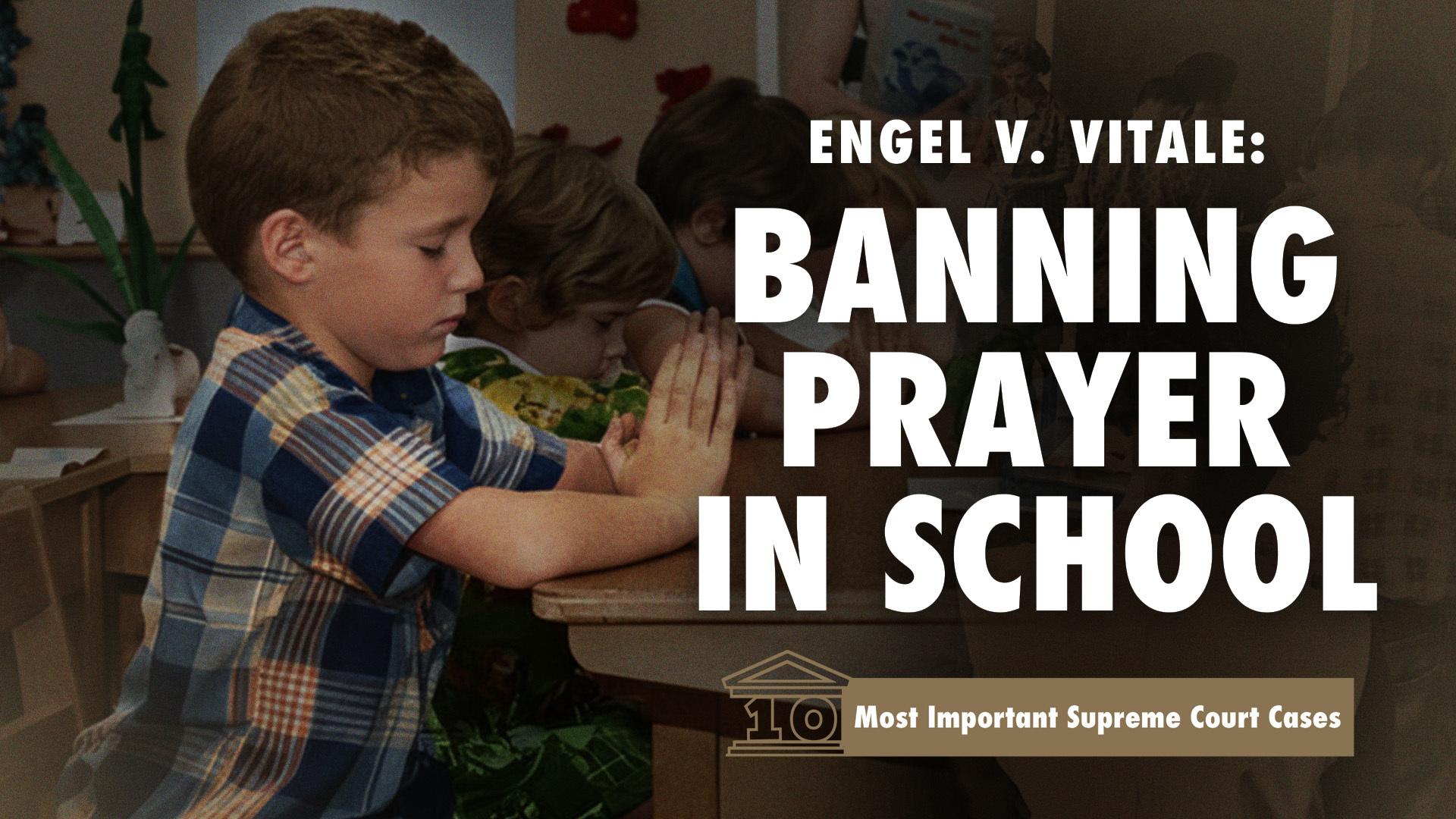
Engel v. Vitale: Banning Prayer in School
Does a simple classroom prayer violate the Constitution? That was the question before the Supreme Court in the 1962 case Engel v. Vitale. Joel Alicea, Associate Professor of Law at Catholic University, explains why this ruling dramatically reshaped the role of religion in public life—and why its impact is still felt today.
Topics
Hosted By
 Joel Alicea
Almighty God, we acknowledge our dependence upon Thee, and we beg Thy blessings upon us, our parents, our teachers and our country.”
In 1951, the Board of Regents of New York recommended that New York public schools open each day with this prayer. Its intention was to promote gratitude, good behavior, and a recognition of God’s role in American life.
The parents of ten students in Long Island strongly objected, claiming that the prayer violated their Constitutional rights and the rights of their children.
Were they correct?
Did the Long Island school district violate the Constitution? Specifically, did it violate the Establishment Clause of the First Amendment, which reads “Congress shall make no law respecting an establishment of religion…”?
That was the question before the Supreme Court in the 1962 case, Engel v. Vitale.
Steven Engel was the lead plaintiff for the parents who objected to the prayer. William Vitale Jr. was the president of the school district.
The two parties argued over three questions:
One: Was the prayer voluntary? The school district said it was. No one was forced to say the prayer. A student could remain silent or be excused from class. The parents argued the prayer was, in effect, compulsory. Children can’t be expected to resist peer pressure or the implicit demand of the teacher to say the prayer.
Two: Was it appropriate for a teacher to recite a government-composed prayer? The school district noted that prayer was commonplace in many government settings. The Supreme Court itself opens its sessions with the prayer, “God save the United States and this Honorable Court!” The parents countered that school prayer violated the Establishment Clause because its “purpose and effect” was “to promote belief in the existence of God.”
The answers to questions one and two both hinged on the answer to question three: What was the purpose of the Establishment Clause? The school district asserted that the clause was not meant to prohibit prayer in public life. It was meant to prohibit the creation of an official national religion of the kind that had existed in England at the time of the Constitution’s writing. The parents maintained that the clause goes further and prohibits the government from composing and encouraging a prayer to be said in a public setting like a classroom.
This is the argument most people are familiar with — that there must be a “wall of separation between Church and State.” What many people don’t realize is that this phrase is nowhere to be found in the Constitution. It’s a phrase taken from a letter Thomas Jefferson wrote in 1802 to the Danbury (Connecticut) Baptist Association.
Nevertheless, the Court found the separation-of-church-and-state argument persuasive and issued a broadly worded decision. By a vote of 6-1, the Court held that it was unconstitutional for the government to compose a prayer and have it recited at a public function. Importantly, the Court said that the prayer was unconstitutional even if it was voluntary. And the Court didn’t limit its rationale to schools. It went much further, suggesting that government-composed prayers were inappropriate in all public settings.
Justice Hugo Black, a strong liberal voice on the Court at the time, wrote the majority opinion. “The First Amendment was added to the Constitution to stand as a guarantee that neither the power nor the prestige of the Federal Government would be used to control, support or influence the kinds of prayer the American people can say…”
The Court took pains to clarify that its decision was not intended to display hostility to religion. Quite the opposite. The Court argued that its decision was intended to protect religion from government interference.
Justice Potter Stewart was the lone dissenter. “I cannot see how an ‘official religion,’” he wrote, “is established by letting those who want to say a prayer say it. On the contrary, I think that to deny the wish of these school children to join in reciting this prayer is to deny them the opportunity of sharing in the spiritual heritage of our Nation.”
Most Americans agreed with Justice Stewart. Newspaper editorials across the country denounced the ruling. The Los Angeles Times’ response was typical. It mocked the decision as “perverse,” a solution in search of a problem.
But as the nation moved deeper into the tumultuous sixties — the Kennedy assassination, the civil rights movement, the Vietnam War — Engel faded into the background.
Or did it? Can we trace the country’s moral decline — assuming you think there has been a moral decline — to the fact that our public life has become disconnected from religion? Many say yes: it’s not a coincidence that so many social ills, like drug use, alienation, and depression proliferated in the subsequent decades. Many say no: in a nation that was becoming ever more diverse, the Court preserved an essential liberty, the freedom to practice any religion or no religion.
Whatever you think of the decision, perhaps we can all agree on this: Engel profoundly altered the role religion plays in public life, making it among the most consequential Supreme Court decisions in American history.
I’m Joel Alicea, Associate Professor of Law at Catholic University, for Prager University.