Brandenburg v. Ohio: Hate Speech Is Free Speech
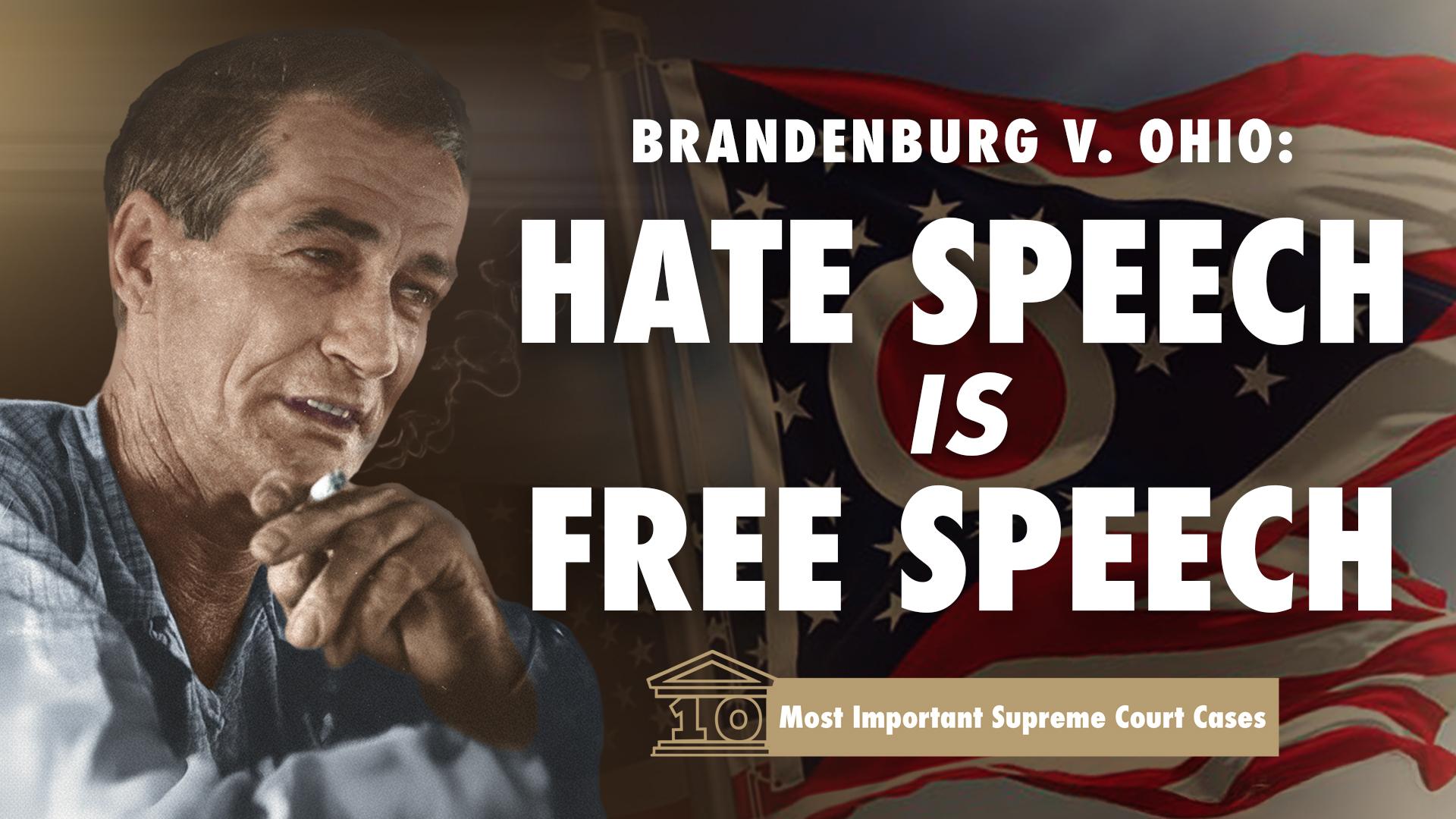
Is all speech protected under the First Amendment or is there a line that can’t be crossed? In 1969, the Supreme Court answered this question in the case of Brandenburg v. Ohio. Joseph Fornieri, Professor of Political Science at Rochester Institute of Technology, explains why free speech is the liberty from which all other liberties flow.
Topics
Hosted By
 Joseph Fornieri
Freedom of speech is indispensable to every other freedom. In fact, it’s the very essence of democracy.
It promotes rational deliberation, holds public officials accountable, and fosters a marketplace of ideas where diverse viewpoints can be debated and tested — the very engine of progress.
If citizens cannot freely speak their minds, they aren’t free.
As the great 19th-century abolitionist Frederick Douglass noted, “No right was deemed by the [founding] fathers… more sacred than the right of speech. It was in their eyes… the great moral renovator of society and government.”
The relevant clause of the First Amendment of the Constitution reads, “Congress shall make no law… abridging the freedom of speech...”
But just how free should this speech be?
We all recognize that there must be limits.
In the 1919 case Schenck v. United States, Justice Oliver Wendell Holmes famously declared that you can’t falsely shout “fire” in a crowded theater. That could induce panic resulting in injury or death. What about speech that incites people to commit violence? Does that cross the line? And what about what we now call “hate speech”? Is that protected?
These aren’t easy questions. The Supreme Court has wrestled with them for decades.
The 1969 case of Brandenburg v. Ohio is a prime example.
Few decisions have done more to define the boundaries between speech that is protected by the First Amendment and speech that is not protected, than this one.
Clarence Brandenburg was the leader of an Ohio chapter of the Ku Klux Klan, a white supremacist group violently opposed to civil rights. The Klan has had a long and ugly past stretching back to the end of the Civil War. Their white hoods and burning crosses epitomized racism and terror.
In the summer of 1964, Brandenburg invited a Cincinnati reporter to film a Klan rally. The televised film captured gun-toting, hooded figures burning a cross.
In a statement filled with racial epithets, Brandenburg said: “We're not a revengent organization, but if our president, our Congress, our Supreme Court continues to suppress the white, Caucasian race, it's possible that there might have to be some revengeance taken.”
Brandenburg was obviously not a Rhodes Scholar. There are no such words as “revengent” or “revengeance,” but his message was unmistakable.
He further announced a forthcoming Klan march throughout the South to begin on July Fourth, America’s Independence Day.
On the basis of these remarks, Brandenburg was convicted under an Ohio law, which made it illegal to “advocate” with others “the duty, necessity, or propriety of crime, sabotage, violence, or unlawful methods of terrorism as a means of accomplishing… political reform."
Laws like this were passed across the country in the early twentieth century to ensure public safety against anarchist and communist threats. In the wake of the Russian Revolution of 1917, these threats seemed very real.
Such laws, however, were vague and overly broad. They failed to draw a clear line between protected speech and punishable speech. For example, in the case of the Ohio law, what did it mean to “advocate” for violent political reform?
Brandenburg appealed to the Supreme Court. On June 9, 1969, the Court ruled in his favor. It cited the precedent of Noto v. United States (1961), which stated that “mere abstract teaching… is not the same as preparing a group for violent action..."
The Court said the Ohio statute failed to distinguish between arguing for a potentially violent idea and what the Court called “incitement to imminent lawless action.”
Under the First Amendment, speech that fell into the first category was, constitutionally speaking, acceptable. Speech that fell into the second category was not — because it led directly to violence; that is, “imminent lawless action.”
In other words, speech can only be restricted when it leads to some tangible, concrete, immediate harm. Because the Klan leader used the conditional tense — some revengeance might have to be taken — his speech fell short of the Court’s new “imminent lawless action” standard.
While Brandenburg's hateful speech rightly deserves condemnation, the Court believed that censoring that speech would have been a greater threat to a free society.
It is a characteristic of authoritarian regimes to stifle dissent to maintain their power.
The First Amendment ensures that the government remains content-neutral. It cannot favor or disfavor one idea, viewpoint, or message over another. Tolerating offensive speech, even so-called “hate speech” is the mark of a free society. The only exception is speech that leads directly to violence.
Free speech comes with costs. People can be offended by it, even deeply so, but in Brandenburg the Court recognized that those costs were outweighed by its benefits.
The antidote to hateful speech is more speech. That’s how we preserve this most indispensable of freedoms.
I’m Joseph Fornieri, professor of Political Science at the Rochester Institute of Technology and Director of The Center for Statesmanship, Law, and Liberty, for Prager University.
What kind of speech is protected under the First Amendment—and what crosses the line? In Brandenburg v. Ohio (1969), the Supreme Court tackled one of the most difficult questions in constitutional law: when does speech become a threat to public safety? Joseph Fornieri, Professor of Political Science at the Rochester Institute of Technology, explains how this historic case still shapes our understanding of free speech today.