Can We Tax Our Way to Equality?
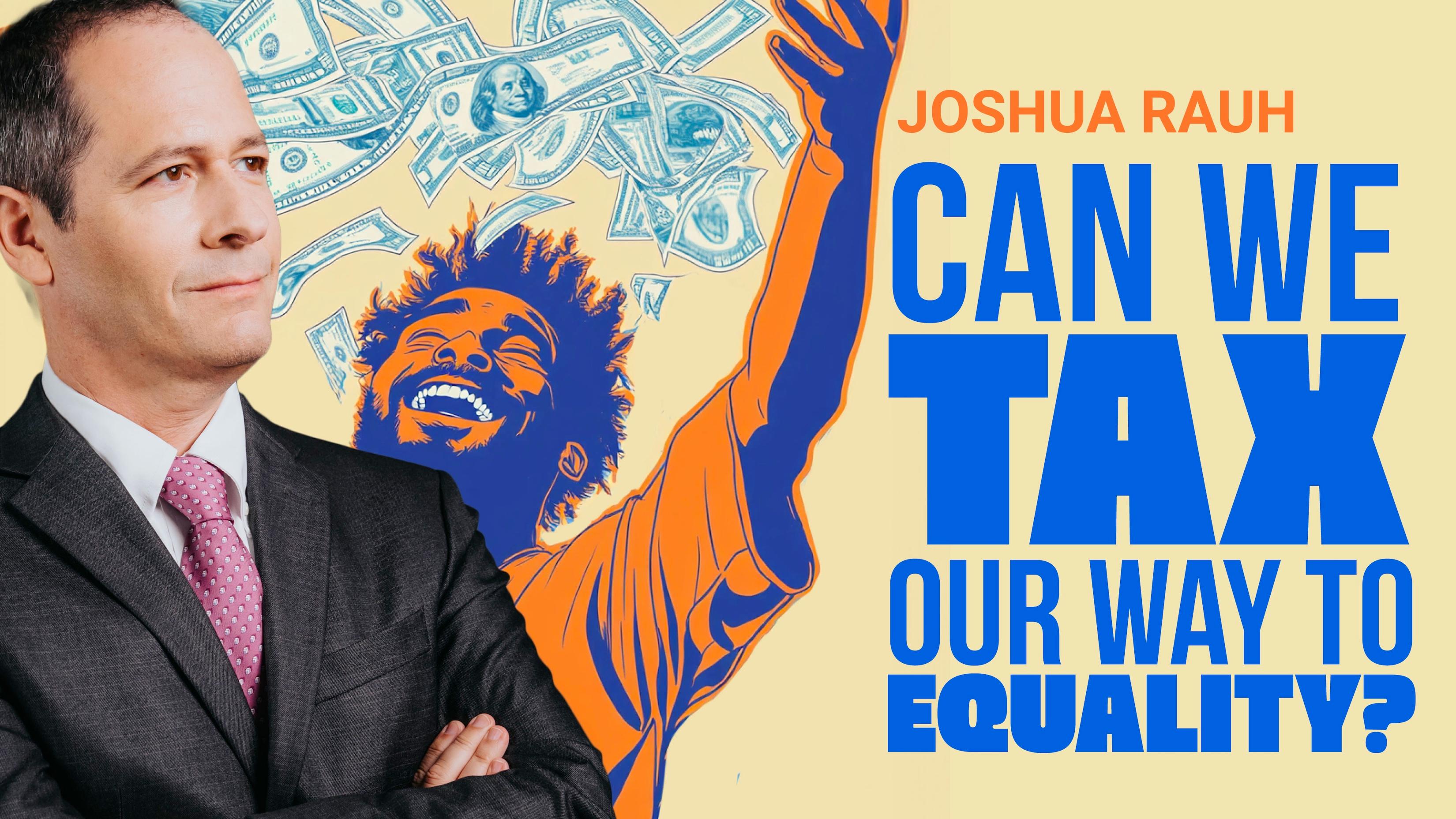
Is income inequality our biggest social problem? If we take more from the rich and give more to the poor, can we solve it? Joshua Rauh, professor of finance at Stanford and Senior Fellow at the Hoover Institution, addresses these questions in this challenging video.
This video was made possible by a generous gift from The Peter & Judy Copses Foundation.
Hosted By
 Joshua Rauh
Is economic inequality, as President Barack Obama said, “the defining challenge of our time…”?
Is the wealth gap, as Bernie Sanders said, “one of the great moral, economic and political crises that we face…”?
And must we, as Vice President Kamala Harris said, “rise to meet this moment” as “we face a dramatic rise in inequality…”?
The left, as you can see, has no doubts about this issue.
It’s a huge problem.
Or is it?
Consider this thought experiment.
Jeff and Bill work for a well-run, innovative steel manufacturer. Let’s call it Acme Steel. Jeff is a factory floor manager and makes $150,000 a year. Bill works in the plant and makes $50,000 a year.
The government decides to reduce taxes and regulations on the steel industry. Acme’s profits soar.
Bill gets a raise and is now making $62,500. Jeff gets a raise too and is now making $200,000 a year.
They’re both better off. But their income gap has widened! Someone tell Bernie!
What would the income inequality crowd propose to correct this new injustice? They’d likely say we should redistribute more wealth from higher earners like Jeff to lower earners like Bill.
That might be fine for Bill in the short term, but in the long run it spells trouble.
Redistribution—code word for “higher taxes”—discourages the creation and growth of businesses.
I recently studied the 2012 tax increases on high-income earners in California. I found that these increases have backfired.
High earners today in California, in addition to a 37% federal income tax, pay a 14.4% state income tax. These people can do the math. Many have decided that doing business in California isn’t worth it, and some leave the state altogether. The upshot: fewer businesses, fewer jobs, fewer high earners paying taxes.
As British Prime Minister Margaret Thatcher famously quipped in response to a critic complaining about income inequality, “He would rather have the poor poorer provided the rich were less rich.”
But what about “the fact” that the rich don’t pay their fair share?
It’s not a fact at all.
According to the IRS, the top 1% of U.S. earners pay 46% of all federal income taxes. The bottom 50% of income earners pay just 2% of federal income taxes. Even after sales and property taxes, the top 20% of income earners pay 41% of all taxes, while the bottom 20% pay only 10%.
But you've been told income inequality is worse than ever. Actually… no. According to the latest study by a pair of US government economists, Gerald Auten and David Splinter, between 1960 and 2019, the top 1% of income earners’ share of pre-tax income only increased modestly from 10% to approximately 14%. When you account for taxes and all the income that people get from social welfare programs, the top 1% income share remained effectively unchanged during this sixty-year period.
Cancel the revolution.
But if you’re still ready to rush to the ramparts, consider this. You’re likely to find yourself in the despised high-income bracket one day.
A study by professors at Washington University and Cornell University found that 73% of Americans will be in the top 20% income bracket at some point in their lives.
Sadly, poorly conceived government welfare programs are making it harder to move up the wealth ladder. They trap people in poverty, ensuring that the income gap will only widen.
The Illinois Policy Institute looked at what happens to lower-income earners’ total income, including government benefits, when they get a raise at work.
The study considered a single mom of two receiving a pay raise from $12 to $18 an hour. That should mean a salary increase from $22,000 to $33,000 per year.
However, before the pay raise she was receiving $39,500 in government benefits, but because of the pay raise, she would lose most of that – $34,300 of it. So on net, she’d be out $23,300 per year as a result of this 50% pay raise.
Sounds crazy? It is.
Free societies allow their citizens to realize their full economic potential. But freedom means something else: some people will work harder than others. Some are more ambitious than others. Some have skills that are more valuable than others.
And therefore, some will make more money than others.
Would you really want it to be any different?
In communist Cuba, under Fidel Castro, nobody could make more than $200 a year. A doctor made the same as a taxi driver.
Perfect income equality. The price: everyone was equally poor.
Is that a price you’re willing to pay?
I’m Joshua Rauh, professor of finance at Stanford and Senior Fellow at the Hoover Institution, for Prager University.