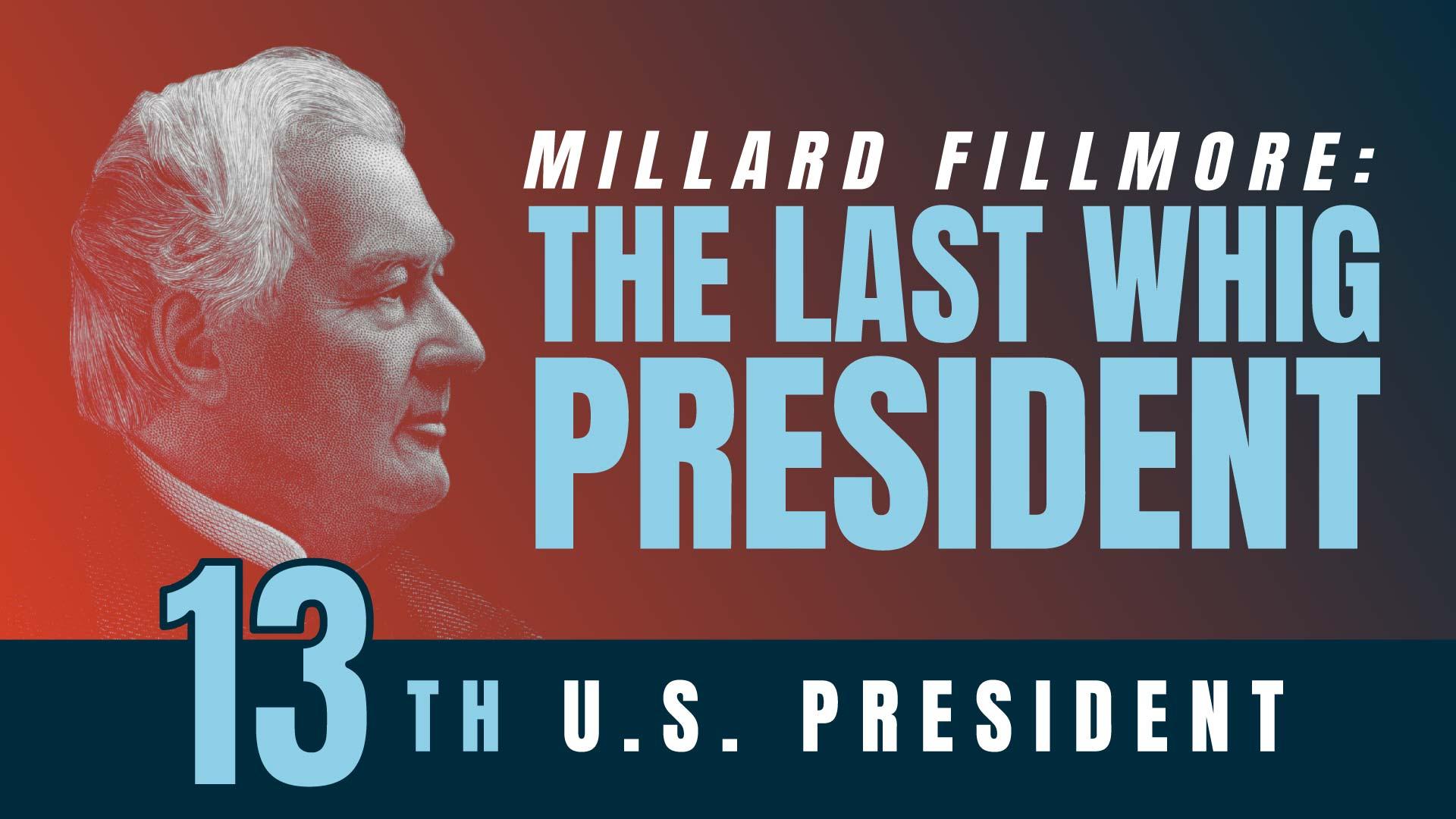
Millard Fillmore: The Last Whig President
Is Millard Fillmore, the 13th President of the United States, the least significant of all the commanders in chief? Or the most underestimated? Jared Cohen, author of Accidental Presidents: Eight Men Who Changed America, has the answer.
This video is part of the American Presidents 5-Minute Video Series.
Once you've seen them all, take our Presidents Quiz.
Topics
Hosted By
 Jared Cohen
No one was more surprised than Millard Fillmore when the Whig Party chose him to be Zachary Taylor’s running mate in the 1848 election.
Working as the comptroller (essentially the treasurer) of New York State at the time, Fillmore was well known in Washington. He had been a New York congressman for a decade. But the VP slot? Fillmore didn’t see it coming.
And he didn’t hesitate to say yes when offered the job.
On the surface, Taylor and Fillmore seemed to be a good fit.
Taylor had never run for elective office. He was the great hero of the Mexican-American War. When he wasn’t soldiering, he lived on a plantation in the Deep South.
Fillmore, a northerner, spent his professional life in politics.
Both had grown up on the edge of the frontier. Both were entirely self-made.
It was a marriage made in machine-politics heaven.
And it worked.
Well, to be more accurate, it worked for Taylor.
It didn’t work for Fillmore.
When they won the 1848 election, Fillmore figured that as Vice President he could dispense lucrative federal jobs to his supporters, securing his future as a major force in New York and maybe even national politics.
He also figured that with his knowledge of Congress and his vast experience in the political arena, he would be a trusted Taylor advisor.
He figured wrong on both counts.
Taylor gave him no access to patronage. He wasn’t interested in boosting Fillmore’s career in New York or anywhere else.
And Taylor did not bring Fillmore into his inner circle. The two men didn’t even meet until after the election. And when they did, they didn’t much like each other. It seems that their many differences on political issues, though assets during the campaign, were detriments after it. For example, Taylor, the Southerner, accepted slavery (though, to his credit, he did oppose its spread to new states), while Fillmore, the Northerner, opposed slavery.
Fillmore made one more miscalculation.
He never thought Taylor would die in office.
After dedicating the base of the Washington Monument on a very hot, humid day, Taylor returned to the White House with heat exhaustion. Then, the doctors got a hold of him. In the mid-19th century, this was not necessarily a good thing. Over the next few days, Taylor’s health got worse. He died on July 9, 1850. The doctors, trying all manner of nostrums, including bleeding him from the wrist, effectively cured him to death.
Fillmore—thanks to the precedent John Tyler established ten years before—suddenly found himself the thirteenth President of the United States.
It would have been a difficult job for anyone.
On the one hand, thanks to victory in the Mexican-American war, a new treaty with Spain, and the rise of the Mormon community in Utah, the United States had in just the previous year almost doubled in size. Texas, California, New Mexico, Arizona, Utah, and Colorado would all eventually become states.
On the other hand, there was a burning question: Which would be free states and which would be slave states?
During a four-hour speech, the aging lion of the senate, Whig Leader, Henry Clay, proposed an omnibus bill that would settle all the issues.
But the Senate was so divided that agreement on a single bill proved impossible. Feelings ran so hot that on more than one occasion actual fistfights broke out on the Senate floor.
Fillmore, with the help of Illinois Senator, Stephen Douglas, a Democrat, came up with a practical solution: break the big bill into five separate parts. Each part could then be debated on its own merits.
This was known as the Compromise of 1850.
Here’s how each piece broke down:
One: California would be admitted as a free state
Two: The boundaries of Texas, already a slave state, were fixed.
Three: The New Mexico and Utah territories would be allowed to determine for themselves whether they would be free or slave.
Four: The slave trade would be abolished in Washington, DC
Five: The right of Southern slave owners to recover runaway slaves in the North was enhanced.
Fillmore hated this last bill, The Fugitive Slave Act, but signed it anyway. He feared, with good reason, that if he didn’t, the Southern states would bolt and the Union would be shattered. In other words, he feared Civil War.
History has not been kind to the Compromise of 1850, but at the time, the nation breathed a huge sigh of relief. Civil war had been averted, or so they thought.
If Zachary Taylor hadn’t died in office, he would have almost certainly vetoed all or part of the five bills. But, thanks to the pragmatic Millard Fillmore, they all crossed the finish line.
To get it done, Fillmore had alienated his own Whig Party, killing any chance he had of winning their presidential nomination in 1852. As it turned out, he was the last of the Whig line.
The party would dissolve over the coming decade, torn apart by internal disagreements. It would be replaced by a new, anti-slavery party with a much clearer vision of the future. They would call themselves Republicans.
I’m Jared Cohen, author of Accidental Presidents: Eight Men Who Changed America, for Prager University.