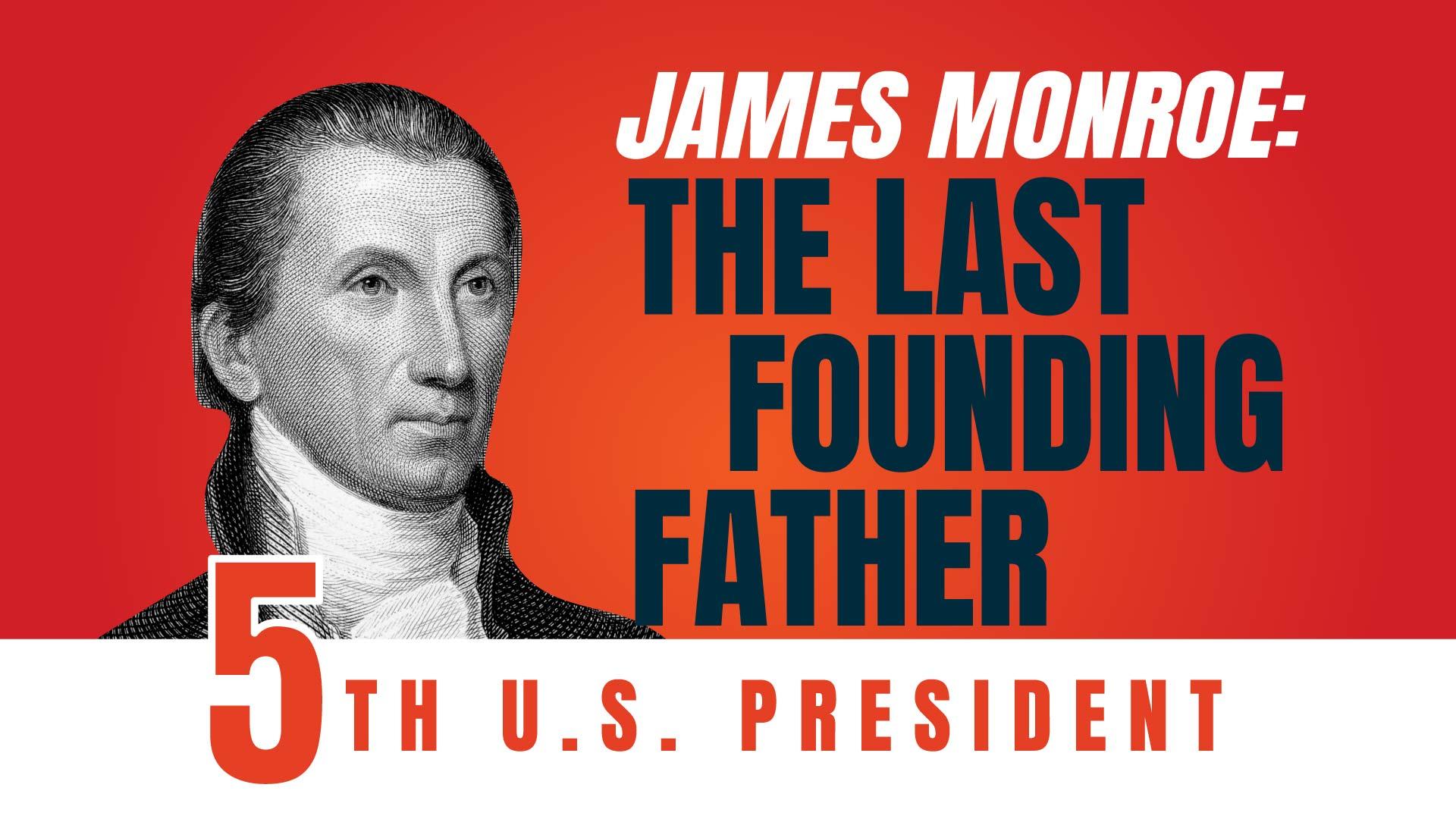
James Monroe: The Last Founding Father
America’s fifth president James Monroe, the last of America’s Founding Fathers, is also the least well known. But that doesn’t mean he wasn’t a giant among giants. He was. Author Chris DeRose tells his story.
This video is part of the American Presidents 5-Minute Video Series.
Once you've seen them all, take our Presidents Quiz.
Topics
Hosted By
 Chris DeRose
On December 26, 1776, 18-year-old James Monroe lay dying outside of Trenton, New Jersey. A musket ball had penetrated his left shoulder, severing a major artery.
The opening months of the Revolutionary War had been a disaster for the American side.
General George Washington desperately needed a victory. He launched a surprise attack against British mercenaries camped at Trenton.
Monroe led the vanguard to secure the roads in and out of town. If the fate of the Revolution rested on the Battle of Trenton, the Battle of Trenton rested on Monroe’s success.
Monroe accomplished his mission. Washington and the Americans had their victory. But it looked like it was going to cost Monroe his life.
Fortunately, a local doctor got to him and stopped the bleeding. That doctor saved the life of a man who went on to play a critical role in the first fifty years of the new American nation.
James Monroe had humbler beginnings than many of the other Founders. Both parents died by the time he was sixteen, leaving him responsible for four siblings and the family farm. He was only able to attend the College of William and Mary with help from an uncle. He didn’t stay long, however, joining Washington’s army at the outset of the revolution.
After his time in the army, Monroe returned to Virginia to study law, but soon turned his attention to politics. He represented Virginia in the Continental Congress, where he met his wife Elizabeth, the daughter of a prominent New York City merchant. They married after a short courtship. It was a genuine love match and one of the great romances of the founding era.
During this time, Monroe also developed a close friendship with fellow Virginian James Madison. But the friends found themselves on opposite sides of the critical issue of the day: the fate of the new Constitution.
In one of the least appreciated, but most important episodes in American history, Madison and Monroe ran against each other in the first Congressional election in 1789. Monroe opposed the Constitution because it lacked a guarantee of fundamental rights, like freedom of speech and freedom of religion. Madison believed those rights were already secured by the limits on government in the Constitution.
Madison won the election, but Monroe won the argument. Madison recognized that a Bill of Rights would be needed in order for the Constitution to be broadly accepted by the people.
After serving terms as a senator and as governor of Virginia, Monroe was sent to France by President Thomas Jefferson to buy the city of New Orleans from the French emperor Napoleon. But to Monroe’s surprise, Napoleon offered Monroe not just New Orleans, but the entire Louisiana Territory.
Monroe had a problem. He didn’t have any authorization to make such a large purchase. He decided to make it anyway, doubling the size of the United States.
Had Monroe done nothing else, his place in American history would have been secured. But his greatest contributions were still ahead.
In the War of 1812, President Madison relied more on Monroe than anybody. Monroe served as both Secretary of State and as acting Secretary of War. Working tirelessly for days on end, often with little sleep, Monroe helped Madison stave off disaster and achieve a negotiated peace with Great Britain.
When Madison’s second term ended, Monroe was the natural choice to replace him. He won the 1816 election decisively and became the fifth President of the United States.
Perhaps more than any Founder, Monroe had a vision for America as a growing, expanding nation. He negotiated with the British to demilitarize the Great Lakes, establish much of our northern border, and set the stage for future American ownership of the Oregon Territory in the west. In the south, he acquired Florida from Spain in exchange for settling some outstanding claims. And he signed the Missouri Compromise, which diffused a major domestic crisis that threatened to split the nation. The Compromise would draw a line across the country: new states above the line would free states, and new states below the line would be slave states.
Instead of civil war, this time became known as the “Era of Good Feelings.” Monroe won re-election in 1820—unopposed.
His most enduring accomplishment would come in his second term: the doctrine that bears his name. The Monroe Doctrine declared that the United States would not permit European powers to colonize the Western hemisphere. In doing so, he put the world on notice: the young nation was now a major power.
While Monroe did as much as any President to secure America’s prosperous future, he had much less success securing his own.
He left the White House deeply in debt—most of it expenses he had incurred on the government’s behalf.
Monroe was forced to sell almost everything he owned and live with his daughter in New York City. He died in 1831, and, like Adams and Jefferson before him, on the Fourth of July.
We’re lucky he didn’t perish on that roadside in Trenton.
I’m Chris DeRose, author of Founding Rivals: Madison vs. Monroe, The Bill of Rights, and The Election that Saved a Nation, for Prager University.