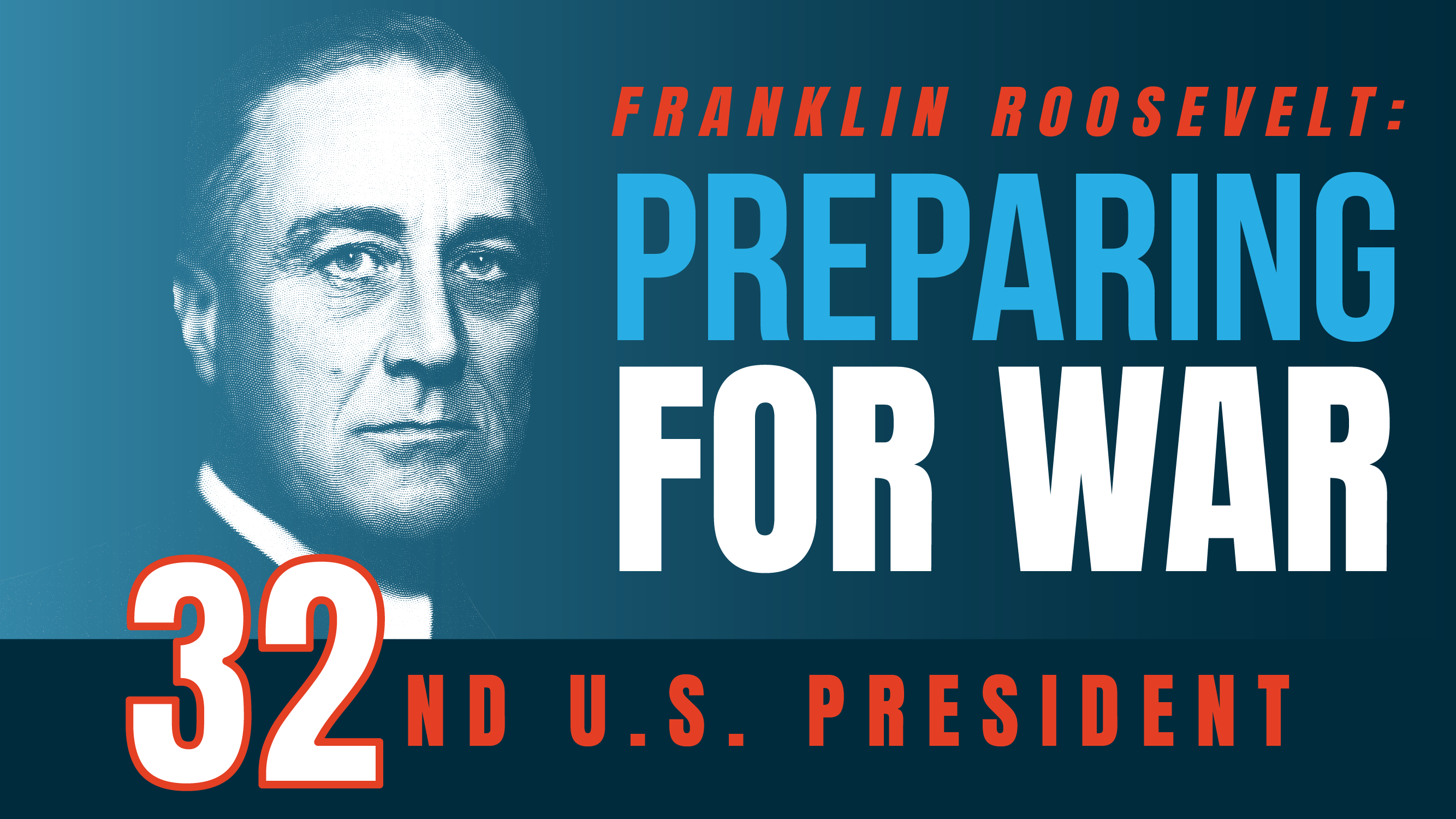
Franklin Roosevelt: Preparing for War
In 1940, Nazi Germany overran France. Britain looked to be the next target. President Franklin Roosevelt knew he had to prepare America for war. But how? Arthur Herman, senior fellow at the Hudson Institute and author of Freedom's Forge, tells the amazing story.
This video is part of the American Presidents 5-Minute Video Series.
Once you've seen them all, take our Presidents Quiz.
Topics
Hosted By
 Arthur Herman
In May 1940 the Nazi Blitzkrieg was overrunning France. Great Britain would be next.
British Prime Minister, Winston Churchill sent a telegram to the American President, Franklin Roosevelt.
“I trust you realize,” Churchill wrote, “the voice and the force of the United States may count for nothing if they are withheld too long.”
Roosevelt was a former Assistant Secretary of the Navy and a student of naval strategy. If Hitler were to take control of Britain, he would take control of the Atlantic. This, Roosevelt knew, would pose a grave threat to America.
Roosevelt also knew America wasn’t ready for war—not psychologically (most Americans didn’t want to get involved in a conflict on the other side of the ocean) and not militarily.
The United States had the world’s eighteenth largest army. Hungary and even Holland had bigger armies, while Hitler commanded the most advanced military machine ever seen.
The Army’s Chief of Staff General George Marshall told Roosevelt that if Hitler overran Europe and landed seven divisions on the East Coast, there was nothing anyone could do to stop him.
With all this staring Roosevelt in the face, it would have been irresponsible for the Commander in Chief not to arm the United States for war.
But how?
Many in his administration believed then, as many Americans believe now, that the only way to deal with an extreme crisis was to give the government as much power and authority as possible.
But FDR had the insight to realize that a massive wartime buildup during what was still peacetime wouldn’t succeed unless he harnessed the productive power of American business; that is to say, American free market capitalism.
The federal government could help coordinate industry’s efforts; it could make sure resources like steel and aluminum got to the places where they were most needed, but otherwise the government would have to back off.
To the president who had created an alphabet soup of Federal agencies to dig the country out of the Great Depression, this was about as un-Roosevelt as you could get.
But to his everlasting credit, the President realized that what he and the Democrats had tried with the Depression and failed—to manage the economy through government decree—wasn’t going to work when it came to preparing for war.
The man Roosevelt called for help was General Motors CEO William Knudsen, a Danish-born immigrant who had worked his way up from the Brooklyn shipyards to head the largest automobile company in the world.
Knudsen told the president that if he gave him 18 months, America would have more planes, tanks, and warships than it would know what to do with.
Roosevelt gave Knudsen what he wanted. In one of his most famous radio speeches in December 1940, a year before Pearl Harbor, the President told the American people that “we must be the great arsenal of democracy.” He backed up his words with action.
In January 1941, defense spending rose to triple what it had been the previous six months. By July it quintupled; by December it jumped another twelvefold.
The factories, plants, and shipyards of America, the isolationist nation still at peace, was fast approaching Nazi Germany in its defense output. In 1942 it would blow past it. Before that year was out the United States was producing more war materiel than all three Axis powers—Germany, Italy, and Japan—combined.
All this was achieved through the miracle of mass production, which could exponentially produce more of something while simultaneously making it cheaper and faster. To cite just one dramatic example, The Saginaw Steering Gear Company contracted to make 280 Browning machine guns by March 1942. When that date came, it shipped 28,000 guns instead.
By then, of course, the United States, following the attack on Pearl Harbor, was fully engaged in the war—both in the Pacific and in Europe.
In every town in every state, manufacturers large and small turned their focus to making the weapons their sons and husbands and brothers would need to win the greatest armed conflict in history.
By 1944, American mills were producing 150 tons of steel every minute. Factories were building a plane every five minutes; and shipyards were launching fifty merchant ships a day; eight aircraft carriers a month.
Two-thirds of all war materiel used by the Allies in World War II, came from America’s plants and workers—one of three of those workers, it should be noted, were women.
And this was all made possible because a president learned from his past mistakes and had the courage to meet a new situation with a new idea. His closest advisors wanted him to put all his chips on government control, but he chose to bet the future of freedom on American capitalism instead.
He won.
And so did the world.
I’m Arthur Herman, senior fellow at the Hudson Institute, and author of Freedom's Forge, for Prager University.