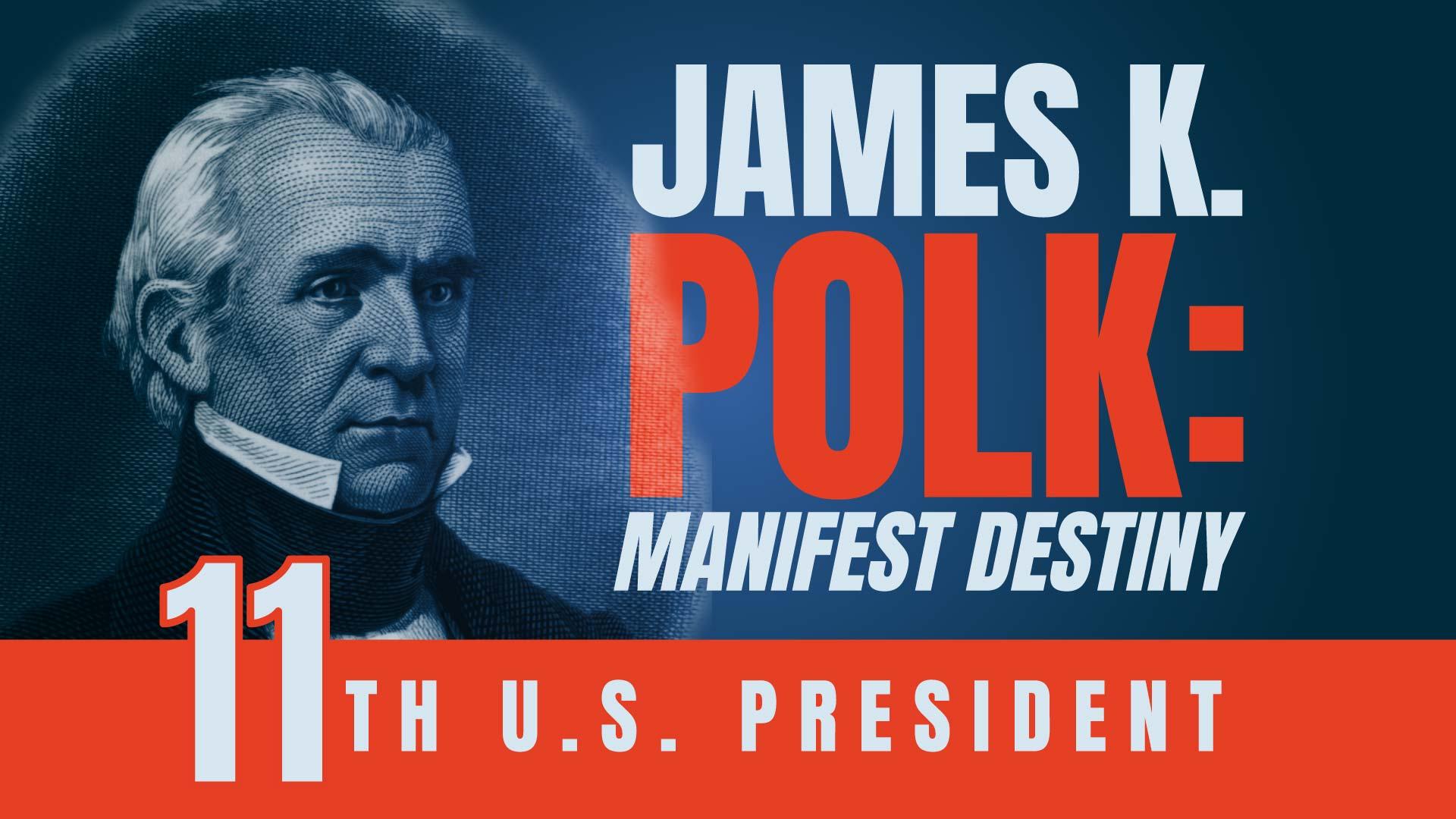
James K. Polk: Manifest Destiny
James K. Polk believed that America was destined to expand west. Did this make him an imperialist or an agent for freedom and opportunity? Wilfred McClay, professor of history at Hillsdale College, sets the record straight about the 11th President of the United States.
This video is part of the American Presidents 5-Minute Video Series.
Once you've seen them all, take our Presidents Quiz.
Topics
Hosted By
 Wilfred McClay
What does the name James K. Polk mean to you?
Probably not much, if anything at all.
That’s a shame, especially considering all he accomplished in just four years, from 1845 to 1849.
As the 11th president of the United States, he acquired the Oregon Territory from the British, carried out the annexation of Texas, and then waged a successful war with Mexico that ended with the US acquiring California and the Utah and New Mexico territories. In doing so he increased the nation’s size by a third—transforming America into a truly continental nation, from sea to shining sea. Just look at a map of the United States. We have Polk to thank for much of it.
You’d think he’d have his own monument in Washington, DC.
And that’s not all he did as president. He reduced taxes, stimulated the economy, and reformed the government’s banking practices. Plus the California Gold Rush of 1848 made his acquisition of the Golden State look like a stroke of genius.
Born on November 2, 1795, young James grew up marinating in the politics of his father, Samuel Polk, a Tennessee county judge and a devoted follower of Thomas Jefferson. Samuel saw the world as a struggle between the virtuous farmer and the crafty banker; the city versus the country; the common man versus the wealthy elite.
His son James never strayed far from this worldview.
After graduating with honors from the University of North Carolina in May 1818, Polk moved to Nashville. There he established a law practice and, like so many ambitious young men of his day, used his legal career as a springboard into politics. He was elected to the Tennessee state legislature in 1823.
There he came to the attention of General Andrew Jackson, the hero of the War of 1812. The two men formed a father-son bond that became so close that Polk earned the nickname “Young Hickory” to Jackson’s “Old Hickory.”
Polk got himself elected to the U.S. Congress in 1825, shortly after Jackson had lost to John Quincy Adams in one of the most controversial presidential elections in American history. Polk proved his loyalty to the general by becoming a persistent thorn in Adams’ side.
When Jackson came roaring back to win the presidency in 1828, Polk was right there with him, as an advisor and confidant. As a Jackson insider, Polk rose quickly, becoming the Chairman of the influential Ways and Means Committee, then Speaker of the House, then Governor of Tennessee. It seemed that every political door was opening to him.
Then, suddenly, it all went south.
Running for re-election as governor in 1841, Polk lost to an obscure, somewhat buffoonish Whig opponent, James “Lean Jimmy” Jones. Polk may have won on the issues, but his 6’2” 125-pound opponent won on crowd-pleasing humor. That was bad enough, but when Lean Jimmy beat Polk again in 1843, everyone assumed that Polk’s once-promising political career was over.
Then, one year later, in 1844, everything changed again.
The reason was Texas.
The new Republic of Texas had achieved its independence from Mexico in 1836 and had been seeking to become part of the United States ever since.
Fearing a war with Mexico, Congress wavered on Texas annexation for almost a decade. By 1844, however, American public opinion, bursting with expansionist fever, had undergone a massive shift in favor of annexation.
Both Martin Van Buren, the likely Democratic nominee, and Henry Clay, the likely Whig nominee, misread the national mood. They publicly stated that they would oppose the annexation of Texas. They didn’t realize it at the time, but this doomed their campaigns and cleared the way for a pro-annexation candidate. That candidate turned out to be Polk, who beat Van Buren for the Democratic nomination and then Clay for the presidency.
At the age of forty-nine, Young Hickory became the youngest president the country had ever had. In the course of just a few months, he had gone from the humiliation of defeat to the shining prize of the White House.
His term of office will always be closely identified with the mid-nineteenth century idea of “Manifest Destiny”—the belief that the American democracy should extend from coast to coast, enveloping the entire continent.
And that may be why today we don’t always give him the credit he deserves. We tend to see Manifest Destiny in negative terms, as a form of American imperialism, pure and simple. But Polk never saw it that way.
Along with most Americans of his day, the very ones who swept him into office, he was confident that what he was doing was noble and good, bringing freedom and prosperity across the continent to ever more people.
Looking back almost two centuries, isn’t that exactly what he did?
I’m Wilfred McClay, professor of history at Hillsdale College and author of Land of Hope, for Prager University.