Colonial America: Jamestown vs. Plymouth
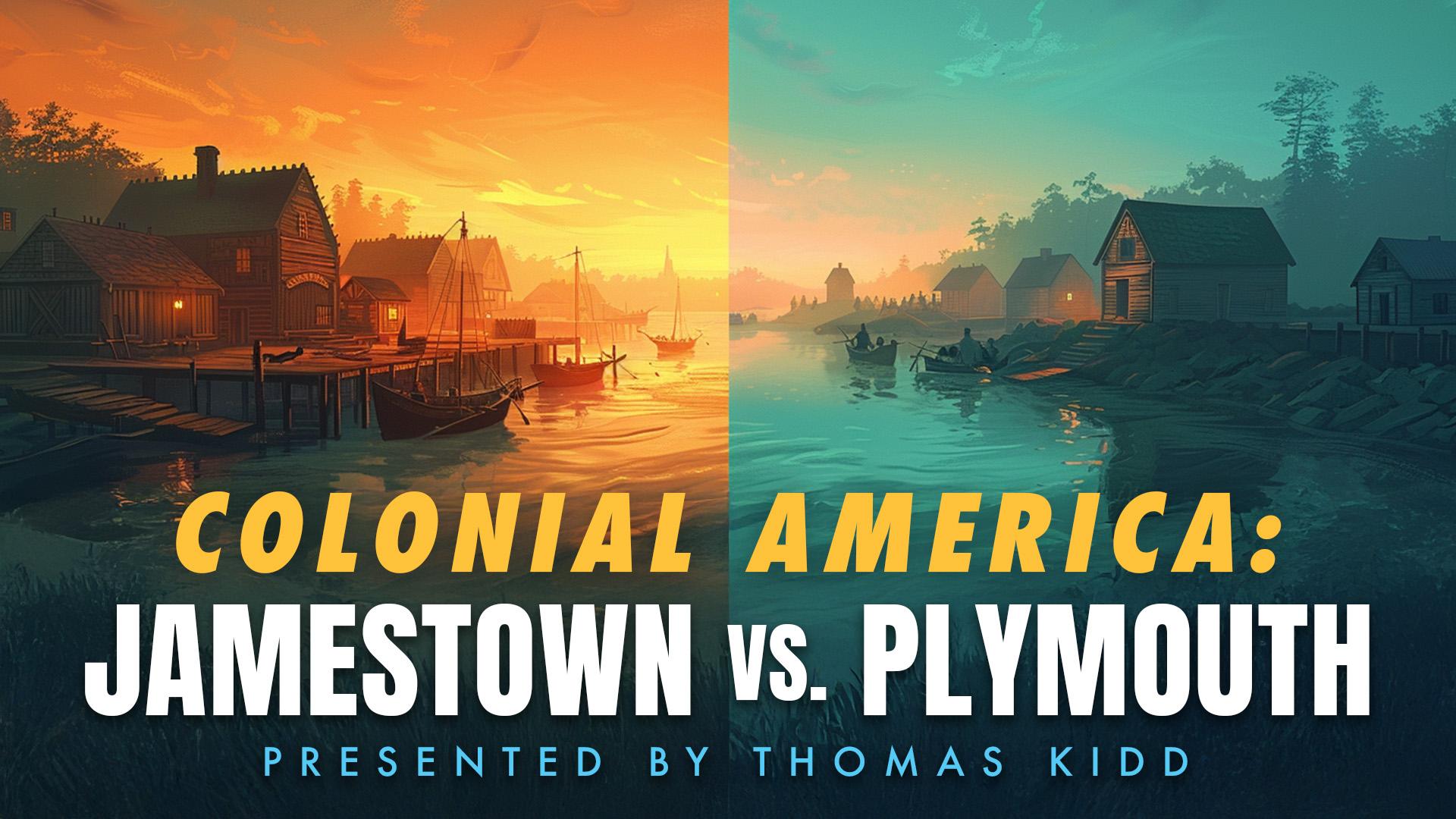
One was founded on profit. The other on faith. Jamestown and Plymouth shaped two powerful forces in American life: commerce and religion. Thomas Kidd, author of American History Volumes 1 and 2, tells the story of the colonies that helped set the stage for the nation to come.
Topics
Hosted By
 Thomas Kidd
What would make a seventeenth-century European leave the relative comfort and safety of the Old World for a perilous life in the New?
This “New World” wasn’t just new, it was utterly unknown. Getting there was incredibly dangerous. Imagine taking an ocean voyage on a small wooden ship equipped only with sails and simple navigational tools.
And once you arrived — if you arrived — then what? How would you survive? What would you eat? Were the natives friendly or hostile?
These are only a few of the daunting challenges and questions that faced the first American colonists.
Their motivations for coming were complex. But for our purposes, we can put them into two broad categories: financial and religious.
The financial was represented by the settlement at Jamestown, Virginia, established in 1607.
The religious was represented by the settlement at Plymouth, Massachusetts, established in 1620.
By comparing these two colonies, we can learn much about the origins of America.
The colonists who established Jamestown in 1607 were sponsored by the Virginia Company of London, a profit-making venture. 104 intrepid souls made up the first group. There was not a single woman among them, suggesting they had little intention of settling down, but hoped to make some easy money and return home to England as wealthy men.
That hope was based on the naïve belief that gold would be so abundant in the New World that they could just pick it up off the ground. Though they experienced many natural wonders, precious metals were not among them.
Their disappointment was compounded by the unfortunate fact that they built Jamestown near marshes — prime incubators for disease-bearing mosquitos. Just three years after that first ship landed, 440 of the first 500 colonists were dead.
The survivors tried selling timber for export and even experimented with making wine. But nothing seemed to catch on until 1614 when they began cultivating tobacco, already a popular consumer product in Europe. By 1617, a visitor to Virginia observed that the small colony’s “streets and all other spare places [are] planted with tobacco...”
Harvesting the broad, brown-leafed plant was labor intensive. As the century progressed, the Virginians came to rely more and more on slave labor, already being utilized on English sugar plantations in the Caribbean.
The Jamestown colonists were Christians, and one of the first things they did was set up a church — the earliest Protestant church in North America — but faith did not fuel the colonists’ ambition. Profit did.
By contrast, the Plymouth colonists came seeking religious freedom. They were “Separatist” Christians, meaning they believed that the Church of England, the nation’s official denomination, had become fatally corrupt. True Christians, they believed, should “separate” from the national church and form their own congregations. But doing this was illegal in the British Isles.
Violently persecuted for their beliefs, these Separatists fled their homeland for the more tolerant Netherlands. Ironically, the Dutch proved to be too tolerant, that is, too secular for these “Pilgrims.” Many decided that to practice their religion successfully, they had to make a clean break with the Old World. They arrived on the Massachusetts coast in 1620.
Before stepping on land, the Plymouth colonists signed the Mayflower Compact, named for the ship that carried them across the ocean. The compact, as short and simple as it was, reflected the religious fervor of the colony, declaring as its priority “the glory of God, and advancement of the Christian faith…” It also reflected the idea — a bold one at the time — that ordinary people could join together to govern themselves.
As with Jamestown, the Plymouth colonists were entering a land inhabited by Native Americans. The colonists endured their own hardship — that first winter, 45 out of 102 settlers perished.
Relations between the new arrivals and the Indians were harmonious and remained so for many years. The nearby Wampanoag tribe taught the colonists how to farm and hunt in the area. In the fall of 1621, both the colonists and the Indians gathered for a harvest festival that we regard as the First Thanksgiving — a feast to thank God for His faithful provision. There was no cranberry sauce and pumpkin pie, but there was boiled cornmeal mush, shellfish, eels, venison – and yes, a “great store of wild turkeys.”
Looking back four hundred years, can we see a connection between Jamestown and Plymouth and America today?
Well, think of it this way:
Financial entrepreneurs founded Jamestown.
Spiritual entrepreneurs founded Plymouth.
Against all odds, through faith and fortitude, they laid the cornerstone for what became the most religiously tolerant nation in the West, and the richest: the United States of America.
I’m Thomas Kidd, author of American History Volumes 1 and 2, for Prager University.