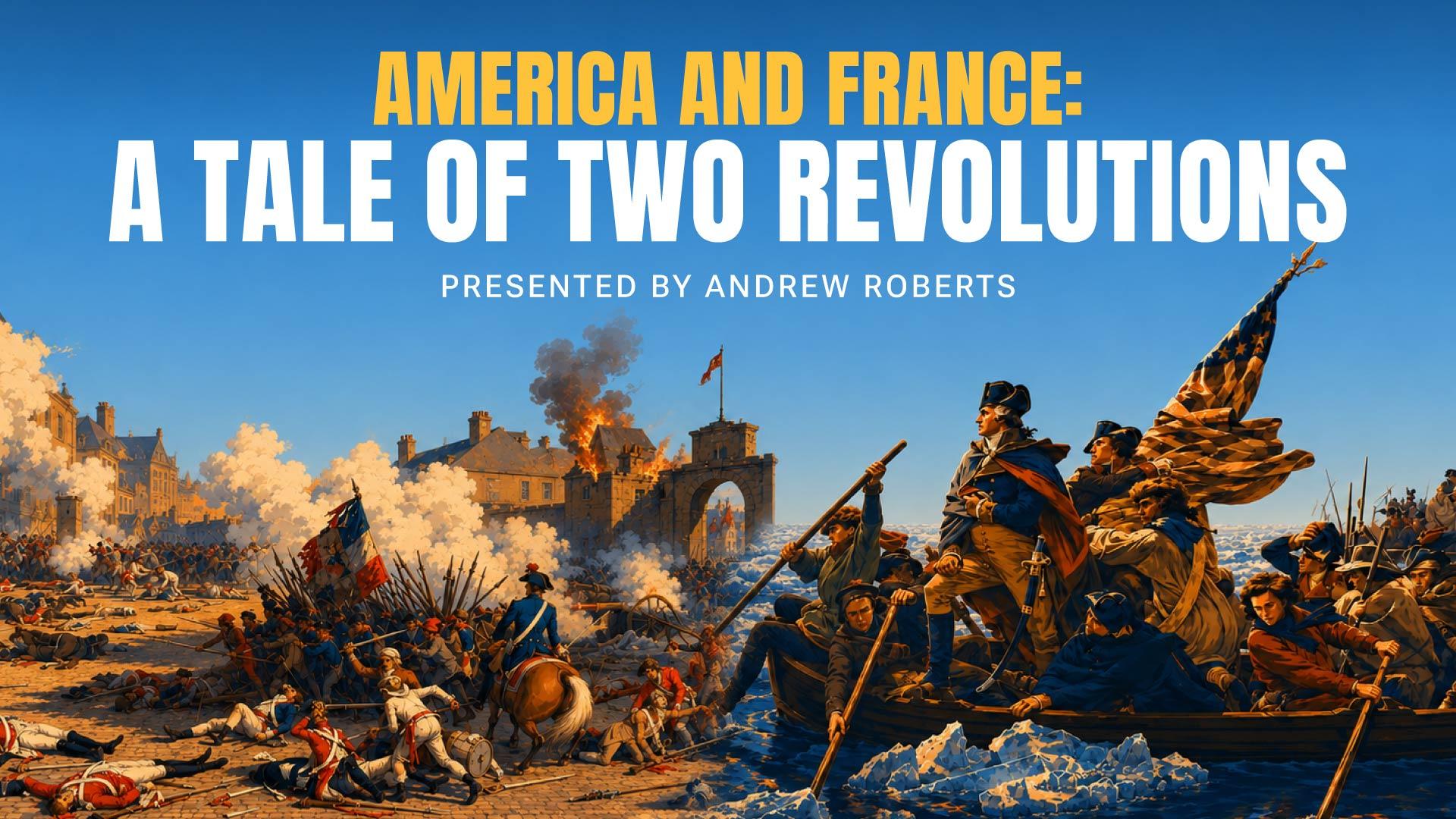
America and France: A Tale of Two Revolutions
Two revolutions reshaped the world in the late 18th century. The American Revolution gave birth to the most successful republic in history. The French Revolution gave birth to the guillotine. So what went right in America, and what went wrong in France? Renowned author and historian Andrew Roberts explains.
Hosted By
 Andrew Roberts
Two great revolutions reshaped the world in the last quarter of the 18th century: the American Revolution and the French Revolution.
One gave birth to the most successful republic in history.
The other descended into violence, bloodshed, and chaos. It ended only when Napoleon Bonaparte declared himself First Consul — effectively dictator — in November 1799. He shut down the legislature and arrested anyone who opposed him.
So why did the American Revolution succeed so spectacularly while the French Revolution collapsed? Why is the American Revolution best known for the Declaration of Independence and the French Revolution best known for the guillotine?
There are many reasons, of course, but we’ll focus on three: understanding of human nature, quality of leadership, and experience in self-government.
First: human nature.
The American Founding Fathers had a sober view of human nature. They viewed it in the classic Judeo-Christian sense as inherently flawed. If men were left to their own devices, corruption, abuse and oppression would inevitably follow. Therefore, human nature must be restrained — first by law.
Thus, the American Constitution divides power among three competing branches, each checking and balancing the other.
But that alone is not enough, which is why the Founders consistently promoted the importance of religious instruction. Given flawed human nature, freedom also requires a strong measure of self-restraint.
As John Adams famously asserted, “Our Constitution was made only for a moral and religious People. It is wholly inadequate to the government of any other.”
The French Revolutionaries, by contrast, had a much more romantic view of human nature. They despised religion and thought men could be perfected by reason alone.
Under the sway of intellectuals such as Jean-Jacques Rousseau and Voltaire, they sought to remake society from the ground up — abolishing the Church, eliminating the aristocracy, even redoing the calendar, declaring the beginning of the revolution as “Year One.” Everything before then was of little or no value.
The American Revolution promised life, liberty, and the pursuit of happiness—achievable goals that allowed people to shape their own destiny.
The French Revolution promised liberty, equality, and fraternity—but these ideals collided, resulting in years of mob violence and all its attendant horrors. True liberty undermines equality; equality requires restricting liberty; and forced equality destroys both liberty and fraternity.
Second: Leadership.
The American Revolution produced giants—the Founding Fathers. George Washington, Thomas Jefferson, Benjamin Franklin, John Adams, Alexander Hamilton and many others — capable men who rose to greatness as the occasion demanded.
The French Revolution produced monsters. The moderate reformers who began it were soon overthrown by radicals like Maximilien Robespierre, Jean-Paul Marat, and Louis de Saint-Just—men who unleashed a reign of terror that later inspired Lenin, Trotsky, and Stalin.
Whereas the French Revolution constantly threw up soldiers who fancied themselves as possible future dictators — of whom Napoleon was merely the last and the most successful — the American Founding Fathers instead were fortunate enough to have George Washington as their leader.
Washington saw himself as the servant of the Republic and never its master. After leading the revolutionary army to victory, he resigned his military commission and returned to his farm, like the ancient Roman general Cincinnatus. He later served as president only when called upon by the people to do so and then voluntarily retired after two terms.
Third, experience in self-government.
Before independence, Americans had almost two centuries of practice in governing themselves. Each colony had its own legislature. Farmers on the frontier were essentially autonomous actors. The only authority they recognized came from the end of a musket.
From Plymouth and Jamestown on, Americans were the freest people in the civilized world: the least governed, the least taxed, the least bound by class distinctions. If you had enough ambition, enough energy, and enough luck, you could carve your own destiny. When independence came, they were ready for it.
In pre-revolutionary France, class was destiny. Taxes on the lower classes—the 99% of the population who were not royalty or nobility—were crushing. Social mobility was almost impossible. Resentment of the aristocracy ran deep.
So, when revolution came, it was not so much about liberty as about revenge. The French people had no foundation in self-government. It’s no accident that an emperor replaced a king. That’s what they were used to.
Both revolutions upended the world order. But the comparison ends there.
The American Revolution changed the world for the better.
The French Revolution changed it for the worse.
I’m Andrew Roberts, author of Napoleon: A Life, for Prager University.