Get credit for watching this video with PragerU Premium. Start your streak.
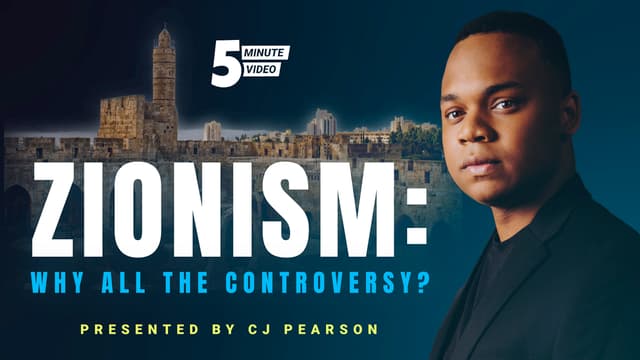
Zionism: Why All the Controversy?
What is Zionism? And why does it generate so much controversy, even hatred? CJ Pearson explains the history and philosophy of this ancient promise.
Hosted By
 CJ Pearson
What is Zionism?
It’s certainly a word that provokes deep emotions—both from its supporters and its opponents.
Is it a political movement?
Is it a philosophy?
Is it something new?
Or is it something old?
Actually, it’s all of these things.
But to summarize it in one sentence, Zionism is the belief that the Jewish people have a right to a homeland and that homeland is the land of Israel where the Jewish people came into being.
This goes back to the most influential book ever written, the Bible.
The book that brought the Ten Commandments to the world is the same book that brought Zionism to the world.
The word “Zion,” by the way, appears in the Bible as a synonym or nickname for both Jerusalem and Israel. It’s not more complicated than that.
In the book of Genesis, God makes an extraordinary promise to the first Jew, Abraham. “I assign the land in which you sojourn to you and your offspring to come…as an everlasting possession.”
And for 3,000 years, Jews have held fast to that possession.
In fact, over those three millennia, there have only been three independent states on that land, and they have all been Jewish states.
But, to put it mildly, it has not been an easy road.
The Romans thought they had finally kicked the Jews out in 70 AD when they destroyed the Great Temple and leveled Jerusalem to the ground. To finish the job, they even changed the name of the area to Palestine.
But it didn’t work.
The Jews’ connection to their land could not be broken.
Even as the Jews were scattered throughout the world, their prayers were always directed toward Israel. So central to Jewish identity is Israel that the Bible invokes a curse against a Jew who doesn’t acknowledge it. “If I forget you, Jerusalem, may my right hand become paralyzed, and may my tongue lose its ability to speak.”
Despite their long exile, there was always a Jewish presence in the Holy Land. Often desperately poor, this community was sustained by the charitable contributions of Jews living outside of Israel.
This kind of medieval Zionism lasted for hundreds of years.
Zionism as a modern political movement emerged in the late nineteenth century under the leadership of a remarkable Hungarian Jew, Theodor Herzl. A journalist and playwright, Herzl was shocked to his core when he witnessed the infamous Dreyfus trial in Paris in 1894. Alfred Dreyfus, a Jewish French army officer, was framed for the crime of treason, a crime he obviously didn’t commit. The trial, which was an international sensation, was the tip of an iceberg of Jew-hatred that had gripped much of Europe. If cultured Europe couldn’t provide safety for its Jews, Herzl concluded, the situation was hopeless.
Chaim Weizmann, a protégé of Herzl’s and later the first president of Israel, summed up the situation this way: “[For the Jews] the world is divided into places where they cannot live and places where they cannot enter.”
Herzl came to believe that there was only one answer for the Jews: to set up their own state where they could control their own destiny. They needed to return to Israel.
Slowly, but steadily Jews throughout Europe migrated there. They started farms and carved cities like Tel Aviv out of the desert landscape. Herzl himself died before he could see these efforts bear fruit. But the momentum was there. Others continued what he had started.
It was the rise of Nazism, the outbreak of World War II, and the Holocaust that made Zionism an existential issue. On November 29, 1947, the prayers of generations of Jews were answered. The United Nations voted to make Israel a state again, making the Jews the only people in history to have regained their homeland after having been exiled from it.
Israel has had to fight three major wars, numerous minor ones, and endure endless terror attacks to hang on to it.
But hang on to it they have. Israel is now a nation of nearly ten million people, one-fifth of whom are not even Jewish.
Yet many still refuse to accept it.
Consider this: At the same time Israel became a state, so did Pakistan. But unlike Israel, Pakistan was a brand-new state, carved out of India. There was no ancient connection to the land of Pakistan. There was no “Pakistanism” that was the equivalent of Zionism. Pakistan was simply wrenched out of India because the Muslims in that area demanded it. Millions of Hindus who lived there were forcibly expelled. Outside of India, few objected even at the time. And today no one questions Pakistan’s right to exist as a nation-state.
So why all the controversy? Why all the hatred directed toward Israel and the idea that the Jews have claim to their ancient land—the Zionist idea?
The answer to that question is as old as the Jewish people.
It’s called anti-Semitism. It takes many forms. Anti-Zionism is just one of them.
At its core, it’s a hatred of all things Western.
How else do you explain this coincidence? Those who most hate Zionism are the same people who most hate the United States.
I’m CJ Pearson for Prager University.