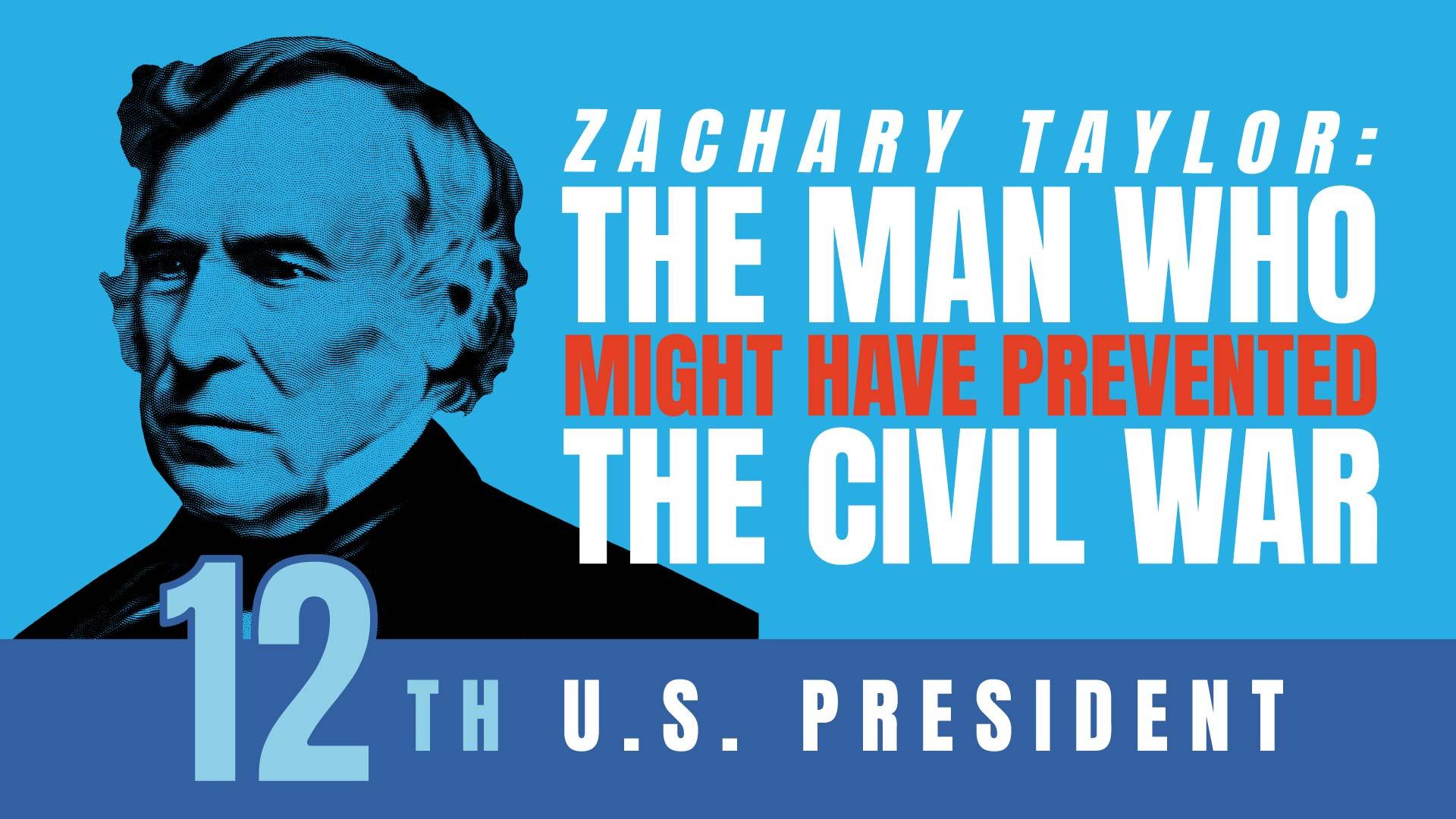
Zachary Taylor: The Man Who Might Have Prevented the Civil War
He was a slave owner who opposed the expansion of slavery; a president who despised politics and politicians. That was Zachary Taylor—“Old Rough and Ready.” Joseph Fornieri, Professor of Political Science at the Rochester Institute of Technology, tells the story of this walking contradiction.
This video is part of the American Presidents 5-Minute Video Series.
Once you've seen them all, take our Presidents Quiz.
Topics
Hosted By
 Joseph Fornieri
Zachary Taylor, the 12th president of the United States, was so indifferent to politics that he never voted until his own election in 1848.
A career military man, “Old Rough and Ready,” as he was affectionately known, was weathered, stocky, and bow-legged in appearance. He was obstinate, easily insulted, and quick-tempered in character. These are not traits that usually make for a successful politician. But then again, he never wanted to be a politician. Until he did.
The son of a Revolutionary War veteran, Zachary Taylor was born in Orange County, Virginia on November 24, 1784. Inspired by his father’s military exploits, Taylor joined the army in 1808. He spent the bulk of the next forty years protecting the frontier against hostile Indians. Steadily rising from the rank of lieutenant to brigadier general, he fought in the War of 1812, the Black Hawk War of 1832, and the Second Seminole War in 1837.
The Mexican-American War in 1846 was a turning point in Taylor’s life. In a matter of months, he went from a respected but obscure soldier to a national hero.
Here’s how it happened.
In January of 1846, President James Polk sent Taylor into the disputed border territory of Texas and Mexico. The idea was that the presence of American troops would pressure the Mexican government into accepting Polk’s offer to buy California. But Mexico wasn’t interested.
So, Polk was stuck.
Things became unstuck when Mexican forces fired on Taylor’s men near the town of Palo Alto, killing 11. That’s all Polk needed to ask Congress to declare war, which it did on May 12.
At that moment, the war rested on Taylor’s shoulders. Despite being vastly outnumbered, he won the battle of Palo Alto and went on to score impressive victories at Monterrey and Buena Vista. Ulysses S. Grant, a recent West Point graduate, who took part in the campaign said of Taylor: “No soldier could face either danger or responsibility more calmly than he… He was known to every soldier in his army, and was respected by all.”
The Mexican War ended in February 1848 with the US acquiring not only California but vast swaths of land in the American Southwest. Within weeks of the end of the war, the Whig Party, which had done so well with war hero William Henry Harrison, saw Taylor as their ticket back to the White House.
Taylor was intrigued, but he didn’t see himself as a party man. “I am a Whig, but not an ultra Whig,” he said. “If elected I would not be the mere President of a party—I would endeavor to act independent of party….”
That was good enough for the Whigs. In short order, they nominated Taylor to be their standard bearer. He went on to defeat Lewis Cass, a Democratic senator from Michigan, in the general election.
Being a war general was hard. But being President was harder.
For one thing, the Mexican-American War had reignited the slavery debate. How would all this new territory be integrated into the Union? What part would be slave; what part would be free?
The political balance stood precariously at 15 free states and 15 slave states. Any additional states would tip the scales one way or the other. How would this be resolved?
If anyone was in a position to resolve it, Taylor seemed to be that man. Like many in the South, he was a slave owner. He owned plantations in Louisiana, Mississippi, and Kentucky with over 300 slaves. Like many in the North, he opposed the expansion of slavery into the new territories. Furthermore, he was strongly pro-Union. When aggrieved southerners threatened secession, Taylor bluntly informed them that he would hang any traitors "with less reluctance than…the deserters and spies in Mexico.”
So, what did Taylor do? Not what most expected him to do—certainly not his supporters in the South. He endorsed immediate statehood for California and New Mexico, both of which were likely to become free states.
As serious talk of civil war arose in Congress and across the country, an aging Henry Clay struggled to engineer one last grand bargain. Here, in part, is what he proposed: California would be admitted as a free state; the territories of New Mexico and Utah would decide for themselves whether to be free or slave; and to appease the South, the Fugitive Slave Act—requiring runaway slaves to be returned to their owners—would be strengthened.
Taylor would have none of it. First of all, he disliked Henry Clay. He thought that Clay never gave him the respect he felt he deserved. If Clay was for it, Taylor was against it. But second, he adamantly opposed the Fugitive Slave Act. Because of Taylor’s opposition, Clay’s grand bargain got nowhere.
And that’s where things stood when Taylor died suddenly in the summer of 1850.
Had he lived, could he have found a way to bridge the gap between North and South, free and slave? We’ll never know.
I’m Joseph Fornieri, professor of Political Science at the Rochester Institute of Technology and Director of The Center for Statesmanship, Law, and Liberty, for Prager University.