Get credit for watching this video with PragerU Premium. Start your streak.
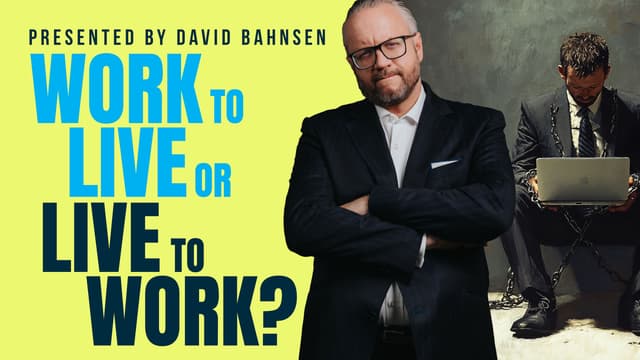
Work to Live or Live to Work?
Do you work to live? Or do you live to work? Most people today would probably affirm the former—work to live. Most people would be wrong. David Bahnsen, author of Full Time: Work and the Meaning of Life, explains why.
Topics
Hosted By
 David Bahnsen
Do you work to live? Or do you live to work?
Most people today would probably affirm the former—work to live. Most people would be wrong.
We should do both: work to live and live to work. We are meant to work. I’ll go one step further: it’s what we are designed to do.
If you have religious leanings, it’s right there in the Ten Commandments. “Six days you shall work.” And then rest on the seventh, just as God did.
If you don’t have religious leanings, well, it’s just common sense.
A productive and meaningful life means spending more time working than doing anything else in your life. No other activity comes close—unless you count sleeping as an activity.
What one has to offer in skill, innovation, and productivity—that is, the work we do—is central to who we are. Nothing is possible without it. All things are possible if you do it well.
If you want to have a family, you have to work. If you want to own a home or give to charity, you have to work. Working is what responsible people do.
So then why does work get such a bad rap? Why do movies and television portray ambition as an enemy of your health, your relationships or just about anything else?
Yes, some use their careers as an escape from other serious responsibilities and obligations. But you can be fully committed to your work without letting it take over your life. I daresay, you know people who have managed this. The far greater risk to our society is the popular view of work as a chore that simply must be endured.
Overachievement is not our problem. Deriding achievement is. We don’t suffer from an epidemic of workaholism, but of “no-aholism”—no passion, no purpose, and no plan.
The best prescription for all three of these modern ailments is work.
Like so much in modern life, it seems like we need to re-discover a traditional value our grandparents and great-grandparents simply took for granted.
So, let’s take a step back and look at the value of work.
Arthur Brooks, a prolific writer on the subject of happiness and a professor at Harvard, has coined the term “earned success” to describe the psychological lift that work creates, the feeling of not receiving something, but earning it. This feeling is the basis of self-worth and deserved recognition. We achieve immense satisfaction from becoming valuable to others through our work.
That’s why it doesn’t matter whether you’re a truck driver or a bond trader. With purpose and hard work—whatever work you do—you earn self-esteem and the esteem of others.
A workless world is not a good world. Ideas like Universal Basic Income completely ignore the value of work to the individual. They ignore the dignity derived from discovering and implementing a solution, solving a problem, collaborating with coworkers, or meeting goals.
Obsession with video games, chronic drug and alcohol use, financial dependence on others: There is no purpose, no meaning, and no dignity in these behaviors. Worse, if you’re not working, you’re constantly reminded of your own inadequacy.
Work solves this problem.
Sadly, however, more and more people are choosing not to work.
The labor participation rate—those age sixteen and over with a job or looking for a job divided by the total population—is the lowest it has ever been, excluding the lockdown years.
This rate sat around 66% from 1990 to 2008.
Now it’s closer to 60%.
That’s about 14 million more adults watching TV, playing video games or engaging in other non-productive activities, as opposed to experiencing the dignity of work.
In the name of compassion, we are making it possible for many people to waste their lives away. This is not just counterproductive, it’s immoral. Of course, for those in real need we should provide help, but we are doing a true disservice to our fellow citizens by making it easy not to work. The problem only grows worse with time: the longer someone is out of the workforce, the less employable, the less marriageable, the less happy they become.
It’s just a fact: human beings don’t vegetate well.
In an ideal society, everyone is working, everyone is productive. But this is becoming a minority view.
More and more one hears about “work-life balance.”
So, while on the subject, here’s a piece of advice for anyone looking for a job.
Don’t bring up “work-life balance” in a job interview.
For most employers that’s a bright red flag.
It’s just a euphemism for asking to work less, think about work less, or care about work less.
When we refer to a work-life balance, we are pitting life and work against each other. We are presupposing that one is not part of the other; that the two are to some degree at odds.
They’re not.
Work is at the very heart of the meaning of life.
You should do it full-time.
I’m David Bahnsen, author of Full Time: Work and the Meaning of Life, for Prager University.