Get credit for watching this video with PragerU Premium. Start your streak.
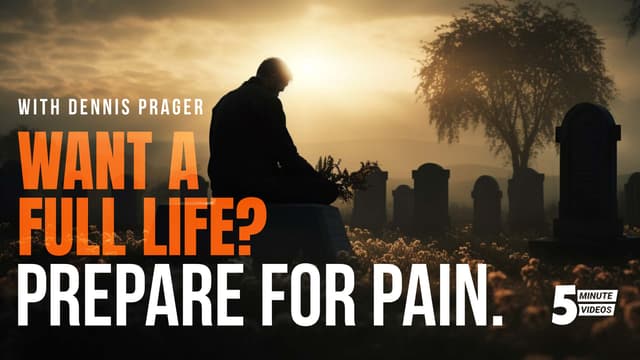
Want a Full Life? Prepare for Pain.
Upon the passing of his beloved bulldog Otto, Dennis Prager reflects on the special bond between people and their dogs. What role should dogs play in our lives? And more importantly, what can we learn from this relationship?
Topics
Hosted By
 Dennis Prager
Otto, my beloved English bulldog, died just before I made this video. His presence in my and my wife’s life for twelve years was an unmitigated joy. He also, amazingly, became the best-known dog in America; he was on camera for virtually every one of my PragerU Fireside Chats and became the hero of a series of PragerU books for children.
And, as I have often noted, none of this fame went to his head.
The sadness we feel at Otto's death and the outpouring of condolence messages have caused me to reflect on three long-held concerns about pets.
Concern No. 1: I have long feared that many people are replacing love of humans with love of animals. For decades, I have asked high school students, “If your dog and a stranger were both drowning, which would you try to save first?”
In nearly every instance, one-third of the students voted to save the stranger, one-third their dog, and one-third declined to vote. In other words, for more than 40 years, two-thirds of high school students have not voted to save a human being they didn't know before their dog.
The primary reason they have given is that they love their dog, not the stranger.
I realized two things as a result of this answer. One was that we are living in an Age of Feelings. Feelings have replaced values as the guide to people's behavior. The other realization was that, as a result of society increasingly abandoning Judeo-Christian—that is, Bible-based—values, the belief that humans are special because only they are created “in the image of God” has all but disappeared. Secular society has no basis on which to declare humans inherently more valuable than animals—especially an animal one loves.
Concern No. 2: Many people who announce that they do not want children—then refer to their dogs or cats as their children. But they are not children.
Concern No. 3: While it is well known that people who are cruel to animals are very likely to be cruel to human beings, the converse is not true: Kindness to animals is not nearly as likely to lead to kindness to humans.
I believe these three concerns are still valid.
But so long as people do not deny the innately greater worth of the human being and do not equate animals with humans, I see people’s love for a dog (or a cat, but I will focus on dogs) as something unambiguously beautiful. Given the extraordinary bond between people and dogs, I now entertain the belief that dogs are God’s gift to mankind.
Still, no love is comparable to love between humans. The proof, if you need one, is that my wife and I are searching for another English bulldog. No one searches for another child if their child dies. As much as we love our dogs, we know we can get another dog, but there is no such thing as getting another child—or, for that matter, getting any other human being we loved.
The companionship of a dog is profound. For that reason, every widow or widower who can take care of a dog—in fact, any person who lives alone—should consider adopting a dog. The many studies showing that people who have a dog live longer are undoubtedly correct.
Now, my wife and I are not alone. We have each other—as well as children, grandchildren and precious friends—but only those who own a dog know how much a dog adds to a home. They are life-enhancers. And when they leave, some life gets sucked out of any home, even homes filled with people.
The Hebrew word for “dog” is kelev. As Hebrew has no vowels, the word is actually spelled klv. Those three letters can also be pronounced as kalev, which means “like the heart.” I don’t believe that’s a coincidence.
A final thought: All those who adopt a dog know that they are setting themselves up for inevitable pain—the pain accompanying that dog’s death. Yet that stops almost no one from adopting a dog.
There is a major lesson about life here. Everything truly worthwhile entails pain—and the risk of great pain. There are people who avoid getting married because they fear the pain of divorce. So they lose out on what could be the greatest contributor to personal growth and happiness. And more and more people choose not to have children. They want to avoid the pain of raising children, the potential pain of having a sick child or even a bad child. But they lose out on the most enriching experience available to us—being a parent.
If you want to live a pain-free life, you won't live a full life. That’s why my wife and I are looking for another dog.
I'm Dennis Prager.