Hiroshima: The Price of Peace
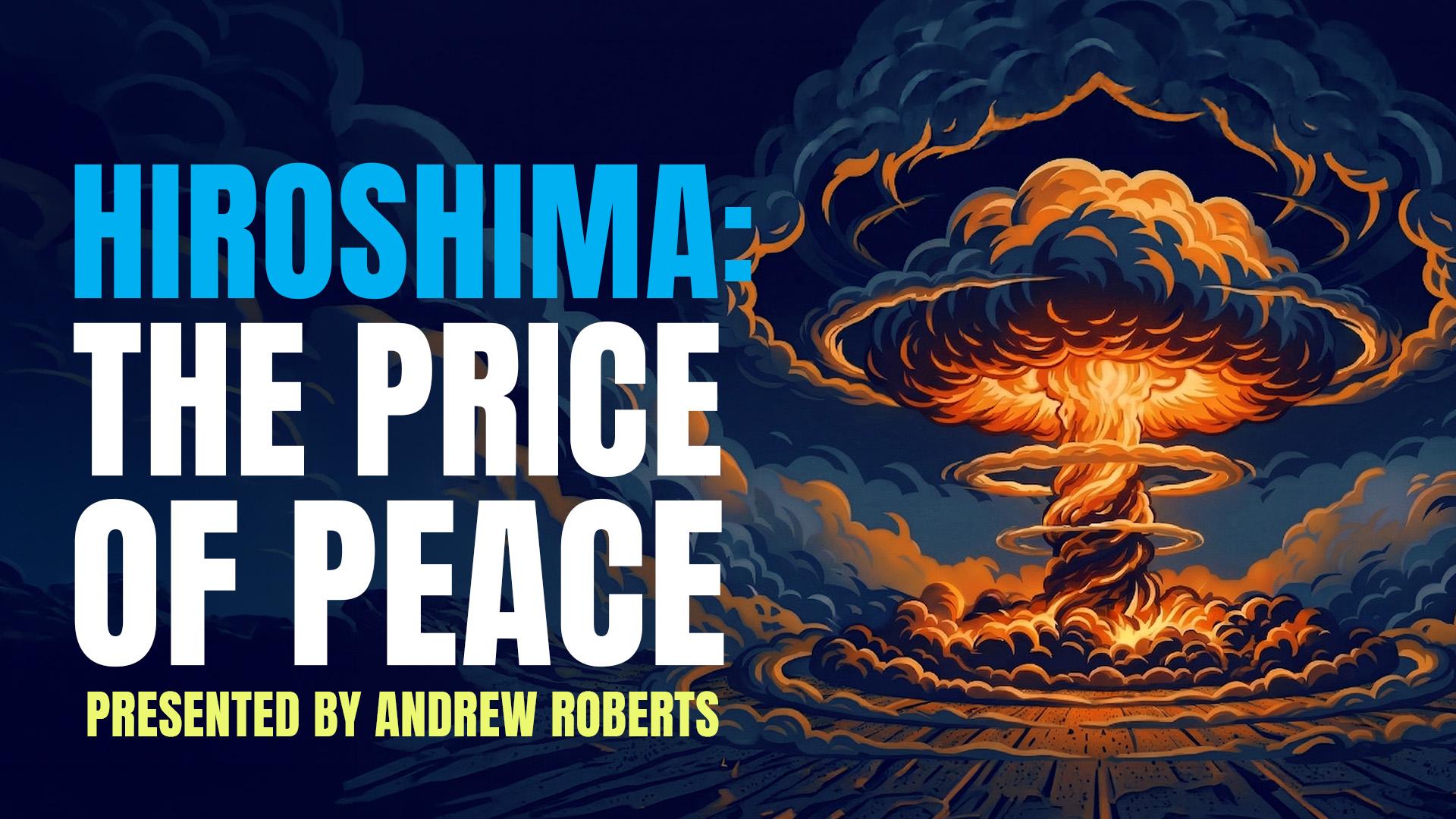
On August 6th, 1945, the world changed forever when the United States dropped an Atomic Bomb on Hiroshima, Japan. This new and terrible weapon led to the end of WWII and began the nuclear arms race that defined the Cold War. Eighty years later, people still ask if the use of such a destructive force was justified. Andrew Roberts, author of The Storm of War: A New History of the Second World War, answers this critical question.
Topics
Hosted By
 Andrew Roberts
In 1945, the United States dropped two nuclear bombs on Japan, killing 70,000 people in Hiroshima on August 6 and 40,000 in Nagasaki on August 9.
Eight decades later, the world still debates whether American President Harry Truman and British Prime Minister Winston Churchill were morally right to use the weapons against civilians, even if the direct result was to end the most terrible war in human history.
Truman and Churchill certainly had no qualms. As Churchill recalled in Triumph and Tragedy, the sixth volume of his World War II memoirs, the decision “was never even an issue. There was unanimous, automatic, unquestioned agreement around our table;” he wrote, “nor did I ever hear the slightest suggestion that we should do otherwise.”
Truman, Churchill, and their advisors had lived through six agonizing years of war. They had the best information available. You would think that would entitle them to the benefit of the doubt — that they had made the right decision.
In his memoirs, Year of Decisions, Truman wrote that he believed an invasion of Japan would have cost half a million American casualties. Secretary of War Henry Stimson and Secretary of State James Byrnes judged that to be conservative, with both estimating the total casualties at one million.
It’s not hard to understand why they came to these conclusions. The assault on Iwo Jima in February 1945 came at the price of nearly 7,000 U.S. Marines killed and 20,000 wounded.
To defend the home islands, Allied intelligence indicated that, in addition to kamikaze pilots, the Japanese planned to use suicide attack boats, small suicide submarines, and navy swimmers trained to be human mines — all of which had been used in battles at Okinawa and the Philippines.
The U.S. 10th Army had taken nearly three months – from April to June 1945 — to capture Okinawa, and it cost the American ground forces almost 7,500 lives with over 31,000 wounded. Further, the Japanese sank 36 American ships, killing 5,000 seamen and wounding another 5,000. The Japanese, meanwhile, lost some 110,000 lives.
It’s reasonable to assume that these numbers would have paled in comparison to an invasion of Japan itself.
Such calculations did not seem to have disturbed the Japanese leadership. In fact, they embraced the coming cataclysm.
On June 8, 1945, the Japanese government had pledged to Emperor Hirohito that “the nation would fight to the bitter end,” and Prime Minister Kantaro Suzuki supported the army’s plan to carry this out, calling it “the way of the warrior and the path of the patriot.”
Even after several square miles of central Nagasaki were destroyed by the second bomb, army chief Yoshijiro Umezu concluded that Japan still had the “ability to deal a smashing blow to the enemy.”
The chief of the naval staff wrote: “We do not believe it possible that we will be defeated.” But even defeat didn’t mean surrender. “Would it not be wondrous for this whole nation to be destroyed like a beautiful flower?” asked War Minister Korechika Anami after both atomic bombs had been dropped.
It took the emperor to state, in his Imperial decree on August 14, that “the enemy has begun to employ a new and most cruel bomb, the power of which to do damage is indeed incalculable, taking the toll of many innocent lives.”
Critics have argued that the U.S. should have demonstrated the awesome power of the weapons in some uninhabited region of the world. Yet the Allies only had two bombs, with several months before the next ones came into production.
Furthermore, a demonstration bomb would have had no impact on the hard men of the Japanese general staff. It took both devastated cities to convince the politicians and the emperor.
Since Japan also had plans to kill Allied prisoners of war as the fighting approached the camps where they were being held, its swift surrender saved tens of thousands of American and British Commonwealth lives, military and civilian.
The bombs also saved an untold number of Japanese. More Japanese had died in the bombing of Tokyo than in the blast at either Hiroshima or Nagasaki.
Assuming Allied bombing would have continued throughout an invasion, it’s fair to speculate that — at a minimum — hundreds of thousands of Japanese would have perished. Plus, the Allied navies would have continued their blockade, leading to mass starvation.
It took a brave former president of the Japan Medical Association, Dr. Taro Takemi, to state the obvious: that “When one considers the possibility that the Japanese military would have sacrificed the entire nation if it were not for the atomic bomb attack, then this bomb might be described as having saved Japan.”
I’m Andrew Roberts, author of The Storm of War: A New History of the Second World War, for Prager University.