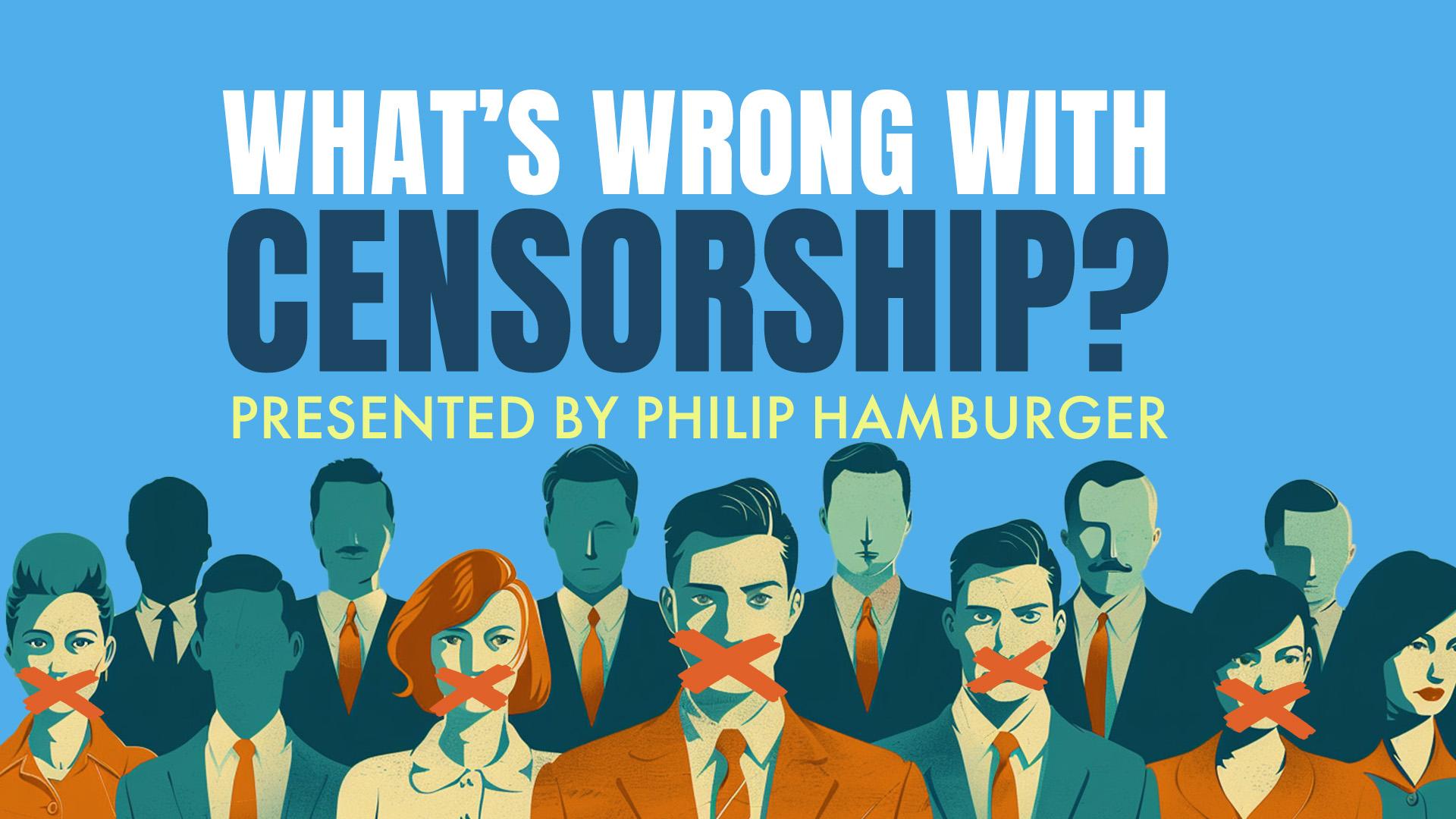
What's Wrong with Censorship?
No one has a monopoly on truth. That’s why we need open, uncensored discussion and debate. Why, then, are the government and Big Tech platforms suppressing what we can read, see, and hear? Philip Hamburger, Professor of Law at Columbia University, sheds light on this alarming trend.
Topics
Hosted By
 Philip Hamburger
“Dismiss anything else. We will continue to be your single source of truth.”
That’s what Jacinda Ardern, the prime minister of New Zealand, told the citizens of her country during the Covid crisis.
Was she right?
Is there a single source of truth? If so, is it the government? The big social media platforms?
The government and the platforms say that they want to protect us from “misinformation.”
Is that what they’re doing?
Or are they just censoring viewpoints they don’t like?
They censored evidence that the Covid virus originated in a lab in Wuhan, China.
They censored claims that the vaccines didn’t prevent infection and that masking didn’t stop transmission.
They censored ideas about natural immunity.
They censored opinions about election irregularities.
They censored reports about a laptop belonging to a presidential candidate’s son.
They censored evidence questioning the extent of man-made global warming and whether it would have catastrophic consequences.
And the list goes on.
Although the censored opinion was called “misinformation,” much of it turned out to be true. The government and its Big Tech allies even suppressed information they knew was true—such as the adverse effects of the Covid vaccines.
That censorship blinded Americans to the risk of the vaccines and therefore was lethal.
Here’s just one example. Not knowing about the adverse vaccine events, Ernest Ramirez pressed his 16-year-old son to get vaccinated. His son died five days later due to an enlarged heart—a symptom that has been linked to the vaccines, especially in young men. When Ernest spoke about his grief on a private Facebook page for vaccine sufferers, Facebook censored him—at the behest of the White House. The censorship blinded Ernest to the risk and then barred him from sharing his pain.
In suppressing “misinformation,” the government and the social media platforms anoint themselves the arbiters of truth—just as Jacinda Ardern did. But if anything can be learned from the Covid debacle, it is that no one—not a prime minister or a president, not Anthony Fauci, not the White House, the National Institutes of Health, or the Food and Drug Administration—has a monopoly on that essential commodity.
The government and the dominant platforms were wrong—tragically wrong—about the vaccines, about medications, about masks, about ventilators, about business lockdowns, about school lockdowns, about the virus’s origins, and about the Hunter Biden laptop. Yet they say we should rely on them to identify “misinformation.”
We shouldn’t.
There is only one way to arrive at truth: through open, uncensored discussion and debate. And nothing is more deadly for truth than centralized censorship, which is precisely what the government and the platforms are imposing on us. The government should never have the power to determine what is error, misinformation, or falsehood.
Nor can that role be left to the social media platforms. They are almost as centralized as the federal government. And being dependent on the government, they can be made to do its bidding, as made abundantly clear by the Twitter files released by Elon Musk.
Censorship is mind control. That’s why governments want it. And that’s exactly why they shouldn’t have it.
Let’s see how this plays out in the political sphere.
Speech is how individuals learn about political candidates and how political opinions are formed. Without free speech, there can’t be free elections.
So, when the government controls election speech, it controls elections. And then you no longer live in a democracy, let alone a republic. Tragically, many Americans now think that free speech is only for them, not their political opponents. In their view, censorship is desirable, and the First Amendment just a quaint 18th-century artifact.
The whole point of freedom of speech is that all of us should be free to explore all sorts of ideas. Only in that way can we test claims of truth for error.
None of us is infallible. None of us has all of the truth. We depend on others to correct our mistakes and teach us what we don’t know.
So, speak up for freedom of speech. Not just for you, but for everyone else, especially those with whom you disagree.
Although the forces arrayed against speech are formidable, do not despair. Their censorship will be their everlasting shame. Your defense of freedom of speech will be to your everlasting credit. It may be the most important thing you ever do.
I’m Philip Hamburger, professor of law at Columbia University and CEO of the New Civil Liberties Alliance, for Prager University.