Get credit for watching this video with PragerU Premium. Start your streak.
Lyndon B. Johnson and the Vietnam War
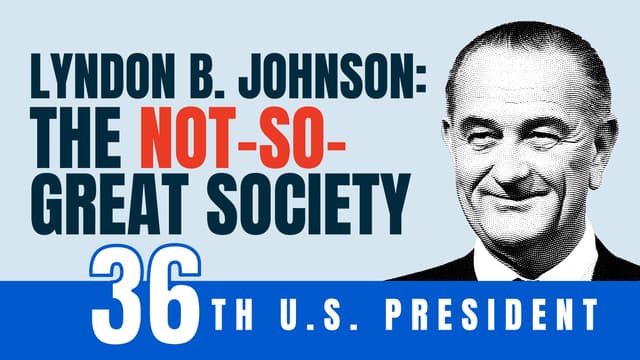
Lyndon B. Johnson wanted to wage a war on poverty. Instead, he waged a war halfway around the world in Vietnam. That conflict defined him, his presidency, and the decade of the 1960s. Historian Bill Whittle tells the story.
This video is part of the American Presidents 5-Minute Video Series.
Once you've seen them all, take our Presidents Quiz.
Topics
Hosted By
 Bill Whittle
It was 2:38 pm Central Standard Time on November 22, 1963. President John F. Kennedy was dead, assassinated less than two hours earlier.
In the cramped quarters of a blue and white Boeing 707, with the call sign Air Force One, Vice President Lyndon Baines Johnson took the Oath of Office. He was now the 36th President of the United States.
He was born just 207 miles to the southwest, in a dusty patch of road called Stonewall, Texas, on August 27, 1908. Lyndon Johnson’s childhood was spent in what biographer Robert Caro described as “a land without electricity, where the soil was so rocky that it was hard to earn a living from it.”
Unlike the perfectly groomed, somewhat aloof Kennedy, Johnson was a classic backslapping, handshaking politician. Everything Johnson did had Texas dust on it.
In his run for the US Senate in 1948, following eleven years in the House of Representatives, Johnson drew huge crowds by showing up at campaign events in a never-before-seen, by-God actual helicopter, which he named “The Johnson City Windmill.”
Out of one million votes cast, Johnson won the Democratic Senate primary by a mere 87 votes. Beating his Republican opponent in the general election proved to be much easier. Only forty years old, the Texan of humble origins was now a member of the most exclusive club in America.
By the late 1950s, Lyndon Baines Johnson—universally referred to as LBJ—had become arguably the most effective Senate Majority leader in the country’s history. This was due in large part to the bullying, flattering, and intimidating one-on-one sessions that became known as “The Treatment.” He would back his target into a corner; poke him in the chest; threaten, cajole, even weep. He’d wax exuberant one moment, be scornful the next, complain, promise, compliment, and curse.
And he almost always got what he wanted.
During his six years as president, he was preoccupied with two things: his Great Society project – hundreds of social programs he was convinced would end poverty—and the Vietnam War.
LBJ didn’t end poverty, and he didn’t end the Vietnam War. But the Vietnam War ended LBJ.
The origins of the war can be traced to the communist takeover of China in 1949 and the Chinese-backed North Korean invasion of South Korea the following year. If South Vietnam were to fall to the communist North, it was logical to assume that Laos, Cambodia, Thailand, Malaysia, Indonesia, and the rest of Southeast Asia would topple in turn; a potential catastrophe known as the Domino Theory.
Johnson firmly believed in the Domino Theory, as most foreign policy experts did, but couldn’t bring himself to make a firm commitment to win the war. His heart was in his Great Society programs. He didn’t want to get bogged down in a conflict on the other side of the world.
But ironically, he ensured that’s exactly what would happen by pursuing an incremental, half-in, half-out strategy.
Johnson personally selected the next day’s airstrike targets from the isolation of the White House Situation Room—often in his pajamas. “Those boys can’t hit an outhouse without my permission,” he once said. He wasn’t exaggerating—it was literally true.
This might have been the worst possible way to fight against a light, fast, and imaginative enemy.
Here are just three examples of the kind of restrictions that Lyndon Johnson imposed upon American forces fighting in Vietnam:
Retreating enemy soldiers could only be fired upon with the intent to wound by aiming at the lower extremities.
Aircrews could not shoot at Surface-to-Air Missile sites unless the SAMs shot first.
And both Hanoi—the enemy capital—and Haiphong—their major port—were off limits completely.
This war needed to be fought. America was defending South Vietnam against a brutal communist invasion from North Vietnam just as it had defended South Korea against a brutal communist invasion from North Korea. The tragedy was that such a morally justifiable war was fought so incompetently, ineptly, and absurdly.
The problem was Johnson. He didn’t see the conflict as a war; he saw it as a negotiation. Unfortunately for Johnson, the United States, and the South Vietnamese people, the North Vietnamese were immune to “The Treatment.” Every cease-fire, every bombing halt was perceived as weakness, another opportunity to resupply and rearm. Johnson’s political inclination was to give the North Vietnamese what they wanted and thereby negotiate a deal. But the North Vietnamese didn’t want a deal. They wanted Vietnam. All of it.
Johnson was trapped. He couldn’t win the war and he couldn’t get out of it.
As more and more American soldiers came home in body bags—the total would come to over 58,000—as anti-war campus protests raged across the country, and as the press turned against him, Johnson’s popularity plummeted.
By the next election in 1968, both LBJ and the American people had had enough.
On March 31, 1968, Johnson shocked the nation and his own closest advisors when he announced on television "I shall not seek, and I will not accept, the nomination of my party for another term as your president.”
He had outdone his hero Franklin Roosevelt with his Great Society programs, but he was undone by a foreign war in a faraway country.
I’m Bill Whittle for Prager University.