Get credit for watching this video with PragerU Premium. Start your streak.
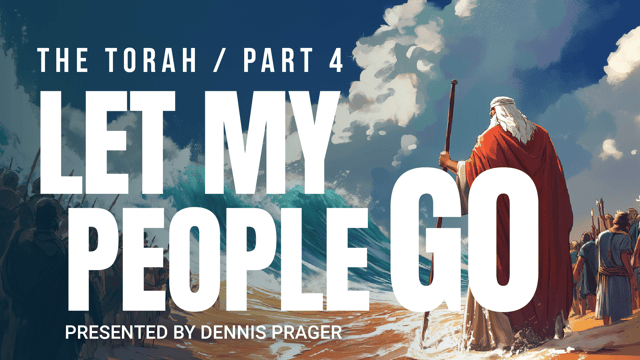
The Torah Part IV: Let My People Go
God performed many wonders to reveal His power to Moses, Pharaoh, and the Israelites—from the Ten Plagues to the parting of the Red Sea and to the giving of the Ten Commandments. So, why did the “Children of Israel” so readily reject God’s authority? Dennis Prager, author of The Rational Bible, delves into this profound section of the Torah, uncovering timeless lessons that still resonate in our lives today.
Click here to watch more videos in our Understanding the Torah series.
Hosted By
 Dennis Prager
When word got out that Moses had killed an Egyptian who was beating a Hebrew slave, Pharaoh himself ordered that Moses be put to death. So, Moses had to leave his privileged life and flee Egypt.
He fled to a place called Midian, where he met Zipporah, the woman who became his wife. She was the daughter of a Midianite priest named Jethro. Moses and Zipporah met at a well, where Moses stood up to protect Jethro’s seven daughters who were being bullied by some men. Moses hated evil no matter whom it was directed against — male or female, Jew or non-Jew.
One day, while herding sheep, Moses noticed that a bush was on fire but, oddly, it was not being consumed by the fire. Curious, he approached. As he did, he heard a voice from the “Burning Bush.”
It was God speaking.
His message would not only change Moses’s life. It would change history.
God told Moses it was time for the Israelites to be liberated from their Egyptian bondage, and that he, Moses, was the man who would make this happen.
Moses did not want the job. He was happily married, living with a family he loved, and which loved him. Moreover, he was a wanted man in Egypt. He even described himself as a poor speaker! And he had no reason to believe that the Israelites would accept him as their leader: “Who am I,” he asked God, “that I should go to Pharaoh and free the Israelites…?”
God answered all of Moses’s objections, and thus began the leadership of the man who dominates the rest of the Torah.
So Moses went to Pharaoh.
To no one’s surprise, Pharaoh repeatedly rejected Moses’s demands to free the Jews. God then brought Ten Plagues on Egypt to change Pharaoh’s mind. Pharaoh ultimately relented. But he almost immediately regretted his decision and sent his army to force the Jews back to Egypt. Then, in perhaps the most famous miracle in the Hebrew Bible, God split the sea — enabling the Israelites to cross to the other side — and then closed the sea on the pursuing Egyptians, drowning them all.
Israel’s liberation from Egyptian slavery became the most widely used story among modern liberation movements. For example, the best-known black American spiritual, dating from the time of slavery, was “Go down Moses”:
Go down Moses
Way down in Egypt land
Tell old Pharaoh
To let my people go!
A black historian, Albert Raboteau of Princeton University, wrote: “Without a doubt the Exodus story was the most significant [story] for American black identity, whether slave or free.”
The Exodus was so meaningful to American Founders Thomas Jefferson and Benjamin Franklin that they designed a Great Seal of the United States that depicted the Jews leaving Egypt.
Two months after crossing the sea, Moses ascended Mount Sinai where God gave him the Ten Commandments. I have explained the Ten Commandments in ten PragerU videos, so I will only note here that the Ten Commandments formed the basic moral code of Western civilization.
The Book of Exodus does not confine its moral laws to the Ten Commandments.
Here are just three examples:
One. You shall not oppress a stranger, in fact you will love the stranger—meaning the non-Jew who lives among Jews. It is doubtful that there was a similar law anywhere in the world prior to the Torah.
Two. Do not follow the many to do evil. Think of how much evil has been committed by people who have been afraid to go against the majority.
Three. Do not favor either the rich or the poor in judgment. Justice is sacred. No one can be favored.
While Moses was on Mount Sinai, the Israelites — fearing their leader might never return — built a Golden Calf and worshiped it. Shortly after God brought ten miraculous plagues on Egypt and split a sea, the Israelites worshiped an idol. They chose a calf because that was one of Egypt’s primary gods, and unlike the God of Israel, it was visible.
It is extremely difficult for human beings to believe in the existence of something they cannot see. Prior to the Torah, gods were visible. But the God of Israel, the God of the Torah, is invisible, wholly beyond and outside of nature. God created nature. That is why the opening verse of the Torah — “In the beginning, God created the Heavens and the Earth” — changed the world. The Creation story is about God creating nature, and therefore not being part of it. In our time, because it is largely a post-biblical time, many people are returning to nature-worship — Mother Earth, for example.
When Moses finally descended from Mount Sinai and saw his people worshiping an idol, he became so furious, he shattered the two tablets on which the Ten Commandments were inscribed.
This was the first of many times the “Children of Israel” rejected divine authority. That is the story of most people ever since — rejecting God’s authority.
I’m Dennis Prager, author of a five-volume commentary on the Torah, The Rational Bible.