Get credit for watching this video with PragerU Premium. Start your streak.
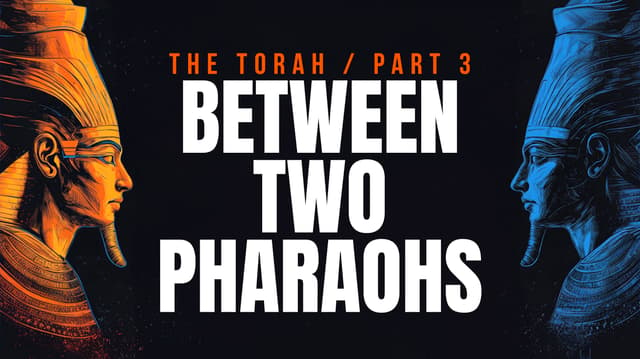
The Torah Part III: Between Two Pharaohs
Joseph brought the Jews into Egypt, and Moses led them out. But what happened in between? How did God's chosen people fall from favor under one Pharaoh to slavery under another? Dennis Prager, author of The Rational Bible, unpacks this pivotal section of the Torah.
Click here to watch more videos in our Understanding the Torah series.
Hosted By
 Dennis Prager
How did Joseph, a lowly Hebrew slave, save mighty Egypt?
In the most famous dream interpretation in history, Joseph told Pharaoh that Pharaoh's dream of seven fat cows devoured by seven lean cows meant that Egypt would be blessed with seven fat years of abundance to be followed by seven lean years of famine. Egypt, he told the Pharaoh, must therefore store grain during the seven “fat” years so as to have food to eat during the seven “lean” years.
Pharaoh knew a leader when he met one and made Joseph the second most powerful man in Egypt.
In one moment, Joseph went from a prison to a palace.
Joseph then implemented his plan and saved the Egyptian nation. As events turned out, he also saved his family. Because of a famine in nearby Canaan, his brothers went to Egypt to purchase food. When they came before Joseph, they, of course, didn’t recognize him. They could never have imagined that the boy they left in a desert pit twenty years earlier would now be the prime minister of the most powerful nation.
After putting his brothers through a series of tests to determine whether they had grown morally, Joseph, in one of the most famous and moving scenes in all literature, revealed who he was to his stunned brothers. He told them not to be afraid, he would not exact revenge — because, he said, this whole incredible story was planned by God.
The entire Hebrew clan — the “Children of Israel” — then settled in Egypt, and that is where the Book of Genesis ends.
The second book of the Torah, Exodus, begins many years later when there arose to the throne a new Pharaoh who, as the Torah puts it, “knew not Joseph.”
Joseph, the man who saved Egypt from mass starvation, was forgotten.
How’s that for typical human behavior — people forgetting the good that has been done to them? The theme of ingratitude occurs constantly throughout the Torah. Why? Because just as gratitude is the mother of both goodness and happiness, ingratitude is the mother of both meanness and misery.
Fearing how numerous the Hebrews had become, the new Pharaoh made them slaves.
The Jews remained enslaved in Egypt until the most important individual in the Hebrew Bible entered the picture. His name was Moses, and he barely survived his infancy.
The Pharaoh had ordered that every Hebrew baby boy be drowned in the Nile River. So, Moses’s mother, in a desperate attempt to save her son’s life, put baby Moses in a basket, a little ark and set him afloat on the river. In a brilliant play on words, the Torah uses the same word for Moses’s basket as it does for Noah’s ark. Just as Noah’s ark saved the world, Moses’s ark would save the Jewish people.
The baby boy was then discovered by, of all people, the daughter of Pharaoh, and though she understood this was a Hebrew baby, she decided to raise him in Pharaoh’s palace as her son.
That the daughter of the Pharaoh saved a Hebrew and raised him as her son shows that there are good individuals in every nation, even nations that commit evils. One of the Torah’s most important insights is this: The division among people that most matters is not between rich and poor, powerful and weak, or white and non-white. The greatest human distinction is between good and bad. As Viktor Frankl wrote in his classic work, Man’s Search for Meaning — I paraphrase: There are only two races in the world: the decent and the indecent.
That the Torah depicts the daughter of Pharaoh as a particularly moral person is one of the many examples of the Torah valuing goodness more than anything else. That’s why the Torah frequently depicts Jews negatively and non-Jews — like Pharaoh’s daughter — positively. Goodness is the Torah’s and the rest of the Hebrew Bible’s major concern — because that is God’s major concern. As the Hebrew Prophet Micah would say centuries later:
God has told you, O man, what is good
And what the Lord requires of you:
Only to do justice,
And love goodness,
And walk humbly with your God.
One day, Moses, now a young man, went out from Pharaoh’s palace and saw an Egyptian overseer beating an Israelite slave. What he then did is remarkable: He killed the overseer. Now, remember, Moses was raised an Egyptian — an Egyptian prince, no less. He could easily have accepted slavery as a normal part of life — which is what it was then and would remain for thousands of years, until the modern era.
Most people would have just walked away. But Moses hated evil. We all should. As it is written later in the Hebrew Bible, “Those who love God must hate evil.” If you don’t hate evil, you don’t love God.
I’m Dennis Prager, author of a five-volume commentary on the Torah, The Rational Bible.