Should You Homeschool?
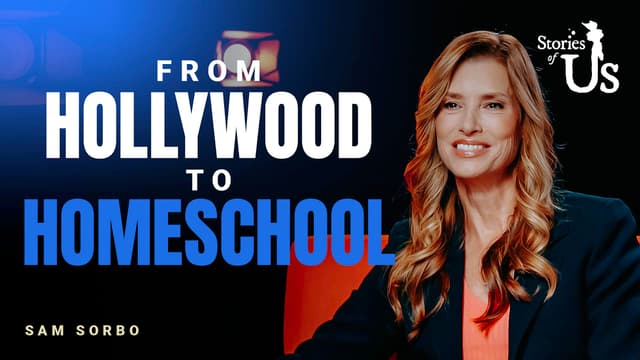
Should we homeschool our kids? There are plenty of reasons for parents to say no: they don’t have the time; their kids won’t be properly “socialized”; it’s financially unworkable. But are these reasons legitimate? Sam Sorbo used to think so. Then she took the plunge.
Topics
Hosted By
 Sam Sorbo
“Should we homeschool our kids?”
More and more concerned parents are asking this question.
I was one of them.
The reasons are obvious.
Our public schools are an embarrassment. Instead of teaching pride in America, they teach that America was founded by racists for racists; instead of teaching students to be boys and girls of good character, they teach them that they might not be boys or girls at all; instead of teaching them about the importance of personal responsibility they teach them to blame others for their problems.
With a curriculum like that, why wouldn’t parents consider homeschooling?
Unfortunately, while many consider it, few actually do it.
They’re afraid that they’re not qualified teachers.
They don’t have the time.
Their kids won’t be properly “socialized.”
They won’t get into a good college.
It’s financially unworkable.
I get it.
I once worried about all those things, too
I don’t anymore because I did it.
And I quickly came to love it. And so did my kids.
The same thing will happen to you and your kids.
So, let’s deal with those fears and then look at some of the benefits of homeschooling.
“I’m not a teacher.”
Well, first, that isn’t true. All parents are teachers. You teach your kids every day — everything from how to tie their shoes to how to throw a baseball. Teaching them how to read, write and do basic math is not hard. Same goes for science and history. If you need help, you can easily find it. In many ways this is the golden age of homeschooling, there are resources everywhere on the Internet. Here’s the bonus. You’ll learn along with your “students.” They’ll get smarter and so will you.
“I don’t have the time.”
You can homeschool your kids in three hours a day. Start at 9am and finish by noon. The kids can do whatever they want the rest of the day. Play. Work on a project they’re really interested in. Help you around the house. You will quickly ask yourself “what do they do in those government schools?” Here’s a statistic that will shock you. The typical, non-homeschool student spends 16,000 hours in school. When you homeschool, you get those hours back. Watch family relationships blossom, especially between siblings.
“They’ll be isolated and not learn to get along with others.”
This is the “socialization” question and it’s another phony baloney argument. Kids don’t need to sit in a room with 30 other children their exact age to develop social skills. Homeschooling gives your child opportunities to interact with people of all ages in the real world. In fact, homeschooled children often have better social skills because they spend less time in artificial environments and more time engaging with diverse groups of people. If you meet a well-mannered, polite teen, ask him if he was homeschooled. There’s a good chance the answer will be “yes.” As for meeting other kids: with a little investigating, you’ll probably be surprised to find that there are homeschool groups or pods nearby — a great source of new friendships for your children and a way for you to meet like-minded parents.
“They won’t get into a good college.”
Putting aside the question of what constitutes a “good college,” this is another anti-homeschool myth. According to the National Home Education Research Institute, home educated children score 15 to 25 percentage points higher than public school students, and in the black community the difference is 23 to 42 points. Those are the kinds of scores colleges fantasize about. Ivy league schools actively recruit home educated children because they know that they are outside-the-box thinkers, more resilient and better adjusted than their peers.
“We can’t handle the loss of income.”
This might get to the nub of the issue: what is your primary job as a parent? If it’s to provide the best life possible for your children, then homeschooling needs serious consideration. As parents, we sacrifice for our children. That’s our job. If that means making a financial sacrifice, we do it. But there’s a selfish reason to home school, one that transcends money: the ability to pass on your values to your children and the peace of mind that gives you. If you send your kids to government schools, you are giving that power to their teachers. Is that a tradeoff you want to make?
For over a century the so-called education experts have told us: “Learning is hard, teaching is hard, and parenting is hard. Leave it to us. Don’t try this at home!”
And we believed them, even as everything got worse.
But the truth is that children are naturally curious, learning is fun, and teaching is tremendously rewarding.
Maybe the time has come to “try this at home.”
I did. I saw the effect on our kids. How it made us a better, closer, happier family.
Name me something else that has this kind of upside.
I’m Sam Sorbo, homeschool mom, for Prager University.